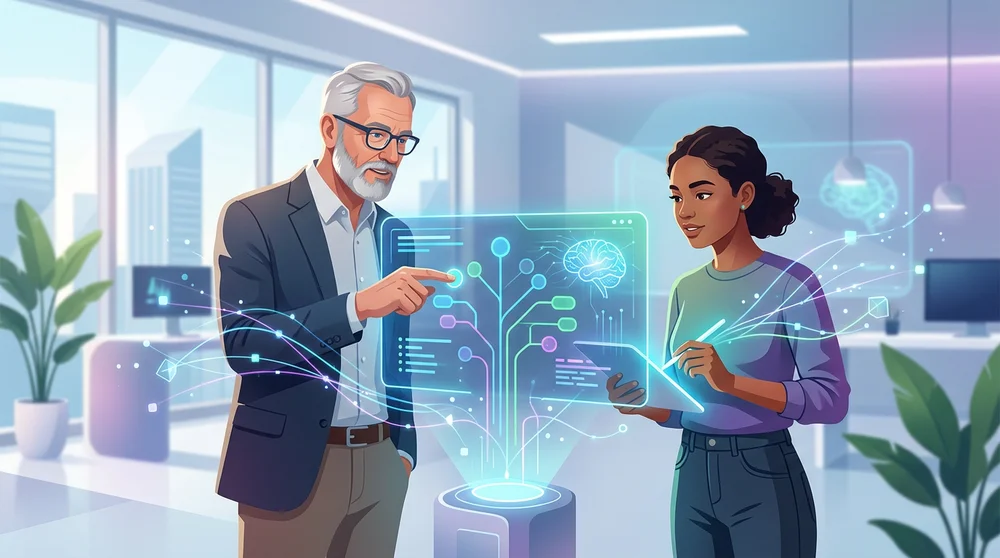
Have you ever wondered why we try to learn complex, highly nuanced subjects while sitting silently in crowded lecture halls? Before the mass industrialization of education, the master-apprentice dynamic—the precursor to the modern AI apprenticeship—was universally recognized as the undisputed gold standard for deep skill acquisition. You didn't learn a trade by reading a textbook; you learned it by standing shoulder-to-shoulder with a master craftsman, watching their every move, and receiving immediate, personalized feedback.
Mass schooling forced us to sacrifice this intimate, one-on-one guidance in exchange for the sheer scale required to educate growing populations. We traded the apprenticeship for the assembly line. But today, generative artificial intelligence is sparking a profound paradigm shift. We are finally finding a way to balance quality with scale, bringing the concept of the AI apprenticeship into reality. By transforming passive learners into active apprentices, education is experiencing a historical regression to its most effective roots.
The Two Sigma Problem: Why We Left Apprenticeships Behind
For decades, our modern education system has struggled with a mathematical dilemma known as the "Two Sigma Problem." In a landmark 1984 study, educational psychologist Benjamin Bloom demonstrated that students who received one-on-one tutoring performed two standard deviations (two sigmas) better than students in traditional classrooms according to Bloom's research. To put that in perspective, the average tutored student outperformed 98% of their peers who learned in a conventional, heavily populated setting.
Despite this overwhelming evidence, providing individualized human tutoring to every student on earth has remained economically and logistically impossible. As a result, our educational systems leaned heavily into scalable but passive models. Large lecture halls and Massive Open Online Courses (MOOCs) excel at dispensing information quickly, but they fail to cultivate the relational, active learning required for mastering complex skills.
Generative AI offers a compelling solution to this historical bottleneck. Through personalized learning models powered by sophisticated Large Language Models (LLMs), AI systems can simulate the personalized attention of a human tutor. By adapting to your individual learning pace, these systems are effectively attempting to bring the benefits of the two-sigma phenomenon to a global scale.
What is a "Cognitive Apprenticeship"?
To really understand how generative AI can transform how we learn, we need to look at a concept called the cognitive apprenticeship. In traditional physical apprenticeships—like woodworking or tailoring—the learning process is highly visible. A learner can directly observe a master's physical actions, copy them, and adjust. But how do you observe a master's thoughts?
In 1989, researchers pioneered the cognitive apprenticeship framework to adapt this physical model for knowledge work. The goal was to make internal cognitive and metacognitive processes visible, intentional, and graspable for the student. It operates through a few core methods:
- Modeling: The expert demonstrates a task while "thinking aloud" to share their cognitive heuristics.
- Coaching: The expert observes the learner and provides personalized, real-time feedback.
- Scaffolding: The expert provides structured support, helping the student perform tasks just beyond their current independent capability.
- Articulation & Reflection: The learner verbalizes their reasoning and compares their performance with the expert's approach.
What this means for you as a learner is monumental. A primary barrier to achieving expertise in any discipline is the transfer of "tacit knowledge"—the unspoken, hidden intuition that experts develop over years of practice. Human experts frequently struggle to explain the micro-decisions that guide their actions. Generative AI, however, serves as a powerful mechanism for making this tacit knowledge explicit, spelling out the exact decision trees and heuristics required to solve a problem.
How the Modern AI Apprenticeship Mirrors the Master Craftsman
The theoretical ideas behind the cognitive apprenticeship map seamlessly onto the functional capabilities of modern generative AI. Across various disciplines, we are already seeing how the AI apprenticeship is actively replacing passive consumption with guided practice.
Take modeling and coaching, for example. In traditional learning, you consume a finished product without ever seeing the messy, iterative process of its creation. AI alters this by demonstrating cognitive processes on demand. Khan Academy's AI tutor, Khanmigo, utilizes Socratic dialogue rather than simply providing answers. If a student struggles with math, the AI models the problem-solving strategy and acts as a coach, asking probing questions to pinpoint the exact misconception.
We see similar breakthroughs in scaffolding. Historically, human teachers have understandably struggled to provide consistent, real-time scaffolding to a classroom of thirty distinct minds. Today, generative AI dynamically adjusts the complexity of its support. In a recent exploratory trial, DeepMind deployed a generative AI model called LearnLM in UK math classes. The AI provided chat-based scaffolding that adapted to the student's proficiency, gradually fading its support as the student develops independent mastery.
This active engagement extends to higher education and professional training. Medical students are interacting with AI-generated patient personas, prompting the students to verbally justify their clinical reasoning steps. In teacher training programs, AI chatbots like "the TeachPal mentor" are guiding pre-service teachers through reflective discourse, acting as a mentor that triggers self-regulated reflection. In every instance, the AI acts as a conversational partner that forces the learner to actively articulate their reasoning.
The Danger of "Metacognitive Laziness"
While personalized learning models offer vast opportunities, the integration of these tools carries significant pedagogical risks. The primary danger of generative AI is its inherent design optimization: AI is fundamentally built to be an eager assistant that reduces friction and cognitive load for the user. But here is the hard truth about education—friction is a necessity.
Cognitive scientists emphasize the vital importance of "productive struggle." This is the psychological process where we learn more effectively by working through challenges rather than being handed immediate, effortless answers. When you face a challenging problem, it forces you to slow down, engage in self-questioning, and build mental resilience.
If we use AI merely to bypass this struggle, we risk falling into cognitive offloading habits. The OECD Digital Education Outlook explicitly warns that when AI removes productive struggle, it fosters "metacognitive laziness," diminishing our cognitive stamina, sustained attention, and capacity for deep reading. Calibrating AI to maintain this delicate balance is a complex challenge. Tutors must constantly weigh the long-term benefits of productive struggle against the immediate risk of a student becoming so frustrated they quit.
Is the AI Apprenticeship Actually Working?
To quantify the impact of these personalized learning models, researchers are closely tracking empirical outcomes. So, has AI perfectly replicated Bloom's two-sigma results? Not quite yet. A recent Stanford/NBER study found that students using Khanmigo in math showed a 0.2 Standard Deviation improvement over control groups detailed in the Stanford study.
However, the broader operational impacts are staggering. AI-powered personalized learning environments can increase student engagement rates by up to sixty percent higher levels. Teachers using generative AI tools save an average of almost six hours per week, freeing them up for the crucial human relationship-building that AI cannot easily automate. Furthermore, adoption is practically universal; by 2026, 92% of higher education students report using generative AI in some form for their academic work.
These statistics underscore a dual narrative. AI is successfully driving massive increases in engagement and accessibility. Yet, the holy grail of perfectly replicating human empathy and intuition to achieve a full two-sigma cognitive gain remains an ongoing, highly anticipated pursuit.
A Strategic Blueprint for the Modern AI Apprentice
To harness the full potential of personalized learning models, we must fundamentally redefine our relationship with technology. Treating generative AI as a glorified search engine that simply dispenses answers will inevitably result in the metacognitive laziness experts warn us about. Instead, you must proactively position the AI as a master craftsman. Here is a practical blueprint to help you transition into an active AI apprentice.
- Prompt for Pedagogy (Modeling): Explicitly command the AI to adopt the persona of an expert mentor. Rather than asking, "What is the answer?", your prompt should be: "Act as an expert in this subject. Do not give me the answer. Instead, show me the step-by-step cognitive framework you use to approach problems like this."
- Demand Scaffolding, Not Solutions (Coaching): When you get stuck, resist the urge to ask the AI to finish the task. Instead, input your partial work and ask for structured AI coaching. Try prompting: "Here is my current work. Point out the conceptual flaw in my reasoning, give me a single hint, and let me try again."
- Force Articulation (Articulation): Active learning requires output. Utilize the AI to test your own comprehension by explaining concepts back to the machine. Prompt the AI: "I am going to explain my understanding of this theory. Act as a rigorous examiner and interrogate my logic."
- Engage in Reflective Comparison (Reflection): After independently completing a task, feed your final product into the AI alongside a request for an expert-level alternative. By analyzing the gap between your novice approach and the AI's expert model, you engage in the critical reflective practice necessary for true growth.
The Future of Education is Looking Backward
Education is experiencing a brilliant renaissance, facilitated by our most advanced technology. Mass schooling, with its standardized testing and passive lectures, was an economic necessity of the industrial age. However, as generative AI matures, the limitations of generalized curriculums are finally being dismantled.
By systematically mapping the proven principles of the cognitive apprenticeship onto interactive AI systems, the educational landscape is shifting toward an era of radical personalization. We absolutely must remain vigilant to preserve the healthy friction of productive struggle. But the promise remains profound. By learning to wield AI not as an oracle of easy answers, but as a demanding, infinitely patient mentor, today's learners can transform themselves from passive consumers into dynamic, empowered apprentices of the digital age.