Ever stared at a study guide full of dry facts and felt your brain just refuse to absorb them? We've all been there. Memorizing historical dates, complex medical terms, or dense codebases usually requires demanding cognitive effort. Traditional memory champions spend hours building elaborate mental frameworks to encode data, but let's be honest—most of us simply don't have the time for that kind of prep work.
Enter generative AI. By acting as an automated associative engine, AI can do the heavy lifting for you, completely bypassing the tedious setup phase of traditional study techniques. We can now use clever AI memory hacks to instantly generate personalized hooks, bizarre imagery, and interactive mental maps. Let's dive into five incredibly effective ways to turn your favorite chatbot into your ultimate study partner.
1. Script Custom 'Memory Palace' Narratives
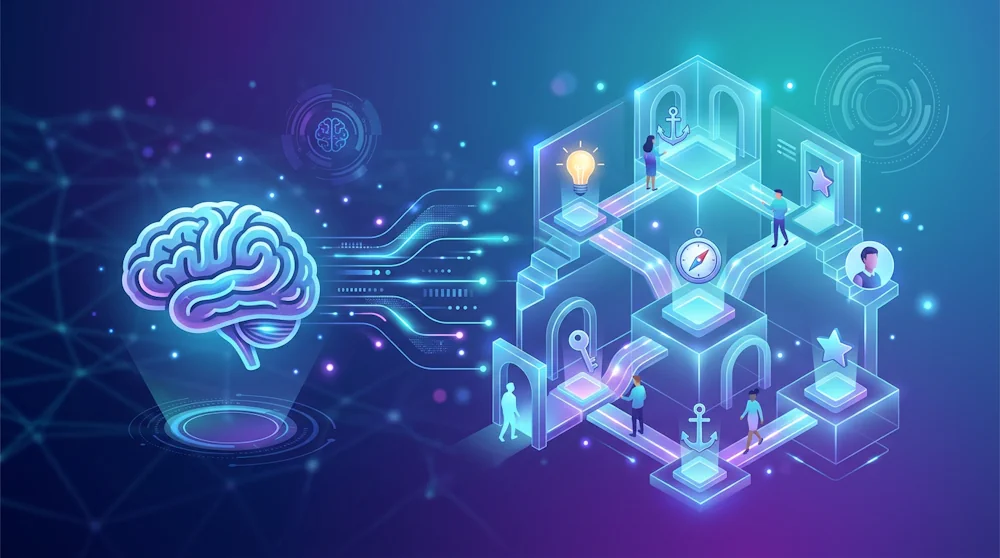
The Method of Loci (often called a memory palace) is a legendary technique that involves mentally placing information inside a physical space you know incredibly well based on the Method of Loci. It's a powerful tool because it taps into your brain's natural spatial navigation skills. Unfortunately, carefully building and populating these mental palaces from scratch can be exhausting.
This is where Method of Loci AI prompts come to the rescue. You can instruct an AI to map abstract concepts directly onto your actual bedroom, your favorite coffee shop, or your daily commute. In fact, experimental developers are already building systems that transform dense PDFs into interactive, room-by-room mental maps for students using AI memory architecture.
Key Takeaway: Ask your AI to "walk me through my kitchen and place these five biology concepts on the counters, providing a clear visual for each."
2. Use AI Memory Hacks to Exploit the Brain's Love for the Absurd
Our brains are hardwired to pay attention to things that break the pattern. In cognitive psychology, this is known as the Von Restorff effect (or the isolation effect), which proves that distinctive, strange, or emotionally salient items are far easier to recall than normal ones.
You can leverage this neurological quirk by asking your AI to generate wildly out-of-place or absurd analogies for dry academic terms. Pairing a boring mathematical formula with a bizarre, AI-generated visual description forces your brain to encode the information much more thoroughly.
Key Takeaway: Prompt your AI with, "Give me the most absurd, bizarre analogy possible to help me remember the layers of the earth."
3. Use the "Hobby Hack" for Deep Semantic Encoding
Elaborative encoding is the process of attaching new, unfamiliar knowledge to a framework that is already deeply rooted in your memory. The absolute easiest way to do this? Lean into your favorite hobbies.
Whether you're obsessed with a specific video game, a reality TV show, or a sport, you already have a rich mental map built around it. Connecting new academic info to these personal, pleasant interests drastically accelerates your learning and long-term storage via elaborative encoding techniques.
Key Takeaway: Tell your AI, "Explain the rules of macroeconomics to me using analogies and terminology from the game Minecraft."
4. Generate Humorous Custom Acronyms
Acronyms are a classic study tool because they organize chaotic information into manageable, bite-sized chunks. However, standard textbook acronyms can still be incredibly dull, making them easy to forget during an exam.
By using your chatbot as an AI mnemonics generator, you can instantly output funny, context-specific acronyms for any list you need to learn. Because understanding humor requires you to process the actual meaning of the words, it triggers deeper semantic encoding, which leads to significantly better recall than just repeating the facts over and over using deep semantic encoding.
Key Takeaway: Paste your study list into an AI and ask for a "funny, slightly ridiculous acronym to help me remember these steps in order."
5. Create Dual-Coded Rhythmic Chants
Connecting meaning to a concept is highly effective, but you can supercharge your memory by adding a second layer: sound. Acoustic patterns provide dual retrieval cues, giving your brain two entirely different paths to find the information when test day arrives.
AI can instantly write rhythmic chants, short poems, or catchy rhymes for sequential data. When you understand the meaning behind the chant and feel its rhythm, you're building a much stronger, multi-sensory neural pathway.
Key Takeaway: Prompt the AI to "Turn this historical timeline into a catchy, four-line rhyming chant with a strong, predictable rhythm."
Memorizing dense information doesn't have to feel like an uphill battle against your own brain. By understanding a few basic principles of cognitive psychology and using AI as your personal associative engine, you can easily strip away the friction of studying. The next time you're faced with a mountain of uninspiring facts, remember that you already possess the tools to make them completely unforgettable.