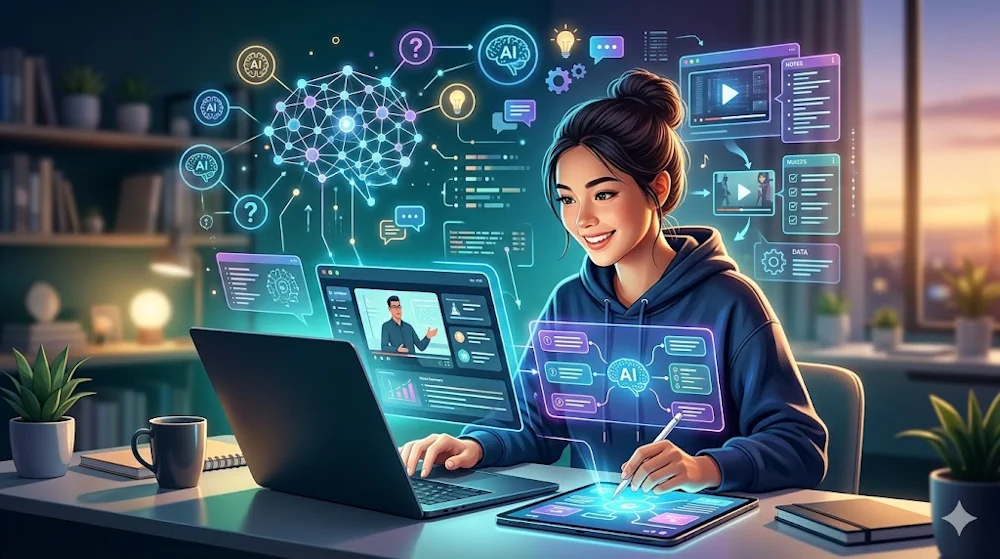
Have you ever finished a long educational video feeling like an absolute expert, only to completely blank on the core concepts a few days later? If so, you aren't alone. This frustrating experience is what researchers call the "illusion of competence." When a great instructor explains something fluidly, our brains mistake that smooth, easy viewing experience for actual comprehension.
To truly retain new information, we have to move away from passive binge-watching and embrace active learning. This means introducing a little bit of friction into our study routines—a concept cognitive psychologists call "desirable difficulties". Since the vast majority of students are already using generative AI tools, we can easily use this technology to create that healthy struggle. Here are five quick AI study hacks to transform your next round of video lectures from a passive watch party into a deep learning session.
1. Active Learning Through the Brain Dump Audit
We're leading with the most impactful strategy of all: retrieval practice. Immediately after finishing a video, resist the urge to immediately check your notes. Instead, open a blank document and type out a rapid "brain dump" of everything you can possibly remember from the lecture.
Once you've exhausted your memory, paste your raw text into an AI chatbot alongside the video's auto-generated transcript. Ask the AI to grade your brain dump and point out any critical concepts you missed or misunderstood. Research shows that AI tutors used this way can actually help students learn twice as much in less time compared to traditional classroom settings.
Key Takeaway: Forcing yourself to retrieve information from memory before relying on external notes is the ultimate way to build durable, long-term retention.
2. The Mid-Point Pause
It is incredibly easy to zone out during a lengthy, dense tutorial. To combat this natural attention decay, try forcing a hard interruption right in the middle of your watch session.
Pause the video halfway through and open your favorite AI tool. Type out a quick, two-sentence explanation of what you've learned so far, and predict what the instructor will cover in the second half. Ask the AI if your summary is accurate based on the topic. This quick check-in acts as a mental reset button.
Key Takeaway: Interrupting your watch session to summarize and predict forces your brain to stay actively engaged with the material.
3. The Pre-Watch Prime
Before you even press play, take a moment to set the stage. Instead of diving blindly into a new topic, copy the video's title, description, or syllabus module and feed it into an AI chatbot.
Ask the AI to generate three to five high-level focus questions based on that summary. Keep these questions open in a separate window while you watch. By knowing what to look for ahead of time, you shift your mindset from a passive viewer to an active investigator.
Key Takeaway: Reviewing targeted focus questions before hitting play primes your brain to actively hunt for specific answers.
4. The Transcript Debate
One major downside of video learning is that it rarely challenges you to think critically in real-time. You can fix this by turning the lecture into a conversation. When the video ends, copy the transcript and hand it over to your AI.
Prompt the AI with something like: "Act as a skeptical academic. Based on this transcript, highlight any potential biases, missing counter-arguments, or blind spots in the presentation." Read through the AI's critiques and try to debate them. Do you agree with the AI's skepticism, or do you side with the lecturer?
Key Takeaway: Debating the material with an AI tutor pushes you past simple memorization and develops your critical thinking skills.
5. The Context Swap
How do you know if you've actually mastered a concept? You should be able to explain it in a completely different context. AI is incredibly good at generating these kinds of creative scenarios.
Ask your AI to take the core theory from your video and apply it to an unrelated industry. For example, if you just watched a biology lecture on ecosystems, ask the AI to explain corporate macroeconomics using those exact same biological rules. Review the AI's analogy and look for flaws. If you can successfully critique how well the theory transfers, you truly understand the material.
Key Takeaway: Transferring a newly learned concept into a brand-new context proves you've achieved genuine mastery of the subject.
Ultimately, technology is just a tool—it is how we use it that dictates our success. By intentionally using AI to interrupt our passive habits, ask hard questions, and test our memory, we can finally break out of the illusion of competence. The next time you sit down to watch an educational video, don't just hit play and hope for the best; invite your AI tutor to challenge you along the way.