Have you ever stared at a glowing laptop screen for hours, silently rereading the same chapter over and over, only to forget most of it by the next morning? You aren't alone. Today's learners are battling immense screen fatigue, and traditional passive reading just isn't cutting it anymore.
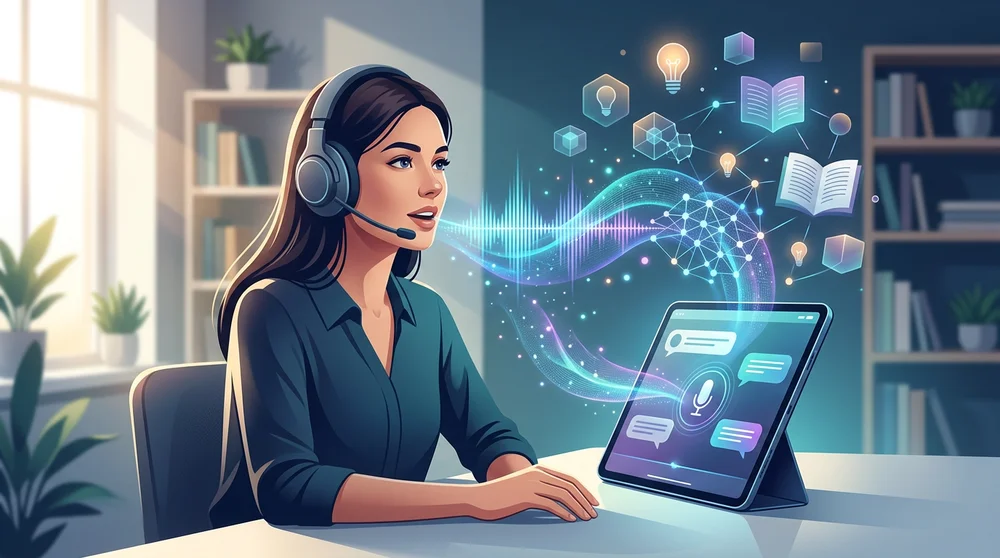
But what if you could close your laptop, go for a walk, and literally talk through your study materials? Thanks to the rapid evolution of Voice AI tutoring, we are entering a new era of education. By shifting from silent reading to conversational learning, you can transform how your brain processes and retains complex information.
Let's break down the science behind why talking out loud helps you learn, and exactly how you can design an AI-powered study routine that actually works.
The Cognitive Science of Voice AI Tutoring and Speaking Out Loud
There is a powerful psychological phenomenon known as the "production effect." Essentially, producing information aloud enhances your brain's ability to consolidate memories much more effectively than reading silently.
According to cognitive research led by Colin M. MacLeod, reading text aloud gives learners a 12% memory performance advantage over silent reading. Why does this happen? When you speak out loud, you engage in a dual cognitive action. You are executing the physical, motor act of speech while simultaneously hearing your own unique voice. This active production makes the information distinct and highly memorable, locking it securely into your long-term memory.
Conversational studying also forces you into a state of "active recall." Instead of passively highlighting text, you are actively retrieving information from your brain. Cognitive scientists have long established that this retrieval practice significantly outperforms passive study methods when it comes to durable, long-term retention.
Measurable Benefits: Why Students Are Making the Switch
We are seeing a massive shift in how educational technology is used. Right now, 86% of higher education students report using AI in their studies, with more than half using it on a weekly or daily basis. But it's not just about getting quick answers; it's about measurable academic improvement.
When students use AI to engage in active recall rather than passive viewing, the results are striking. One recent study showed that interrupting passive learning with a conversational AI tutor boosted immediate post-test performance by over 8 points, revealing a massive statistical leap in comprehension.
Broader industry data supports this as well. Students utilizing AI tutors like GPT-4 have experienced up to a 33% improvement in test outcomes, specifically in quantitative subjects like math.
Escaping the Screen: The Power of Hands-Free Studying
Beyond the test scores, one of the most immediate benefits of Voice AI is its ability to facilitate true hands-free studying. Modern learners are increasingly exhausted by complex visual dashboards and glowing screens. Voice technology removes this burden entirely.
Imagine commanding your AI tutor to quiz you on historical dates while you fold laundry, or debating the themes of a novel while commuting on the bus. You can transition idle transit time into highly productive learning sessions without ever opening an app interface.
Furthermore, an AI voice agent provides a perfectly patient, non-judgmental environment. This has been shown to significantly reduce anxiety for students. You can ask an AI tutor to explain the same concept five times in a row, practice speaking a foreign language, and make mistakes without any fear of human judgment.
How to Design Your Conversational Study Routine
To truly harness these cognitive benefits, you can't just turn on a voice assistant and say, "teach me." Without direction, AI models tend to deliver long, encyclopedic monologues that disrupt your conversational flow. Here is how to take control and build an effective, rapid-fire study routine.
Step 1: Activate the Proper AI Modality
First, ensure you are using a natively multimodal voice feature—like ChatGPT's Advanced Voice Mode. Unlike old text-to-speech engines that sound robotic, multimodal models process audio directly. This allows them to capture the nuances of your emotional tone, hesitations, and speaking pace, making them incredibly lifelike.
Try this: Look for features often labeled as "Study Mode," which prompt the AI to use Socratic questioning. This forces the AI to test your memory recall and offer helpful hints rather than just giving away the answers.
Step 2: Establish the Socratic Persona
You must provide specific instructions to constrain the AI's behavior. If you don't, it will default to lecturing, which puts you right back into a passive learning state. You want to establish the AI as your personal Socratic tutor or verbal flashcard partner.
Try this prompt: Say directly to your voice assistant, "Act as an expert Socratic tutor. Ask me one question at a time. Do not lecture.".
Step 3: Implement Constraints for Active Recall
To maximize the "production effect," you need to be the one doing most of the talking. You can achieve this by putting strict parameters on the AI's feedback loop. This keeps the session moving quickly, making it perfect for a walk or a commute.
Try this prompt: Tell your AI, "After each of my answers, correct or expand upon my response in under fifteen seconds. Rate my understanding on a scale of 1 to 10, and immediately ask the next best question.".
By limiting the AI's feedback to brief intervals and enforcing a one-question-at-a-time structure, you guarantee that your mind stays actively engaged.
Key Takeaways for Your Next Study Session
- Embrace the production effect: Speaking your answers aloud gives you a significant memory advantage over reading them silently.
- Ditch the screen: Protect your eyes and your posture by turning walks, chores, and commutes into hands-free auditory learning sessions.
- Control the conversation: Never let the AI lecture you. Use specific voice commands to enforce a rapid-fire, one-question-at-a-time structure.
- Practice without pressure: Lean into the non-judgmental nature of AI to ask repetitive questions and safely work through your mistakes.
The era of staring blankly at textbooks and hoping the information sticks is fading. By combining the proven cognitive science of active recall with the flexibility of voice technology, we are turning learning back into a dynamic dialogue. The next time you need to study for an exam or master a new topic, consider leaving your laptop closed, putting in your earbuds, and simply starting a conversation.