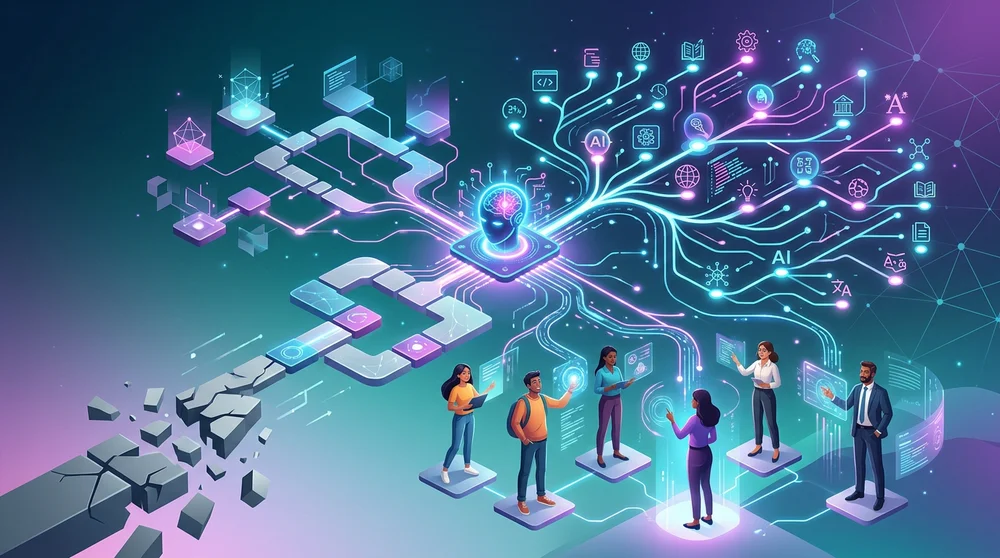
Have you ever felt a sudden burst of inspiration to learn something new—maybe analyzing data for a personal project, writing a complex script, or exploring game design—only to hit a massive, discouraging wall of prerequisites? We've all been there. Prerequisites are the enemies of curiosity, but the shift toward non-linear learning is providing a solution. You want to build a house, but traditional education tells you that you must first spend a year studying the molecular structure of bricks.
For centuries, formal education has been built on this rigid, sequential architecture. But a massive paradigm shift is currently underway. We are rapidly transitioning from a linear, "just-in-case" educational model to a dynamic, "just-in-time" learning experience. And at the heart of this transformation is artificial intelligence.
The prerequisite is dying, and that is incredible news for curious minds. Let's explore how adaptive AI education is rewriting the rules of how we learn, why our brains actually prefer this new approach, and how you can navigate this shift without falling into common learning traps.
The Architecture of Non-Linear Learning: From Rigid Ladders to Dynamic Webs
To understand why this shift is so revolutionary, we have to look at how we've been taught to learn. Traditional education operates on a "just-in-case" philosophy. You sit through years of foundational theory, banking generalized knowledge in the hopes that it might eventually prove useful in your career. It functions exactly like a ladder: you must step on rung 101 before you are ever allowed to touch rung 201.
Originally modeled after industrial factory systems, this linear curriculum standardizes the sequence of learning. But human curiosity isn't linear. Forced memorization of disconnected theory long before a learner encounters a practical application often extinguishes the very spark that initiated their interest.
Conversely, just-in-time learning represents a radical departure from the factory floor. Inspired by lean manufacturing techniques—specifically Toyota's revolutionary inventory models from the 1970s—just-in-time learning delivers actionable skills at the exact moment you actually need them. Instead of hoarding knowledge in a vacuum, you engage with information to solve the immediate problem directly in front of you.
This replaces the rigid ladder with a flexible, interconnected web. Rooted in the educational theory of Connectivism, this non-linear approach recognizes that knowledge is a dynamic network rather than a static sequence. It means you can follow paths based on your unique talents and immediate goals, drastically increasing your independence as a learner.
How Adaptive AI Education Acts as Your 24/7 Safety Net
So, what exactly is killing the prerequisite? It's the advent of adaptive AI education. Historically, if you attempted a complex, advanced task without prior foundational knowledge, you would quickly become frustrated and give up. There was no one around to instantly explain the missing piece of the puzzle.
Today, artificial intelligence acts as an embedded, 24/7 mentor that dynamically weaves a safety net of prerequisites right beneath you. Instead of following a static curriculum, you can confidently parachute directly into advanced, high-interest subjects. When you inevitably hit a knowledge gap, your AI tutor detects the deficit and instantly backfills the exact foundational concept you need, right in that moment.
Educators call this just-in-time scaffolding. In traditional classrooms, teachers often provide "just-in-case scaffolding," giving hints to the whole class at once. Unfortunately, this can inadvertently reduce the cognitive challenge and stop students from productively struggling through a problem. AI, however, continually assesses your readiness—gauging your response time, confidence, and context—to deliver help only when you demonstrate a distinct need.
What this means for learners: You no longer have to wait for permission to tackle advanced specialty skills. AI democratizes knowledge, allowing you to bypass months of preparatory coursework and dive straight into the applications that genuinely excite you.
The Neuroscience: Why Adult Brains Crave Non-Linear Learning
If you observe how adults naturally solve problems in the real world, the shift toward AI-enabled, non-linear learning makes perfect sense. In our daily lives, we rarely read a manual cover-to-cover before trying to fix a leaky sink. We encounter a problem, identify our knowledge gap, and seek specific information to resolve it. AI simply aligns formal education with our natural adult cognition.
From a neuroscientific standpoint, this leverages Cognitive Load Theory. The human brain is an absolute powerhouse, processing an estimated 11 million bits of information per second. However, our conscious working memory can only handle roughly 40 bits at any given moment. Traditional learning often overwhelms this limited working memory with "extraneous load"—mental effort that doesn't actually contribute to learning.
When you are given theoretical training completely out of context, you burn massive amounts of mental energy just trying to store that information for some vague future use. Adaptive AI optimizes your brain's processing power by:
- Presenting optimal chunk sizes: Delivering micro-learning modules tailored specifically to your current working memory capacity.
- Reducing barriers: Intervening right before frustration sets in, translating complex jargon into plain language.
- Reinforcing germane load: Encouraging the mental processes that build long-term memory by contextualizing the theory within a broader, engaging goal you care about.
By applying knowledge immediately to a high-interest task, you experience improved retention. You effectively escape the dreaded Ebbinghaus forgetting curve, which so often plagues traditional, lecture-based education.
The Empirical Proof: The Harvard Physics Case Study
This isn't just theory. The benefits of non-linear, AI-supported learning have recently been validated by rigorous research. A groundbreaking randomized controlled trial conducted at Harvard University provides concrete data on just how effective AI tutors can be.
Researchers engineered an AI tutor for undergraduate students in an introductory physics course. The AI was programmed to follow pedagogical best practices, including cognitive load management and immediate personalized feedback. They then compared the AI tutor's effectiveness against a traditional active learning classroom.
The results were staggering. Students utilizing the AI tutor not only learned more material, but they also do so in less time, all while reporting higher levels of motivation. Specifically, learning gains more than doubled compared to the baseline. Furthermore, the median study time dropped from 60 minutes in the traditional setting to just 49 minutes with the AI.
Why did this happen? Researchers noted that the success was largely driven by personalized pacing. Because the AI acted as a patient mentor, students could linger on the foundational prerequisites they found challenging while rapidly zooming through the material they already understood. It proves that when AI is responsive to our needs, the old classroom-paced prerequisite model becomes obsolete.
The Nuance: Beware the Pitfalls of Cognitive Deskilling
While the systematic dismantling of linear curricula is exciting, it isn't without risks. If we aren't careful, the complete abandonment of structured learning can lead to what educators call fragmented mental models.
When you learn exclusively through just-in-time micro-learning, you risk acquiring isolated bits of information without ever understanding how they fit together. You might become a "snorkeler" who skims the surface of many topics, rather than a "scuba diver" who possesses deep, systematic expertise. Traditional curricula, for all their faults, do provide a macro-level map of a discipline.
Furthermore, experts have raised alarms regarding "cognitive deskilling". As AI takes on the heavy lifting of interpreting data, providing step-by-step guidance, and backfilling basic knowledge, we risk losing our ability to cope with uncertainty. If the AI is doing all the thinking, you are merely executing instructions. Over time, you might start reflexively trusting AI advice without having the foundational mental models to critically evaluate if that advice is actually correct.
What this means for learners: AI is exceptional at delivering the how and the what right exactly when you need it. But you must deliberately take responsibility for cultivating the why. You have to stay engaged in critical reasoning.
A Strategic Framework for Self-Directed AI Learning
To truly harness the power of non-linear learning while avoiding the trap of fragmented knowledge, you need a strategy. This four-step framework transforms your AI from a simple search engine into a powerful metacognitive coach.
Step 1: Goal-Driven Immersion
Don't look for "Intro to 101" courses. Instead, identify a complex, high-interest project that is currently way beyond your skill level and parachute directly into it. By plunging into the application phase, you create an immediate demand for knowledge in your brain. This guarantees that whatever you learn next is highly relevant and immediately useful.
Step 2: Dynamic Interrogation
When you inevitably hit a knowledge gap, prompt your AI tutor to backfill the prerequisite. But here is the critical part: demand explanation, not just execution. Instruct the AI to identify the underlying principle causing your bottleneck, and ask it to explain that concept using an analogy related to your specific project. Never let the AI just hand you the finished answer.
Step 3: Mid-Project Mapping
To combat the "snorkeler" problem, schedule regular synthesis checkpoints. After you learn a new micro-skill with AI support, prompt the AI to zoom out. Ask it, "How does this specific concept connect to the broader rules of this discipline?" By explicitly asking to map these relationships, you stitch your non-linear web of knowledge into a cohesive, structural whole.
Step 4: Metacognitive Reflection
Finally, engage in "thinking about thinking". Periodically review your AI conversation logs. What foundational concepts do you consistently struggle with? You can even ask the AI to generate a custom spaced-repetition quiz based on your past questions. This ensures the prerequisites you learned dynamically are actually committed to your long-term memory.
Looking Ahead: The Future of the Knowledge Web
The traditional, linear prerequisite model was a necessary compromise. In an era where personalized instruction was impossible to scale, standardizing the sequence of learning was the only way to manage a classroom. But that era is ending.
Today, adaptive AI serves as a limitless, infinitely patient guide, capable of delivering highly customized learning tailored to your exact cognitive load and contextual needs. By bridging the gap between isolated theory and immediate application, artificial intelligence allows you to leapfrog artificial bottlenecks and engage directly with the subjects that inspire you the most.
If we remain vigilant against the risks of cognitive deskilling, the thoughtful integration of AI promises to fundamentally reshape our intellectual lives. We are finally retiring the rigid learning ladders of the past, making way for the dynamic, interconnected, and intensely personal knowledge webs of the future. The only question left is: what are you going to build first?