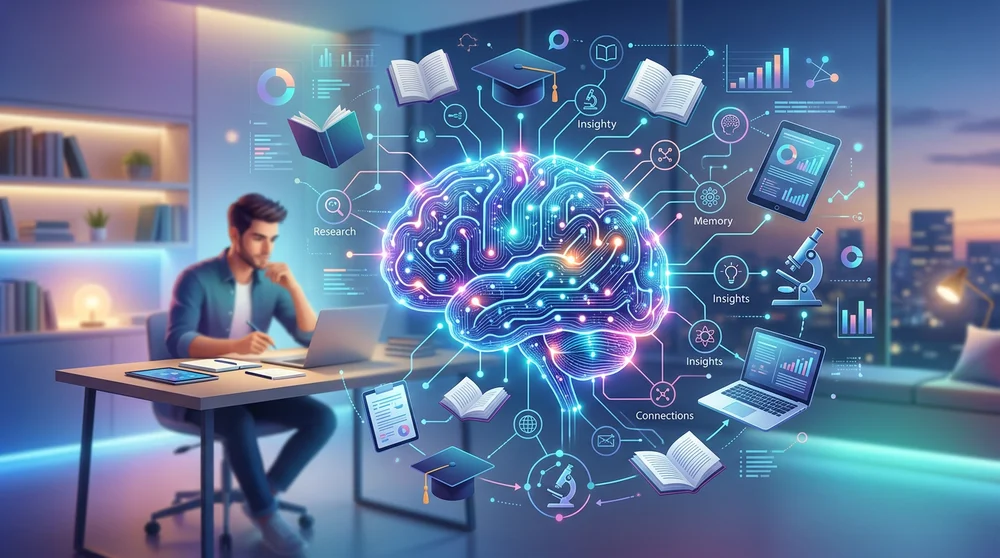
Have you ever had a massive "aha" moment while studying with an AI tutor, only to completely forget the concept a week later? You are definitely not alone. Many learners are now building a Second Brain for students to bridge this gap. We are living in a golden age of digital study tools, and the statistics prove it. Today, over 86% of students use AI for daily academic tasks, with a staggering 92% of higher education students utilizing generative AI in 2025.
But while we are incredibly good at generating answers, we are struggling to keep them. When you close your browser tab, that brilliant, personalized analogy or perfect code snippet vanishes into a messy history log. You are experiencing what researchers call the "retention gap."
To fix this, we need to rethink how we interact with artificial intelligence. Instead of using AI as a disposable search engine, we can use it to build a permanent, personalized digital library. In this guide, we will walk through how to build an AI-powered Second Brain for students, helping you capture, organize, and remember your best insights forever.
The Problem: Why Your AI Breakthroughs Keep Disappearing
The scale of AI adoption in schools has fundamentally changed how we learn. Students who study in AI-enhanced environments often see their test scores jump by up to 54%. However, this rapid shift has a hidden downside. Nearly 70% of educators worry that relying too heavily on AI might weaken our critical thinking and long-term memory.
Think about a typical study session. You ask an AI to summarize a complex lecture, and it gives you a fantastic breakdown. You read it, understand it, and move on. But because large language models (LLMs) aren't built for long-term knowledge retrieval, that deep insight remains trapped in an isolated, temporary chat thread.
Without a system to capture these insights, you are forced to re-prompt the AI later or, worse, you simply forget the material before your exam. To solve this, we need to borrow a concept from the world of productivity.
The Solution: Personal Knowledge Management and the Second Brain for Students
To stop losing your AI-generated insights, you need to dive into Personal knowledge management (PKM). A PKM system acts as an external digital memory—often called a "Second Brain." It is designed to capture and organize information so your actual brain is free to focus on critical thinking and creative problem-solving.
There are two major concepts that make this work:
- The PARA Method: Created by productivity expert Tiago Forte, this system organizes your digital life into Projects, Areas, Resources, and Archives. It ensures every piece of information has a specific home.
- The Zettelkasten Method: Developed by sociologist Niklas Luhmann, this approach involves breaking information down into "atomic notes." These are single, bite-sized ideas written in your own words that you link together like a web.
By blending these two frameworks with artificial intelligence, we can transform a passive folder of notes into an intelligent, lifelong study partner.
How to Build Your AI Note-Taking Workflow
Turning a long, rambling AI chat into a permanent piece of knowledge requires a deliberate AI note-taking workflow. By following these three steps, you can seamlessly move your study breakthroughs into powerful PKM tools like Notion, Obsidian, or Roam Research.
Step 1: The Extraction Prompt
When you finish a great study session with an AI, the raw chat transcript is usually too long and messy to be useful. Instead of copying and pasting the whole conversation, you need to use a final "extraction prompt." This command tells the AI to distill your entire session into actionable, structured data.
Try This: At the end of your next AI study session, copy and paste this exact prompt:
"This is a personal knowledge management note. Please do the following: 1) Summarize the main insight in 2–3 sentences. 2) Extract 3-5 fundamental atomic ideas from our session. 3) Add 3–5 thematic tags (e.g., #biology). 4) Return the output entirely in properly formatted, Obsidian-compatible Markdown text."
By explicitly asking for Markdown formatting, you ensure the AI's output can be instantly pasted into your notes app without losing headers, bullet points, or bold text.
Step 2: Markdown Integration and Automated Tagging
Once your AI generates the clean Markdown summary, it is time to move it into your Second Brain for students. Tools like Obsidian are heavily favored by learners because they store notes locally as plain Markdown files. This means you maintain total ownership of your study materials forever.
Because you asked the AI to generate tags in Step 1, your new note is already categorized. If you were studying the nervous system, tags like #neuroanatomy or #exam_prep tell your software exactly where to group this new insight. You no longer have to spend time manually sorting files into deeply nested folders.
Step 3: Synthesis Through Bidirectional Linking
This is where the real magic happens. Bidirectional linking is a feature in tools like Obsidian and Notion that allows you to connect ideas together. By simply placing double brackets around a word—like [[Action Potential]]—you create a two-way hyperlink between your new AI note and your old lecture notes.
When you consistently link your notes together, you build a visual web of knowledge. Over months and years, this practice forces you to see the hidden connections between different academic disciplines. It actively prevents you from forgetting older material, making exam prep infinitely easier.
Real-World Examples: Seeing It in Action
It helps to see how other students are already using these systems to dominate their coursework. Let's look at how this plays out in the real world.
Consider the workflow of a Mechatronics Engineering student. When facing complex math problems, they solve the exercises manually on a tablet to maintain focus. Afterward, they use an AI voice dictation tool to explain their understanding of the concept out loud. The AI is prompted to convert this verbal rambling into a clean, structured Markdown note, complete with mathematical formatting.
The student then pastes this into Obsidian, adds visual diagrams, and uses bidirectional links to connect it to broader engineering concepts. The deep comprehension achieved during problem-solving is perfectly captured and preserved.
The need for this kind of system is massive. In a recent survey of the UCLA Class of 2025, 73% of seniors reported using Generative AI to research topics and study for exams. If those students aren't using a Second Brain to capture those sessions, the vast majority of that synthesized knowledge is abandoned the moment they close their laptops.
Key Takeaways for Your Study Routine
Ready to upgrade your study habits? Keep these tips in mind as you build your system:
- Keep it atomic: Don't let your AI generate massive essays. Ask it to break concepts down into single, bite-sized ideas.
- Always use Markdown: Requesting Markdown formatting from your AI ensures your text pastes perfectly into tools like Obsidian or Notion.
- Link everything: Don't leave your notes isolated. Always use bidirectional links to connect new AI insights to your previous class lectures.
- Prioritize context over queries: As productivity expert Tiago Forte notes, better results come from better context. The more interconnected your notes become, the smarter you will study.
Summary
The combination of generative AI and structured note-taking is the ultimate cure for digital study clutter. You no longer have to accept that your brilliant AI tutoring sessions are temporary. By adopting a smart workflow—using extraction prompts, capturing ideas in Markdown, and connecting them with bidirectional links—you can permanently capture your best academic insights.
Building an AI-powered Second Brain transforms fleeting chatbot interactions into a durable, compounding library of your own intelligence. The next time you have a major breakthrough while studying with AI, where will that knowledge live tomorrow?