Have you ever perfectly memorized a formula for a math test, only to draw a complete blank when trying to balance your own budget? You certainly aren't alone. Traditional study methods often leave our knowledge trapped in rigid, academic silos.
We easily learn surface-level details, but we often miss the underlying mechanics. When this happens, we fail at what cognitive scientists call "far transfer"—the ability to take a rule from one context and apply it to a completely completely unexpected, real-world scenario.
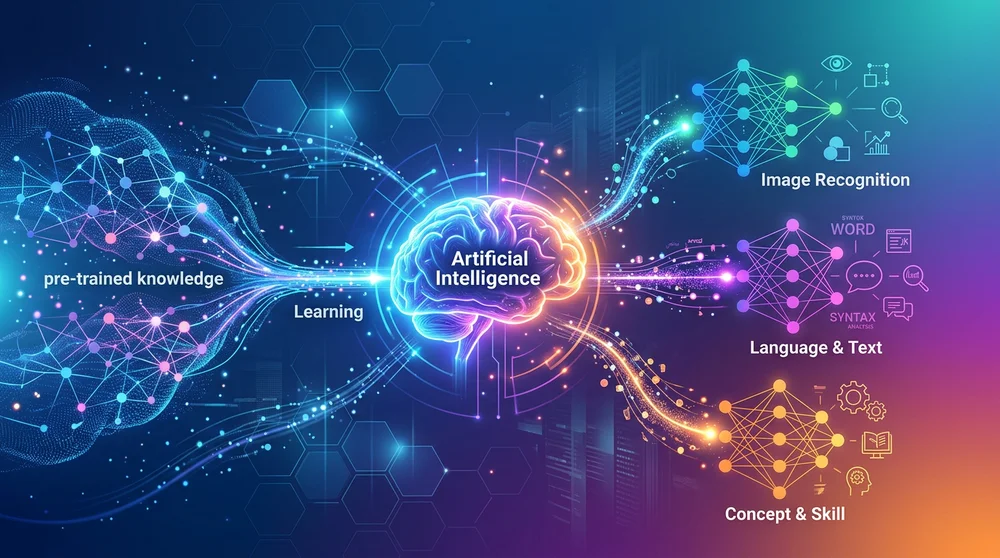
The secret to true mastery isn't having a photographic memory. It relies on transfer learning, a dynamic process of adapting knowledge from one domain to solve novel problems. In this guide, we'll explore how you can use AI not as a shortcut, but as a Socratic tutor to build deep, adaptable intelligence.
The "Forklift at the Gym" Dilemma
Generative AI is a revolutionary tool for breaking down complex subjects, but it comes with a hidden trap. When we use AI simply to summarize texts or retrieve direct answers, we risk falling into "cognitive offloading."
Educators often compare this to bringing a forklift to the gym. If you use a machine to lift all the weights, the heavy object moves, but you don't build any muscle. Similarly, if an AI does all the cognitive heavy lifting—like structuring an essay or solving an equation outright—you bypass the productive struggle required to encode long-term memory.
While AI can drastically improve our general productivity, over-relying on it can actually stunt our expertise. In fact, recent experimental studies show that novices using AI for complex, domain-specific tasks actually lagged 13% behind human experts. To genuinely learn, we must maintain active stewardship of our tasks. AI should augment our perspective, not replace our judgment.
Deconstructing Ideas with First Principles Thinking
To successfully transfer a concept into a new domain, you first need to isolate its core logic. This is where first principles thinking becomes your most valuable tool. Rooted in philosophy, this strategy involves stripping away all jargon and assumptions to find the fundamental, undeniable truths of a concept.
When you break down ideas this way, you create highly flexible AI mental models. For example, imagine you are studying cellular division in biology. Instead of getting bogged down in biological terminology, you can look at the first principles: it's essentially a core algorithm of resource allocation and replication.
Once you understand that underlying structural pattern, you can suddenly apply that exact same algorithm to a completely different field, like business scaling or urban planning. That is transfer learning in action.
Step-by-Step: How to Master Transfer Learning with AI
To build these cognitive pathways, you need to shift away from using simple retrieval prompts. Instead, you'll want to use high-complexity prompts that force a Socratic dialogue. Let's walk through a three-step framework you can try today.
Step 1: Isolate the Core Logic
Before applying a concept, force the AI to help you strip away the domain-specific noise. This builds your foundational mental model.
Try this prompt:
"I am learning about [Insert Concept]. Step 1: Break this
concept down using first principles thinking. Strip away all domain-specific jargon and explain the
underlying fundamental truths or mechanics. Step 2: Provide a generalized mental model for this
concept that could theoretically apply to fields completely unrelated to its original domain."
Step 2: Generate Analogical Scenarios
Drawing comparisons across distinct examples highlights shared structures, a process called analogical transfer. Once you have your mental model, force the AI to create a testing environment from a radically different discipline.
Try this prompt:
"Acting as an expert tutor, test my ability to perform 'far
transfer' with this concept. Present me with a complex, real-world scenario from a completely
unexpected discipline (e.g., if the concept is biological, give me an economics or sociology
scenario). Do NOT give me the answer. Ask me to explain how the first principles of our concept
dictate the outcome of this new scenario."
Step 3: Evaluate and Defend Your Logic
This is the most crucial step to avoid the "forklift" effect. You must do the thinking, and the AI must act purely as an evaluator.
Try this prompt:
"Here is my application of the concept to the scenario you
provided: [Insert Your Answer]. Step 1: Evaluate my reasoning. Did I successfully align the
structural relationships of the original concept with this new domain? Step 2: Point out any logical
flaws, false analogies, or surface-level comparisons I made. Step 3: Ask me one follow-up question
that forces me to defend or refine my logic."
Real-World Application: Learning from the Experts
This exact framework is already transforming forward-thinking classrooms. At the University of Cincinnati's design college, professors are integrating custom AI tools to cultivate cross-disciplinary understanding among their students.
Instead of letting AI generate rapid, finished concepts, their systems are specifically designed to withhold direct answers. The AI scaffolds the learning process by prompting students to speculate and bridge insights across engineering and psychology.
The students are held accountable for the reasoning behind their decisions. The AI accelerates the brainstorming process, but human judgment drives the final outcome.
Key Takeaways for Your Learning Journey
Ready to put this into practice? Keep these essential tips in mind next time you sit down to learn something new:
- Beware cognitive offloading: Don't let AI do the heavy lifting for you. Engage in the productive struggle required to encode real memory.
- Look for the underlying structure: Use first principles thinking to strip away jargon and find the core mechanics of whatever you're studying.
- Test yourself across disciplines: If you learn a concept in math, try applying it to sociology. If you learn it in art, apply it to business.
- Force Socratic dialogue: Use prompts that demand the AI evaluate your reasoning, point out your logical flaws, and ask you follow-up questions.
Final Thoughts
Mastering transfer learning fundamentally changes how you interact with the world. You stop seeing isolated academic facts and start recognizing a beautifully interconnected web of systems.
By leveraging AI to extract first principles and generate unexpected analogies, you can transform rigid information into highly adaptable frameworks. Ultimately, true intelligence isn't about how many facts you can store. It's about how gracefully you can adapt what you know to the unknown challenges of tomorrow.