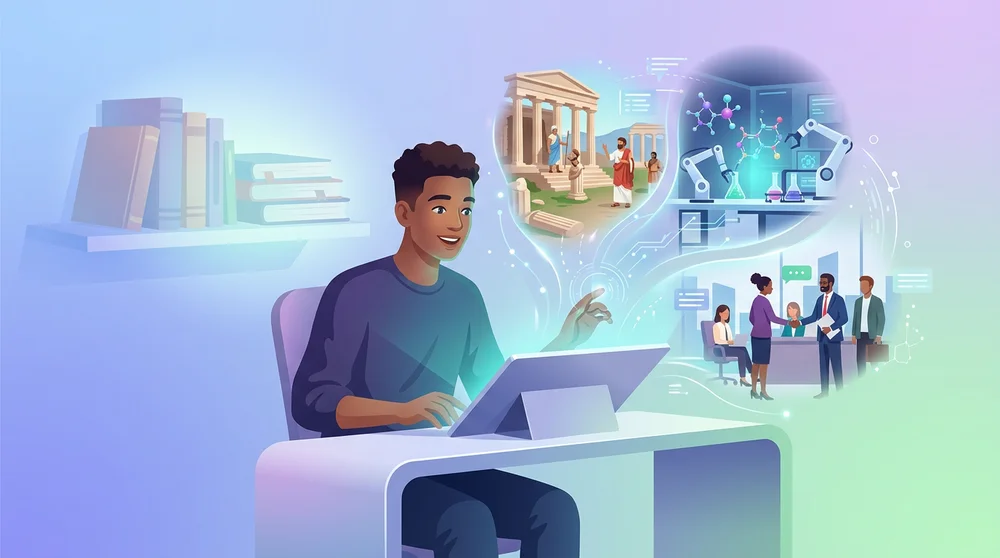
Have you ever aced a written exam or flawlessly memorized a training manual, only to freeze up the moment you had to apply that knowledge in the real world? You certainly aren't alone. For generations, we’ve relied on a learning model built around passive consumption. We read textbooks, highlight notes, and watch lectures, operating under the assumption that if we memorize the theory, the practical application will naturally follow. This gap is now being closed by experiential learning AI, which prioritizes active application over observation.
But human beings don't work that way. Reading about how to de-escalate an angry customer doesn't prepare your nervous system for the reality of someone shouting at you. Memorizing a list of symptoms doesn't prepare you for the chaotic environment of a busy emergency room. Traditional education is incredibly effective for basic knowledge acquisition, but it consistently falls short when it comes to preparing us for the unpredictable nuances of real-world challenges.
Today, we're watching the dawn of a massive transformation in how we learn. Thanks to the rapid advancement of generative artificial intelligence, we are moving away from static text and entering the era of the "Simulation Shift." By generating highly realistic, responsive environments, AI allows us to step directly into a subject and learn through active participation rather than passive observation. Let's explore why this shift is happening, the cognitive science that backs it up, and how you can use it to build your own path to mastery.
Experiential Learning AI: Breaking the Illusion of Competence
One of the biggest traps in traditional education is what cognitive psychologists call the "illusion of competence." When you read a well-written textbook passage or flip through flashcards, your brain easily recognizes the information. It’s comforting, and it makes you feel like you've mastered the material. But true situational judgment requires far more than basic recognition. It requires the ability to navigate unpredictability, manage your emotions, and solve problems on the fly.
This is where learning by doing becomes critical. Generative AI shatters the illusion of competence by introducing "productive friction" into the learning process. Instead of just reading a script, you might face unexpected objections from a simulated client, rapid vital-sign changes in a virtual patient, or unscripted ethical dilemmas that force you to think critically. This unpredictability demands active synthesis of information.
The numbers behind this shift are hard to ignore. Studies repeatedly show that the average knowledge retention rate for passive, lecture-style learning sits at a dismal 10 percent. In stark contrast, hands-on, experiential learning boasts a retention rate ranging from 65 to 90 percent, particularly when that knowledge is applied immediately. By engaging multiple senses and demanding real-time processing, AI-driven roleplay bridges the gap between knowing what to do and actually knowing how to do it.
The Cognitive Science Behind the Shift
The success of the Simulation Shift isn't just a happy accident of new technology; it is deeply rooted in established cognitive science. Specifically, it brings to life theories that emphasize the contextual, active nature of human learning.
At the center of this educational evolution is a concept known as situated cognition. This theory argues that knowing is absolutely inseparable from doing. Knowledge isn't just an abstract substance you can deposit into a student's memory bank; it is tightly bound to the specific physical, social, and cultural contexts in which it is used. You cannot truly separate the information from the environment where it lives.
Generative AI breathes life into situated cognition by allowing learners to practice within authentic contexts. When you engage in dynamic **AI study simulations**, you are forced to use your knowledge as an active tool rather than just recalling it as a passive fact. The context and the content become linked, helping you develop the critical awareness needed for real-world application.
We can see this in action by looking at David Kolb’s famous Experiential Learning Theory. Kolb argued that true learning is a continuous, four-stage cycle. Experiential learning AI seamlessly supercharges every single step of this process:
- Concrete Experience: Instead of reading about leadership theory, the AI plunges you into a realistic scenario where you must actively manage a resistant employee.
- Reflective Observation: After the interaction, the AI acts as an objective mirror. It analyzes your tone, pacing, keyword usage, and soft skills, providing immediate, non-judgmental feedback on your performance.
- Abstract Conceptualization: The AI can then help you connect your specific performance to broader theoretical frameworks, helping you understand why a certain approach failed or succeeded.
- Active Experimentation: You can immediately restart the simulation and apply your new strategies. The AI dynamically adapts to your new approach, ensuring you face fresh challenges and preventing you from just memorizing a "correct" script.
From Theory to Mastery: Real-World Applications
To really grasp the profound impact of this shift, we have to look at how experiential AI is currently transforming high-stakes industries. In environments where the margin for error is razor-thin, turning theoretical education into practical mastery is a game changer.
Take healthcare, for example. Historically, medical professionals have had to rely on expensive manikins, hired human actors, or incredibly limited clinical hours to practice complex bedside manners and crisis response. Today, generative AI is creating hyper-realistic virtual patients. Medical students can now practice rapid assessment and decision-making during simulated cardiac arrests or trauma care, with the AI generating evolving patient histories and realistic physiological changes. This allows professionals to practice rare or high-risk procedures without ever putting a real human life in danger.
We are seeing equally dramatic results in the corporate sector. Traditional leadership and sales training usually relies on rigid, "choose your own adventure" e-learning modules that are quickly exhausted. Modern AI simulators allow organizations to upload complex playbooks, instantly generating dynamic, unscripted roleplay scenarios. Employees can interact with customizable AI personas that mimic the exact objections and personalities of their target clients.
The empirical data backing up these corporate applications is staggering. Organizations that invest heavily in experiential leadership development are 2.4 times more likely to outperform their industry peers. A recent field study of over 5,000 agents showed that generative AI training models lifted productivity by an average of 15 percent, heavily benefiting novice and newly onboarded workers. By turning soft skills—like empathy and active listening—into quantifiable, practice-based competencies, organizations are reducing training costs while significantly boosting performance.
Building Your Own AI "Holodeck"
What does all of this mean for you as a learner? It means a fundamental shift in your educational mindset. In the past, when faced with a knowledge gap, your first question was likely, "What book should I read to learn this?" Today, your default question should be, "What simulation can I build to experience this?"
You no longer need to be part of an elite medical academy or a Fortune 500 company to access high-fidelity training. By using readily available generative AI models, any self-directed learner can design a low-stakes, highly realistic "holodeck" to practice high-stakes skills. Here is a simple, strategic framework to build your own experiential learning environment:
- Define the Context and Persona: Establish the exact parameters of your situation. Prompt the AI with specific details. For example: "Act as a skeptical CFO of a mid-sized logistics company. You are highly analytical, risk-averse, and resistant to adopting new software." Setting a strict persona ensures the AI behaves realistically and avoids being overly polite or accommodating.
- Establish Productive Friction: A simulation is only useful if it challenges you. Program constraints directly into your prompt. "Do not agree to my proposal easily. Raise objections regarding implementation downtime and integration costs." This forces you to engage in active problem-solving and emotional regulation.
- Engage in the Experience: Step into the roleplay. If possible, use voice-to-text features to simulate the actual cognitive load of real-time verbal communication. The unpredictable back-and-forth will transform your static knowledge into fluid, persuasive capability.
- Initiate the Feedback Loop: Once the scenario concludes, step out of the simulation and instruct the AI to switch roles from actor to coach. "End roleplay. Analyze my performance based on active listening, empathy, and clarity. Identify where I failed to address your core concerns." This objective critique allows you to conceptualize new strategies before diving right back in for another round.
The Future of Active Learning
The Simulation Shift represents one of the most profound advancements in educational methodology we've ever seen. By moving away from passive text consumption and embracing dynamic, AI-driven experiential learning, we are finally aligning our educational practices with the biological realities of how human beings actually learn. We learn by doing, by stumbling, by reflecting, and by trying again.
The days of relying solely on textbooks and one-way lectures to prepare for the chaotic, unpredictable nature of the real world are fading. High-fidelity simulations are now accessible to anyone with an internet connection, democratizing the kind of elite training that was once heavily restricted. As AI continues to evolve, the ability to quickly generate customized, challenging roleplay scenarios will become the absolute standard for human development.
For the modern learner, the path forward is clear. Mastering a new subject no longer means observing it safely from the outside. It means rolling up your sleeves, embracing the friction, and stepping directly into the simulation.