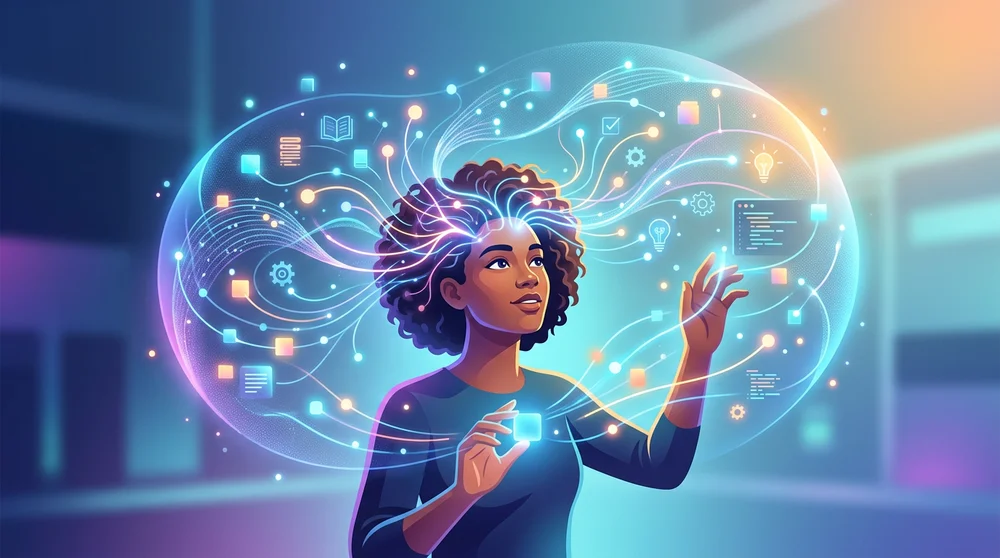
Have you ever stared at a blinking cursor, opened a generative AI tool to help structure your messy thoughts, and suddenly felt a twinge of guilt? Are you working smarter, or are you just outsourcing your intellect? We are all wrestling with this as we navigate a world where machines challenge the traditional boundaries of the extended mind theory.
For decades, our relationship with digital technology was strictly archival. We used search engines and digital databases like external hard drives, reliably holding factual knowledge so our biological brains could bypass rote memorization. But the arrival of generative artificial intelligence represents a massive, structural shift. Today's AI tutors and large language models (LLMs) do not just retrieve information; they process, analyze, and synthesize it. AI is no longer just changing what we learn—it is actively redefining the boundaries of how our working memory functions.
The New Frontier of the Extended Mind Theory
To really understand what is happening to our brains right now, we need to look back to 1998. Philosophers Andy Clark and David Chalmers proposed a radical, game-changing idea: the human mind does not stop at the boundaries of the biological skull. Their "extended mind theory" suggested that when we reliably couple our internal neural processes with external tools, those tools become a literal, functional part of our cognitive architecture.
In their classic thought experiment, they described a man with memory impairment who uses a physical notebook to navigate his daily life. Because he relies on the notebook seamlessly, they argued it acts as a genuine extension of his mind. For a long time, we applied this theory to static tools like calculators, written language, or GPS navigation apps. Generative AI, however, forces an incredible evolution of this framework.
Modern LLMs are interactive, fluent, and highly responsive cognitive partners. Rather than just passively storing data, AI systems actively participate in the cycle of cognition. When you are untangling a complex problem, an AI can function as a "prosthetic prefrontal cortex". It takes over the heavy lifting of maintaining sequential steps and juggling messy datasets in its vast context window. By handling this mental juggling, it effectively creates a shared AI working memory. This allows your biological working memory—which is notoriously limited in the number of variables it can hold at once—to bypass systemic overload and focus entirely on high-level strategy.
The Learner's Dilemma: Amplification vs. Atrophy
This leap from using technology as an external storage device to an external processor is thrilling. But it also introduces a profound psychological debate. As we increasingly integrate AI into our learning environments, we are facing what researchers call the Cognitive Atrophy Paradox. This is the frustrating reality that the exact technological systems designed to enhance our cognitive efficiency can simultaneously erode the vital mental functions they are meant to support.
Let's look at the threat of cognitive atrophy first. Humans are naturally predisposed to take the path of least mental resistance. We heavily favor fast, intuitive, effortless thinking over slow, laborious, analytical thought. Because AI delivers highly polished, friction-free answers instantly, it caters perfectly to this cognitive laziness. When we rely entirely on an algorithm for process-oriented thought, we skip the internal encoding processes necessary to build complex knowledge structures in our long-term memory. We end up with "borrowed competence," confusing the machine's artificial fluency with our own biological understanding.
The empirical evidence of this hollowing out is sobering. In a recent MIT Media Lab study, researchers tracked EEG data during AI-assisted writing tasks. They found up to a 55% reduction in cortical activity, resulting in what they termed "cognitive debt" and severely impaired memory integration. Similarly, a randomized controlled trial in Brazil found that undergraduates studying with unrestricted ChatGPT access scored 11 percentage points lower on a surprise retention test a month and a half later, compared to non-AI users.
But before we declare the end of human intellect, we have to look at the flip side: cognitive amplification. When AI is managed with intention, it extends the reach of human thought. A compelling example comes from a Wharton School study involving 770 high school students learning the Python programming language. Researchers built an AI tutor that intentionally prevented students from bypassing the thinking process. Instead of giving direct answers, the AI calibrated the difficulty, acting as a scaffold that forced students to put in the effort. The results were staggering. Students using this engagement-demanding AI outperformed their peers by a margin equivalent to six to nine months of additional learning.
The Fine Line: Cognitive Offloading vs. Outsourcing
The stark difference in outcomes between the Brazilian retention deficit and the Wharton learning amplification wasn't the underlying AI technology itself. It was the user's relationship to the tool. To safely navigate this new era, we must draw a rigid boundary between productive cognitive offloading and destructive cognitive outsourcing.
Destructive outsourcing occurs when a learner hands over the intrinsic cognitive work itself to the machine. If an AI chooses what is relevant, structures the ideas, and makes the final arguments, the cognitive work is no longer human. This eliminates what educational psychologists call "desirable difficulty." The productive struggle you experience when trying to make sense of complex, non-obvious concepts isn't just an annoying obstacle. It is the fundamental neurological mechanism through which durable expertise is formed. If you prompt an AI to write an analytical essay evaluating a novel's core themes, you bypass this required friction. You might get an A on the paper, but you are left with incredibly fragile, shallow knowledge.
Productive cognitive offloading, on the other hand, leverages AI to handle extraneous cognitive load, liberating your limited working memory to focus on high-order tasks. Imagine you are analyzing dozens of raw data logs to find anomalies. Your brain struggles to process all those parallel information streams at once, leading to cognitive fragmentation. By offloading the routine data sorting and summarization to an LLM, you safely expand your processing capacity. You are using the AI as a cognitive workspace. Your biological brain is freed from the exhaustive work of context management, allowing you to dedicate your metabolic energy to critical judgment and narrative synthesis.
Becoming a Cognitive Orchestrator
What does all of this mean for you as a learner or a professional? It means the paradigm of education is shifting. We can no longer be evaluated merely on our ability to retrieve and regurgitate information. The future of learning is about how well we can integrate our biological and artificial minds. We must transition from being mere receptacles of information to active directors of cognitive labor.
To do this, we need to adopt a new operational framework: Cognitive Orchestration. Think of this as a metacognitive control plane—a set of deliberate guidelines for intentionally dividing labor between your biological brain and your AI tools. Here is how you can put Cognitive Orchestration into practice today:
- Maintain the "Human-in-the-Loop" for Intrinsic Reasoning: Before you open an AI tool, actively map out the cognitive requirements of the task. Under this framework, you never use AI to generate the final synthetic argument or the core strategic decision. The biological brain must maintain ownership of the hypothesis generation. Use the AI to gather the ingredients, but you must be the one to bake the cake.
- Strategically Allocate Extraneous Load: Explicitly identify the logistical, formatting, and high-volume data-processing components of your assignment. These are the elements that deplete your attention. By delegating these specific sub-tasks to the AI, you safely expand your capacity without sacrificing your grasp of the core material.
- Enforce Metacognitive Reflection: Because AI removes natural friction, you have to artificially reintroduce it to ensure neural pathways are built. Use AI as a sparring partner rather than an all-knowing oracle. Prompt the AI to challenge your assumptions, point out logical fallacies in your drafts, or act as a Socratic tutor. Use the tool to induce the productive struggle you need to grow.
- Audit for "Cognitive Debt": Finally, you must remain hyper-vigilant against the illusion of fluency. Studies show that a shocking 47% of enterprise AI users have made major decisions based on hallucinated, highly confident AI content. Cognitive Orchestration requires you to cultivate an aggressive editorial mindset. Treat all AI outputs as probabilistic drafts that require active, effortful validation.
Designing Our Cognitive Future
The intersection of generative AI and human cognition represents one of the most significant evolutionary leaps in the history of learning. We are currently witnessing the literal expansion of the extended mind theory in real-time. Artificial intelligence systems are grafting onto our biological prediction-and-action cycles, offering us unprecedented processing power.
However, this technological power is fundamentally agnostic. If we leave our learning habits on autopilot, the path of least resistance will undoubtedly drive us toward destructive cognitive outsourcing. We risk trading the deep, rich neural architecture of critical thought for the fleeting, hollow efficiency of algorithmic output.
But cognitive atrophy is not an inevitability; it is a design choice. By embracing the principles of Cognitive Orchestration, you can reclaim your intellectual sovereignty. When we view AI not as an outsourced brain that replaces our thinking, but as a dynamic amplifier for biological working memory, we open up extraordinary new frontiers for human intelligence. In this new era, the ultimate measure of a learner will be their metacognitive mastery—their ability to elegantly orchestrate the dance between the wetware of the human mind and the vast, synthetic capabilities of artificial intelligence.