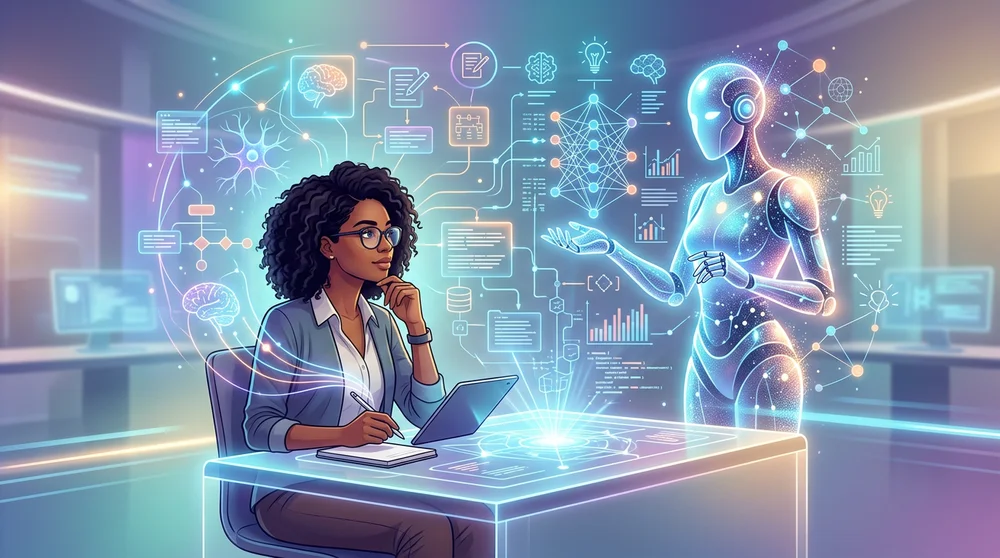
Have you ever stared at a beautifully formatted, highly insightful report you just generated with an AI tool and thought, "I didn't really do this"? You aren't alone; this experience of AI imposter syndrome is becoming increasingly common. As generative AI becomes a daily partner in how we learn and work, it is stripping away the traditional friction of creating. But the easier the work gets, the harder it becomes to claim it as our own.
We are facing a fascinating new psychological hurdle. Are we losing our edge, or are we simply learning to think in a completely new way? The answer lies in how we manage the invisible boundary between outsourcing our thinking and expanding our minds.
The Rise of AI Imposter Syndrome
Classic imposter syndrome usually hits when you work incredibly hard but still feel like a fraud despite your achievements. AI imposter syndrome flips this completely upside down. It is driven by "authorship ambiguity," a phenomenon where a tool produces polished work so quickly that you simply don’t have the temporal space to mentally absorb credit for the outcome. Because the output feels completely effortless, you naturally question if your own skills played any meaningful role at all.
This isn't just a problem for students or junior employees finding their footing. Senior professionals are feeling the heat, too. In fact, 43% of senior executives admit to experiencing AI-related imposter syndrome as workplace expectations rapidly shift. The sheer speed of AI is compressing timelines and making highly trained people wonder if their hard-earned expertise still matters in an automated age.
Look around, and the anxiety is everywhere. Data shows that 30% of daily AI users report feeling like imposters on a regular basis. Even more concerning, 26% of professionals admit to actively exaggerating their generative AI skills just to keep pace with their peers.
What this means for learners: For anyone trying to master a new subject, this data reveals a quiet crisis. When we rely heavily on AI without deeply understanding our own underlying competence, we tend to hide our insecurities. This creates an environment where we stop genuinely learning and start quietly depending on the machine.
The Trap of Cognitive Offloading and Skill Atrophy
Why does this new dependency feel so damaging to our confidence? It comes down to a concept called cognitive offloading. Using tools to reduce our mental workload isn't new—we have been doing it since the invention of the abacus and the written word. But the specific way we use generative AI introduces a very real risk of accumulating "cognitive debt". Just like borrowing money, taking a mental shortcut today comes at the cost of the analytical capacity you would have built by doing the work yourself.
The neurological cost of this debt is becoming alarmingly clear. A 2025 study found that students who used ChatGPT as a "cognitive crutch" scored significantly lower on a surprise retention test 45 days later compared to those who studied traditionally. By skipping the productive struggle of wrestling with the material, these learners bypassed the exact biological processes required to form durable, long-term memories.
For specialized learners, like software developers using AI auto-complete tools, this creates a dangerous metacognitive loop. You doubt your ability to solve a complex problem, so you offload the code to an AI assistant. Because you didn't practice the skill, your confidence drops even further, making you offload even more the next time you face a challenge. Eventually, your core skills begin to atrophy, trapping you in a cycle of dependency.
Reframing the Brain: Extended Mind Theory
Before we declare AI the enemy of human intellect, we need to look at another, more empowering perspective. What if relying on AI isn't a deficit of your intellect, but an evolution of it? This brings us to the extended mind theory. Originally proposed in the late 90s, this theory argues that human cognition naturally extends into our physical environment when we use external tools. If a tool performs a function we’d recognize as "thinking" if it happened inside our heads, it counts as a genuine part of our cognitive system.
Today, researchers are updating this framework to fit the dynamic nature of artificial intelligence. Instead of trying to seamlessly merge human and machine, we are entering an era of "symbiotic cognition". In this setup, the human stays human and the AI stays AI. We share the cognitive labor. The AI handles the rote mechanics—like organizing vast amounts of data or scaffolding a first draft—while the human keeps evaluative judgment firmly at the center of the process.
What this means for learners: We need to stop feeling inherently guilty about cognitive offloading and start mastering cognitive distribution. Think of a Socratic dialogue or a peer-reviewed scientific paper: humans have always distributed their thinking through language and other minds. The goal of modern education shouldn't be to ban AI. Instead, we should aim to become "cyborg-learners" who strategically use technology to free up our working memory for higher-order creativity and synthesis.
The Crisis (and Cure) of Cognitive Authorship
So, how do we distribute our thinking without losing ourselves in the process? The key is fiercely defending our cognitive authorship. This term describes our ability to identify exactly which parts of a judgment, decision, or creative output genuinely belong to us as the human operator.
When an AI writes your outline, drafts your paragraphs, and checks your grammar, the boundaries of authorship blur. This creates a deficit in what researchers call "perceptual integrity." You might completely trust the AI's output, but you feel zero cognitive ownership over it because you didn't actively participate in forming the logic. In academic circles, this lack of friction is leading to the "cognitive laundromat," where students use AI to entirely outsource their intellectual labor, creating essays that easily bypass traditional plagiarism detectors.
Even if the AI-generated work is completely original and undetected, the learning process is violated. Removing the friction of the blank page removes the very cognitive space where human judgment is forged. To fix this, innovators are designing new authorship protocols. Rather than scanning documents for synthetic text, these systems use AI to ask students brief, conversational questions about their submitted drafts. By asking for a novel example or a restatement of a main point, the system measures if the learner's internal reasoning actually matches the final output. This ensures the cost of cheating remains higher than the effort of genuine thinking.
How to Reclaim Your Cognitive Sovereignty
If you want to confidently collaborate with AI and conquer AI imposter syndrome, you must establish clear boundaries that protect your cognitive sovereignty. This means maintaining deep awareness of how you use AI, agency over the direction of the task, and accountability for the final output. When you maintain these traits, you preserve your agency; when they fracture, self-doubt creeps in.
What this means for learners in practice: You can adopt a "Human-in-the-Loop" methodology for your daily learning and working. Here are four actionable ways to self-assess your true mastery when using AI tools:
- Own the Intent and Perspective: You must originate the core thesis or "take." An AI can structure a complex problem or summarize a long article, but it cannot hold an original, human perspective. If the core idea is yours, the AI is simply a productivity multiplier.
- Test Offline Knowledge Transfer: Can you retain and apply what you've learned when the screen goes dark? A great test of true mastery is trying to recreate your core arguments, code, or strategic analysis in a completely offline environment.
- Try Unassisted Peer Teaching: If you can confidently explain a concept to a coworker or classmate, and defend the logic without looking at your AI assistant, you have successfully engaged in healthy cognitive distribution rather than harmful offloading.
- Practice Reflective Verification: Imposter syndrome often stems from the subconscious fear of being exposed as a fraud. Neutralize this by actively verifying AI outputs. Tracing AI-generated claims back to primary sources forces you to monitor the quality of the work, reinforcing your position as the ultimate cognitive authority.
The emergence of AI imposter syndrome is a totally rational response to a world where intellectual labor is being rapidly automated. As artificial intelligence fundamentally reshapes how we measure productivity, we are being forced to reevaluate what it actually means to learn, think, and create. By adopting the principles of the extended mind theory, we can let go of the guilt associated with technological assistance. But that freedom demands responsibility. By intentionally protecting our cognitive authorship, we can stop using AI as a shortcut to bypass struggle, and start using it as a profound partner in our pursuit of authentic mastery.