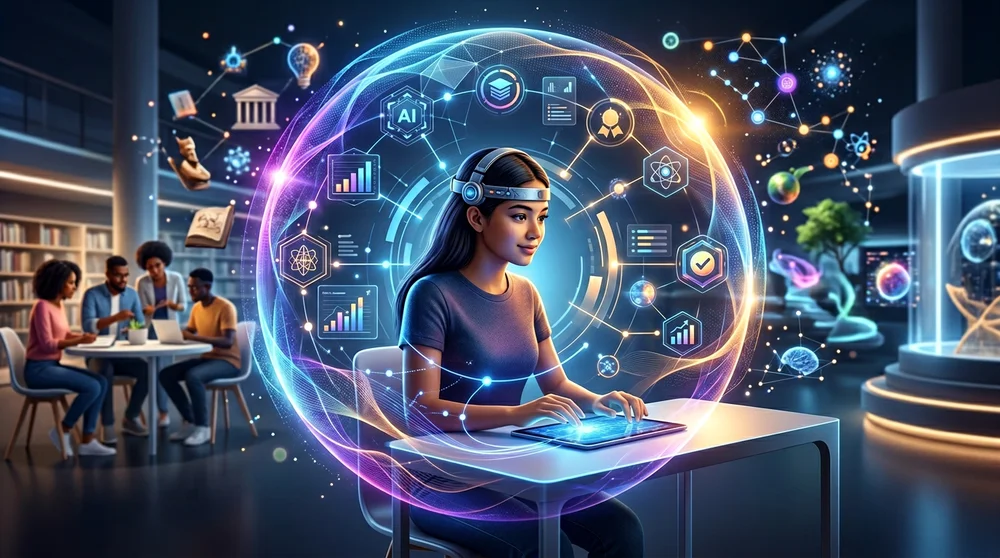
Imagine you are grappling with a complex macroeconomic theory, and suddenly, an AI tutor explains the entire concept perfectly by comparing it to the in-game economy of your favorite video game. Instantly, the confusion clears, the math clicks, and you feel a surge of academic confidence. This is the undeniable magic of modern education technology. But as we embrace these tools, are we inadvertently creating an educational filter bubble where every lesson is flawlessly translated into your personal comfort zone?
It is a provocative question that educators and cognitive scientists are just beginning to ask. As we rush toward a future where algorithms adapt pacing, content, and analogies to our exact preferences, we are bumping up against a profound paradox. Are we building highly accessible bridges to new knowledge, or are we inadvertently stranding learners on isolated cognitive islands?
While AI personalized learning offers incredible short-term benefits for initial comprehension, hyper-personalization carries a hidden cost. When learning becomes too frictionless, we risk trapping ourselves inside a digital echo chamber. Let's explore the delicate balance between the comfort of customized analogies and the long-term necessity of shared academic friction.
The Sweet Spot: Why AI Personalization is Booming
Let's be clear—AI-driven personalized learning is an extraordinary achievement that solves a very real historical problem. For centuries, traditional education systems have struggled to meet the highly individualized needs of diverse classrooms. Now, dynamic algorithms can analyze a student's real-time performance and adjust instructional delivery on the fly to prevent them from falling behind.
The measurable impacts of this technology show exactly why institutions are adopting it at breakneck speed. For instance, the Indian EdTech market is projected to surge from $12.75 billion in 2024 to a staggering $61.25 billion by 2035, reflecting a massive global appetite for tailored education. When students use personalized AI platforms, they actually want to learn more, with average daily engagement times increasing by an impressive 41.5%.
What this means for learners: Personalized learning paths act as the ultimate "on-ramp" for difficult subjects. By translating abstract, intimidating concepts into familiar contexts, AI immediately lowers your anxiety and boosts your motivation. However, the very mechanisms that capture your attention so effectively also harbor latent socio-cognitive risks that we need to talk about.
The Trap of the Educational Filter Bubble
We are well aware of how social media algorithms create echo chambers, feeding us content that perfectly aligns with our existing worldviews. As AI systems become highly proficient at tailoring educational content, they inadvertently risk creating a similar phenomenon: the educational filter bubble. In a learning context, this bubble limits your exposure to diverse perspectives, unfamiliar formats, and universal frameworks.
Education is fundamentally meant to be an expansive, social endeavor. If an AI perfectly curates your curriculum so you never encounter an analogy you don't instantly grasp, the system essentially acts as a gatekeeper against productive struggle. Over time, this kind of algorithmic coddling stifles interdisciplinary curiosity and isolates you from the broader academic community.
This leads to a dangerous state of "metaphorical isolation." If you exclusively learn physics through the lens of sports, you might ace your AI-generated quizzes. Yet, when you walk into a university lecture hall or a corporate boardroom, you will lack the standardized vocabulary necessary to communicate your brilliant ideas to others, potentially worsening feelings of social isolation.
Social Constructivism and the Loss of Shared Meaning
To really understand why metaphorical isolation is a problem, we need to look at how humans actually learn together. According to the theory of social constructivism, pioneered by Lev Vygotsky, learning is inherently a social process where knowledge is co-constructed through interactions with peers and experts. We learn best when we are forced to negotiate meaning with another human being.
Collaborative problem-solving relies heavily on a shared vocabulary, which builds shared situational awareness and allows groups to converge on a collective understanding. When an AI tutor perfectly adapts to your idiosyncratic language, it completely removes the necessity for you to negotiate that meaning. You are never forced to translate your personal, messy thoughts into a universal language that your peers can comprehend.
What this means for learners: If you prioritize frictionless AI interactions over human collaboration, you miss out on the relational aspects of education. The back-and-forth struggle of explaining a concept to a confused classmate isn't just a byproduct of learning; it is the primary driver of deep, retained comprehension.
Cognitive Flexibility: Preparing for an Unstructured World
The real world is messy, chaotic, and rarely aligns perfectly with our pre-existing schemas. This is where Cognitive Flexibility Theory (CFT) provides a crucial lens for understanding the limits of AI tutoring. According to CFT, acquiring advanced knowledge requires you to process unstructured, multifaceted information from overlapping perspectives.
To develop cognitive flexibility, you must actively grapple with complex, irregular domains where the "rules" aren't always clear-cut. A perfectly personalized AI tutor does the exact opposite. By continually serving you pre-digested, rigidly structured knowledge wrapped in comfortable analogies, it deprives your brain of the opportunity to practice abstraction.
If you only consume information mapped to your preferred learning style, your mental frameworks become rigid. You are effectively building a beautiful, comfortable cognitive island. But the moment you graduate and face a chaotic professional environment that doesn't cater to your learning style, you risk freezing up completely.
The Science of Desirable Difficulty
Modern EdTech platforms are heavily optimized for user engagement and satisfaction, operating on the flawed assumption that a seamless, frustration-free experience equals great learning. Cognitive science fiercely opposes this idea. True mastery actually requires "desirable difficulties"—intentional educational frictions that make initial learning feel more taxing but drastically improve long-term retention.
Techniques like spaced repetition, interleaving different subjects, and delaying feedback force your brain to struggle just a little bit. Letting a memory degrade slightly before forcing your mind to retrieve it creates the necessary mental friction to build robust, lasting neural pathways. Frustration is actually a biological indicator that your brain is upgrading its software.
Herein lies the paradox: the better an AI tutor gets at immediately correcting your errors or preemptively simplifying a text, the more it interferes with your natural thinking processes. By smoothing out all the academic friction to keep you happily clicking, AI tutors risk optimizing against the very struggle that causes deep learning to happen.
Real-World Case Studies: Finding the Balance
The risks of the educational filter bubble don't mean we should throw AI out of the classroom. Instead, we need to look at intelligent implementations that balance tailored support with necessary friction. Two excellent case studies highlight how this can be achieved in practice.
At UniDistance Suisse, psychology students used an AI tutor developed by MAGMA Learning. Instead of simplifying core academic content, the AI was explicitly programmed to implement desirable difficulty through personalized spaced repetition. The AI figured out exactly when to test the students to make them struggle productively, preserving the shared neuroanatomy vocabulary. Students who used it improved their academic ranking by up to 15 percentile points.
Similarly, a collaborative initiative between JA Worldwide and McKinsey produced "JA Pitch Master," a generative AI communication coach for young entrepreneurs. The AI provided hyper-personalized feedback, but it didn't rewrite students' pitches into localized slang to make them comfortable. Instead, it met them where they were and actively pushed them toward globally recognized standards of effective business communication, serving as a supportive on-ramp to universal standards.
A Learner's Playbook: Escaping the Cognitive Island
So, how do we use this incredible technology without isolating ourselves? The answer lies in intentionality. Modern learners and educators must adopt a strategic approach to AI that lowers the initial barrier to entry while deliberately returning to the shared friction of the real world.
- Strategic On-Ramping and Off-Ramping: Use AI's hyper-personalization to grasp intimidating concepts initially. If you need quantum mechanics explained through basketball, do it. But follow up with an intentional off-ramp. Prompt the AI: "Now explain this again using standard academic terminology, and tell me where the basketball metaphor breaks down."
- Demand Socratic Tutoring: Instead of asking an AI to generate answers, constrain it to act as a Socratic guide. Give it a prompt like, "You are a Socratic tutor. Do not give me direct answers; ask me guiding questions that force me to figure this out myself". This intentionally injects desirable difficulty back into your study sessions.
- Preserve Human Debate: Never let AI replace the fundamental human relationships at the core of education. Engage in debate, disagreement, and collaborative problem-solving with peers as often as possible. That messy human interaction is where you learn to translate your knowledge for the world.
What this means for learners: You are in control of your cognitive agency. By understanding that AI platforms often optimize for engagement over rigorous learning, you can consciously choose when to accept a helpful shortcut and when to demand a productive struggle.
Looking Ahead: Technology That Expands, Not Coddles
The advent of AI personalized learning is a monumental leap forward for educational accessibility. We finally have the tools to ensure that no student is left behind simply because a traditional lecture didn't resonate with their unique way of thinking. However, the promise of tailoring every lesson to our exact preferences carries a severe, hidden cost.
If we allow algorithms to entirely insulate us from academic friction and complex, unstructured problems, we will slowly erode the shared vocabulary required for collaborative human progress. Education is not merely about downloading facts; it is about building the cognitive flexibility to navigate a world that will never be perfectly customized for us.
Technology should expand human potential, not coddle it. By understanding the critical importance of desirable difficulty and shared human connection, we can use AI as a brilliant, bespoke on-ramp to difficult concepts. We must simply remember to eventually merge back onto the main highway, embracing the beautiful, shared friction of the real world.