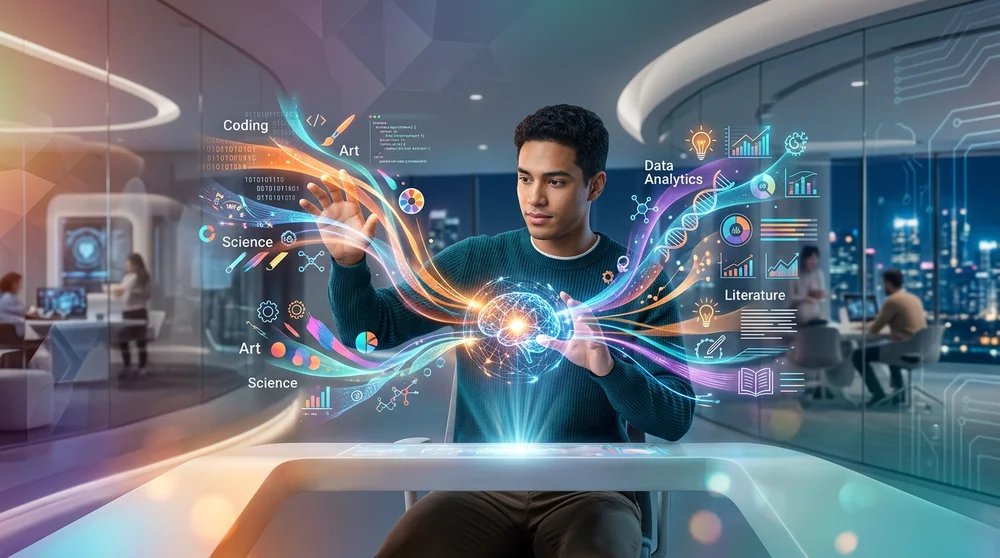
For generations, the defining question of almost every student’s and professional’s journey has been: "What should I major in?" It's a question that inherently forces us to pick a lane, build a silo, and commit to a single path of specialization. But as artificial intelligence reshapes the foundation of how we work and think, what if that's entirely the wrong question to be asking?
Historically, the global economy heavily rewarded the hyper-specialist. Deep, isolated expertise was the safest route to a secure career. Today, however, generative AI is forcing a radical recalibration of human value. If an algorithm can instantly access and apply the entirety of a specialized textbook, what happens to the professional whose entire value rests on memorizing it?
The answer isn't that human knowledge is obsolete. Rather, we are witnessing the rise of the AI polymath. The human competitive advantage is decisively shifting away from narrow execution and toward synthesis, adaptability, and cross-disciplinary learning. Let's explore why the future belongs not to the specialists who stay in their lane, but to the synthesizers who build bridges across them.
The Commoditization of the Hyper-Specialist
To understand where the labor market is heading, we have to look at the difference between codified and tacit knowledge. Codified knowledge is established information that can be documented, structured, and learned from a textbook. Tacit knowledge is experiential, deeply contextual, and rooted in human judgment. Artificial intelligence is exceptionally proficient at replicating codified knowledge, which means jobs relying heavily on established, textbook facts are increasingly vulnerable to automation.
We're already seeing this shift in the enterprise technology landscape. Companies are no longer just buying raw computing power; they are purchasing specialized, automated labor outcomes like accounting audits, legal document reviews, or baseline healthcare diagnostics. As AI subsumes these highly specialized execution tasks, organizations are flattening their hierarchical structures. Industry forecasts predict we'll see ecosystems where small teams of highly capable human workers orchestrate large fleets of AI agents.
What this means for learners:
- Your entry-level technical skills are no longer a protective moat.
- Developing strong judgment and tacit knowledge is just as critical as learning the theory.
- Your goal should shift from executing rote tasks to orchestrating complex workflows alongside AI.
Surviving "Wicked" Learning Environments
If AI is taking over specialized execution, where does that leave us? Cognitive science gives us a brilliant framework through the concepts of "kind" and "wicked" learning environments. Kind environments—like playing classical music or a game of chess—have clear rules, repeating patterns, and immediate, accurate feedback. Wicked environments are messy. They are characterized by ambiguity, fuzzy rules, and novel challenges where the exact same problem rarely presents itself twice.
Artificial intelligence is the ultimate hyper-specialist. It excels in kind environments where it can be trained on vast datasets of clear, repeatable patterns. Because AI handles the domain of the kind and the codified so efficiently, human ingenuity is disproportionately required in broad, wicked domains where creative problem-solving is paramount.
But before you assume that being a generalist is the ultimate safe haven, there's a catch. The baseline skills of the junior generalist—like summarizing basic research or formatting presentations—are also highly susceptible to automation. The competitive edge isn't just about knowing a little bit about everything. It's about problem framing: the ability to ask the right questions, understand complex systemic trade-offs, and blend human and machine intelligence to find a solution.
From T-Shaped to M-Shaped Thinkers
Because neither the pure specialist nor the superficial generalist is perfectly adapted to the AI-augmented workplace, our models for talent are evolving. For decades, the "T-shaped" professional was the gold standard: someone with deep expertise in one specific discipline (the vertical bar) alongside a broad ability to collaborate across others (the horizontal bar).
In an era of rapid technological disruption, the T-shaped model is proving insufficient. The future of work increasingly demands M-shaped professionals. These are polymathic individuals who cultivate multiple peaks of deep expertise seamlessly connected by meta-skills like curiosity, agility, and courage. They are multi-specialists who have the flexibility to translate knowledge into immediate impact.
We are even seeing the rise of the Sigma-shaped (Σ) practitioner. These are systems thinkers who excel at integration, synthesizing data across various feedback loops, and managing the ethical trade-offs of complex AI ecosystems. Top-tier corporate hiring practices reflect this shift, with leading consulting firms publicly prioritizing candidates who possess a high "tech quotient" and the ability to integrate advanced technology into overarching business strategies.
Combinatorial Creativity: Your Ultimate Human Differentiator
As AI takes over the execution of established knowledge, the highest premium is placed on genuinely novel ideas. This brings us to combinatorial creativity, which is the capacity to produce surprising and useful artifacts by systematically recombining familiar concepts in unfamiliar ways.
While Large Language Models (LLMs) are great brainstorming partners, rigorous evaluation shows they have fundamental limitations here. AI systems suffer from a persistent "novelty-utility tradeoff." They often face an "ideation-execution gap," meaning they might generate superficially novel ideas, but struggle profoundly to ensure the structural utility and practical feasibility of those concepts.
Because AI cannot autonomously generate structurally sound, highly novel combinations without degrading in utility, combinatorial creativity remains a distinctly human superpower. Breakthroughs almost always happen at the intersections of disparate fields—a space known as the "Adjacent Possible". High-agency generalists naturally cross these boundaries, importing methodologies from one field to solve entrenched problems in another, effectively translating context that AI simply cannot process on its own.
AI Tutors and the Future of Cross-Disciplinary Learning
Historically, the biggest barrier to becoming an M-shaped polymath was the sheer amount of time and money required to master multiple disciplines. Traditional universities enforced academic silos, making it structurally exhausting for a student of evolutionary biology to seamlessly integrate advanced macroeconomics.
Fortunately, AI learning trends are fundamentally changing this dynamic. Personalized AI learning agents are emerging as powerful tools capable of scaling hyper-personalized teaching to every individual learner. These autonomous systems can effectively act as "universal translators" between wildly different fields.
Imagine a software engineer who wants to understand complex user psychology. An AI tutor can instantly translate the specialized jargon of psychology into the native mental models of software engineering. This capability democratizes cross-disciplinary learning, empowering you to aggressively expand your skill set.
How to leverage this as a learner:
- Practice Serial Mastery: Don't try to learn everything at once. Dedicate focused seasons (6 to 18 months) to deeply learning one new pillar of expertise using personalized AI tools.
- Build Cognitive Bridges: Once you achieve foundational fluency, pivot to a new domain. Ask your AI tutor to explain the new topic using metaphors from your previous expertise.
- Curate a Library of Metaphors: Over time, these diverse pillars combine to form a vast mental library of structural insights that algorithms cannot organically replicate.
A New Framework: Synthesize, Don't Just Specialize
The core skills required for the global workforce are undergoing a massive transformation. Projections indicate that analytical thinking, adaptability, and cross-domain synthesis will be the fastest-growing professional demands by the end of the decade. Forward-thinking technology companies are already drafting job requirements that explicitly ask candidates to "Be Polymath Oriented," urging them to champion holistic systems thinking.
This means our foundational educational framework requires an urgent update. We must replace the outdated question of "What should I major in?" with a much more powerful one: "What disciplines can I uniquely synthesize?"
When you approach your education through this lens of "specialized generalism," you stop viewing AI as a crutch for passing a specialized exam. Instead, you start viewing it as an indispensable partner for exploring diverse curiosities. You build core technical competencies while aggressively expanding your breadth into adjacent, seemingly unrelated fields.
The Bigger Picture
The era of the hyper-specialist isn't entirely over, but its dominance as the only secure path forward has been permanently disrupted. As generative AI continues to commoditize narrow, textbook knowledge, the intellectual and economic premium is shifting toward humans who can navigate complexity, manage ambiguity, and connect disparate dots.
The rise of the AI polymath represents a return to a deeply human pursuit: the joy of combinatorial creativity. We finally have the personalized tools to transcend traditional academic silos and learn fluidly across boundaries. By embracing an M-shaped model of expertise, you have the unprecedented opportunity to become an adaptable, high-agency synthesizer. In a wicked and unpredictable world, it is the integrators, the translators, and the polymaths who will inevitably shape the future.