Have you ever sat in a classroom or a crowded video call, completely confused by the material being presented, yet found yourself nodding along anyway? If so, you are far from alone. For generations, traditional education has operated as a highly social arena. While this social dynamic is fantastic for collaboration, it inadvertently triggers a massive barrier to true comprehension: a lack of psychological safety in learning, driven by the deeply human fear of asking a "stupid" question.
When we are learning in front of others, we are acutely aware of how we are perceived. This awareness often breeds a quiet academic anxiety that causes us to conceal our confusion rather than risk public embarrassment. Over time, these small moments of silence accumulate, creating foundational knowledge gaps that can severely derail our educational journeys.
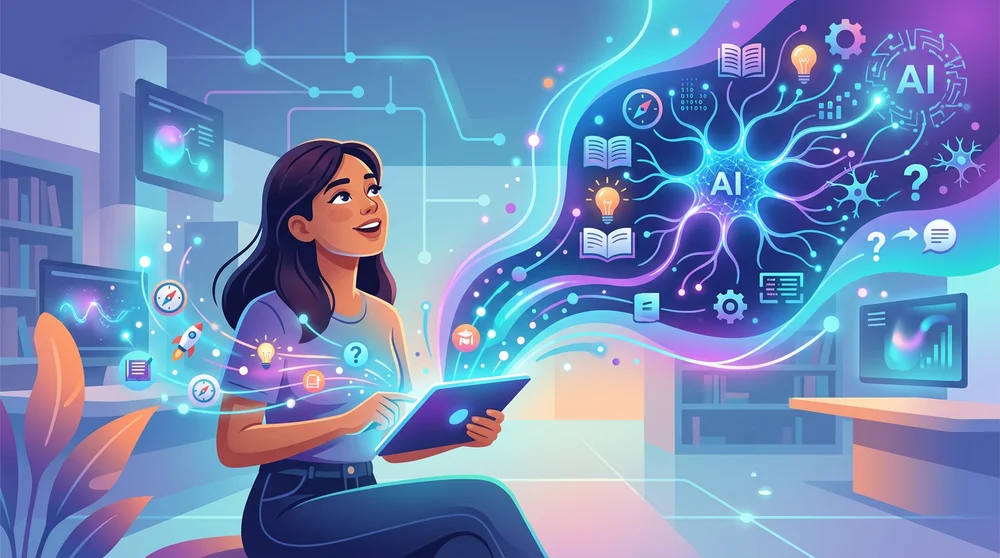
However, the recent integration of generative artificial intelligence into educational technology is offering a fascinating solution to this age-old problem. By replacing a human teacher with a machine for foundational questions, we are effectively removing the social stakes from the learning equation. AI tutors are granting learners the freedom to fail, to ask repetitive questions, and to expose what they do not know without penalty. It is a fundamental restructuring of how we study, paving the way for a new era of fearless learning.
The Hidden Cost of "Impression Management"
To truly appreciate how transformative AI can be for education, we first need to look at the psychological constraints of traditional learning environments. In any group setting, we naturally engage in what sociologists call "impression management." We want to shape how others perceive us, which usually means highlighting our achievements and hiding our struggles. In academic and professional settings, people frequently worry that asking a basic question will expose their ignorance and invite negative judgment from peers or instructors.
This fear of evaluation is a massive cognitive roadblock. It directly inhibits adaptive learning behaviors, like participating in class or simply raising a hand to say, "I don't understand." In fact, research examining language learners found that the "fear of asking questions" was the highest-rated anxiety factor, significantly correlating with poorer overall performance. We see the exact same pattern in STEM fields, where the apprehension associated with asking math and science questions decreases student motivation and lowers the likelihood of academic success.
What this means for learners: If you have ever felt paralyzed by the thought of asking for clarification, you are experiencing a systemic psychological barrier, not a personal failing. When placed in a public arena, our brains calculate that it is simply safer to remain silent. Unfortunately, this kicks off a cycle of academic shame where hidden gaps in our understanding compound over time, making future learning feel impossibly difficult.
Creating a Masterclass in Psychological Safety in Learning
So, how does technology fix a deeply human problem? By eliminating the audience entirely. In the late 1990s, organizational behavioral scientist Amy Edmondson introduced the concept of "psychological safety"—the shared belief that an environment is safe for interpersonal risk-taking. When we feel psychologically safe, we are more likely to speak up, share ideas, and admit mistakes without the fear of humiliation.
Fostering psychological safety in learning environments is incredibly difficult for human educators managing a room of thirty diverse students. AI tutors, however, mechanically simulate a flawless environment of psychological safety. An AI possesses a unique emotional strength: infinite patience combined with absolutely zero judgment. The AI will not sigh, roll its eyes, or show frustration if you ask it to explain fractions for the fifth time in a row. It simply recalculates and tries a new explanatory approach.
Language learning provides a brilliant illustration of this benefit in action. Language anxiety is a measurable, physical phenomenon where stressed learners enter a "fight-or-flight" mode. In this state, they produce less output, make more errors, and retain less information from corrections. By practicing with generative AI, learners remove the pressure of being evaluated by a native speaker. Recent data from Duolingo's AI roleplay features showed that learners experienced a 30% reduction in speaking hesitation after just five sessions with an AI interlocutor, alongside a 25% increase in self-rated confidence.
Real Results: Measuring AI Tutor Benefits
For decades, the holy grail of education has been solving Bloom's "2 Sigma Problem." In 1984, educational psychologist Benjamin Bloom demonstrated that students receiving one-on-one tutoring performed two standard deviations better than their peers in conventional classrooms. The problem was scalability; society simply could not afford to give every single student a personal, dedicated human tutor. Today, industry analysts point to generative AI as a viable, scalable solution to this historical bottleneck.
We are now seeing rigorous empirical research validating the immense AI tutor benefits that come from this personalized, judgment-free approach. A landmark 2025 randomized controlled trial conducted at Harvard University tested this directly within an introductory physics course. Researchers divided undergraduate students into two groups: one attending a traditional active learning classroom, and the other utilizing a specialized AI tutor.
The results were staggering. Students using the AI tutor achieved more than double the learning gains compared to those in the traditional classroom, and they did so while spending less time on the tasks. Furthermore, platforms like Khan Academy, which utilize AI to act as a Socratic guide rather than a simple answer-generator, are seeing similar behavioral shifts. Educators report that students who were previously too shy to speak up in class are now flourishing in these low-stakes, digital environments.
When we break down the data, the core AI tutor benefits for overcoming academic anxiety become clear:
- Adaptive Pacing: You are no longer held hostage by the speed of the group. You can linger on difficult concepts or accelerate through familiar ones.
- Judgment-Free Correction: Mistakes are immediately corrected in private, removing the social stigma of being "wrong."
- Infinite Iteration: You can ask the AI to explain a concept "like I'm a beginner" as many times as necessary until true comprehension clicks.
The Shift: From Defensive Studying to Fearless Learning
Ultimately, this technological intervention sparks a behavioral revolution in how we approach knowledge. In high-stakes, evaluative environments, students often adopt a posture of "defensive learning." This is an orientation toward avoiding failure rather than actively pursuing growth. When studying defensively, curiosity gives way to performance management. We study to appear competent to our teachers, rather than engaging deeply with the messy, confusing parts of the material.
When the social cost of confusion drops to zero, this defensive posture dissolves. We transition to fearless learning. This shift is particularly vital for adult and self-directed learners who may feel a mismatch between their age and their perceived knowledge levels. For years, an adult might hide a foundational gap in mathematics or writing due to the shame of admitting they do not know a basic concept. An AI tutor provides a private sanctuary to finally patch those gaps.
This private practice also prepares us for public success. The World Economic Forum emphasizes that a culture of psychological safety is essential for developing modern skills, as mistakes become valuable learning opportunities rather than career-limiting exposures. For example, generative AI is now being used to coach young people in highly anxiety-inducing skills like public speaking. Tools that provide a private space for students to test pitch presentations allow them to build resilience and receive actionable feedback before ever stepping in front of a human audience.
The Future of Fearless Education
It is important to clarify that the rise of artificial intelligence does not signal the end of human teaching. Human educators remain absolutely irreplaceable for emotional connection, long-term accountability, empathy, complex mentorship, and complex mentorship. A machine cannot inspire a student to discover their life's passion, nor can it provide the shared human context that makes learning truly meaningful.
However, AI excels at eradicating one of the most stubborn bottlenecks in the learning process: the psychological barrier of the stupid question. By offering a space characterized by absolute psychological safety and an absence of judgment, AI tutors free us from the exhausting task of managing how smart we look.
What this means for learners: You are now empowered to confront your own ignorance directly. You can use these tools to ask the questions you have been holding back for years. In this new paradigm, we are finally uncoupling the pursuit of knowledge from the fear of judgment, allowing all of us to learn a little more fearlessly.