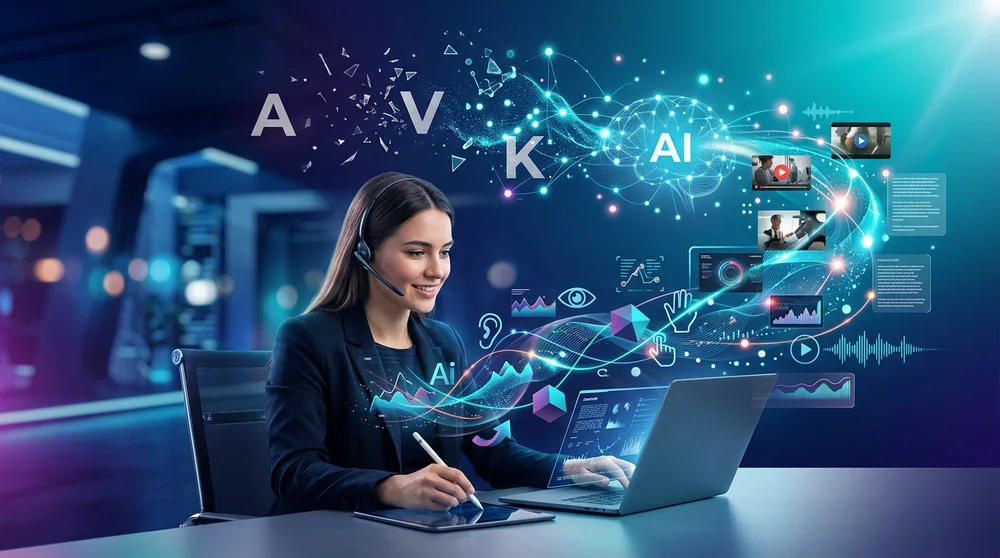
Have you ever labeled yourself a "visual learner" or claimed you just don't absorb information well by listening? If so, you're far from alone. As we explore the benefits of multimodal AI learning, we find that identifying a single "style" may be less effective than embracing new technological frameworks. For decades, we've been told that identifying our personal learning style is the secret key to unlocking our educational potential. But what if this widely accepted concept is actually holding you back?
The rapid evolution of artificial intelligence is fundamentally changing how we interact with information. We are no longer limited to static textbooks or one-size-fits-all lectures. Instead, we are entering an era of multimodal AI learning, where technology adapts to the material in real-time. This technological leap is finally driving a stake through the restrictive categories we've placed ourselves in, replacing them with a far more powerful and scientifically grounded concept: dynamic multimodality.
Let's explore why the way we think about learning is fundamentally flawed, and how modern AI is stepping in to train us to become more adaptable, robust thinkers.
Deconstructing the "Learning Styles" Neuromyth
The belief that individuals learn best when instruction is tailored to their preferred sensory modality—commonly known as the VARK model (Visual, Auditory, Reading/Writing, and Kinesthetic)—is one of the most deeply entrenched ideas in modern education. Surveys consistently demonstrate that 80% and 95% of educators in industrialized countries still believe in this concept. It feels incredibly intuitive to think that because you enjoy watching documentaries, you must be a visual learner.
However, an extensive body of cognitive science literature has categorically classified the learning styles myth as a "neuromyth"—a misconception about brain function that thrives despite overwhelming empirical refutation. When researchers analyzed dozens of studies focused on matching instructional styles to teaching methods, they uncovered an average effect size of 0.04, a statistical result that is essentially zero. Simply put, matching a lesson to your "style" does not improve your ability to comprehend or retain the material.
Crucially, holding onto this myth actively harms learners by creating artificial limitations. Categorizing a student as a "kinesthetic learner" frequently serves as an unintentional euphemism for ability grouping, inviting artificially low expectations. Research highlights that children, parents, and teachers often actively stereotype "visual learners" as smarter and more suited for academic rigor, while "hands-on learners" are viewed as less intellectual.
What this means for learners: When you abandon these self-imposed labels, you immediately expand your intellectual playground. You stop avoiding subjects or mediums that feel uncomfortable, and instead, you open the door to genuine cognitive flexibility.
The Shift to Dynamic Multimodality
The emergence of multimodal generative AI is fundamentally dismantling the old frameworks by introducing dynamic multimodality. Unlike early AI tools that processed only a single data type (like a text-only chatbot), advanced multimodal AI models are capable of processing, integrating, and generating text, images, audio, and interactive code all at the same time.
This technology closely mirrors human perception. We don't process the real world through isolated sensory channels; we synthesize visual, auditory, and linguistic data simultaneously to form a complete understanding of our environment. Educational intelligence data shows a massive 420% surge in multimodal AI adoption in learning environments since 2022, signaling a rapid shift away from static content.
By leveraging these systems, self-guided learners and educators can transition from a rigid, text-heavy paradigm to a fluid ecosystem. Content can now morph instantly to meet the immediate cognitive demands of the user, creating a deeply personalized and immersive educational experience.
Let the Subject Matter Dictate the Medium
The most transformative aspect of dynamic multimodality is its potential to end the debate between catering to what a learner prefers versus challenging them with what the material demands. The learning styles myth falls apart when tested against logical constraints. If you are trying to learn a physical dance, a piece of music, or the spatial geometry of a molecule, your "preferred" modality is irrelevant. The subject matter itself inherently dictates the optimal instructional mode.
Generative AI resolves this friction by acting as an intelligent translational engine. Rather than permanently labeling a student and forcing all content through one sensory bottleneck, AI dynamically adjusts the modality to fit both the micro-context of the topic and the macro-context of your current comprehension level.
Imagine you are grappling with advanced physics and struggling with a dense textual explanation. Rather than concluding you "just aren't a reading learner," an AI tutor can instantly generate an interactive, Python-coded spatial simulation of the physics concept, allowing you to manipulate variables visually. Once you grasp the fundamental mechanics, the AI can seamlessly shift you into a text-based debate to explore the history of the discovery, and finally generate a natural-sounding audio podcast for your commute.
What this means for learners: This fluid morphing ensures you are exposed to the optimal format for the specific cognitive task at hand. It forces you to practice engaging with information through various channels, systematically breaking down the psychological barriers you may have built around your assumed learning weaknesses.
Backed by Brain Science: Dual Coding and Cognitive Load
The efficacy of dynamic multimodality isn't just an exciting tech theory; it is firmly rooted in established cognitive science, most notably Dual Coding Theory. This theory asserts that the human brain utilizes two distinct, non-competitive subsystems to process information: a verbal system for processing linguistic text and speech, and an imaginal system for handling non-verbal, spatial, and visual information.
These channels function independently but additively. When an AI system simultaneously presents a clear verbal explanation alongside a dynamically generated, relevant visual diagram, it forces your brain to create two separate but interlinked memory traces. The results of applying this correctly are staggering. In corporate learning and development environments, transitioning from unimodal text to dual-coded multimodal design lifted 30-day knowledge retention from a baseline of 20-30% to an impressive 70-80%.
However, AI must be applied with pedagogical discipline to manage your brain's cognitive load. If AI is used to generate flashy but irrelevant images, it overloads your working memory and actually damages comprehension. The goal of multimodal AI learning isn't to bombard you with sensory input, but to synchronize visual and verbal channels seamlessly, removing extraneous content and highlighting key features so your brain can process complex ideas without burning out.
Real-World Results: Multimodal AI Learning in Action
The theoretical promise of dynamic multimodality is already being realized through extensive implementations across varied educational tiers. We are seeing incredible results when AI is allowed to stretch beyond simple text generation.
- Interactive Reading: Researchers recently tested an experimental AI-powered platform that automatically generated multimodal variations of source texts. Grounded in Dual Coding Theory, the system allowed students to explore content through diverse, AI-generated interactive formats. Efficacy studies demonstrated that students utilizing this dynamic multimodality scored 11 percentage points higher on retention tests than control groups using standard digital readers.
- Spatial Reasoning: At the Massachusetts Institute of Technology (MIT), researchers identified that traditional AI tutors fail at calculus and geometry because they rely exclusively on text-based feedback. To solve this, they developed an interactive sketchpad built on a large multimodal model. Students can draw, annotate, and visually collaborate with the AI, proving that spatial and mathematical reasoning requires multimodal interventions.
- Cyber-Social Learning: A recent study involving 198 undergraduate students demonstrated the power of multimodal AI in complex, creative problem-solving. By synthesizing text, image, and audio generation, students engaged in collaborative partnerships where they evaluated and reimagined AI outputs across multiple sensory modes, breaking down initial comprehension barriers.
- Scaling Personalization: Another higher education study involving fourth-year students confirmed that AI-enhanced multimodal frameworks allow educators to scale varied content formats without overburdening themselves. The technology acts as a central engine for adapting content to the subject's needs, rather than replacing the human educator.
Building Robust, Adaptable Thinkers
The ultimate promise of multimodal AI is not merely that it adapts to how we learn, but that it trains us to become better, more versatile learners. To practically adopt this mindset shift, we have to consciously abandon the "learning styles" vocabulary and change how we prompt our AI tools.
First, utilize AI not to cater to your comfort zones, but to deliberately practice cognitive flexibility. Cognitive flexibility is the mental ability to switch between thinking about two different concepts or to process multiple streams of varying information simultaneously. If you historically avoid data-heavy subjects because you "aren't a numbers person," prompt an AI to synthesize the raw data into an audio-narrated infographic first. Over time, gradually adjust the AI's output back to complex text to build the cognitive muscle you previously avoided.
Second, we must learn to prompt AI for "content-first" multimodality. Instead of asking ChatGPT, "How do I teach this to a visual learner?", your prompt should be, "What is the optimal combination of modalities to explain the Krebs cycle?" Multimodal AI can instantly generate the necessary cross-modal assets—a 3D rendering, a step-by-step text breakdown, and an auditory mnemonic—creating a unified learning experience exactly suited to the biology itself.
What this means for learners: You are in the driver's seat of your own cognitive development. By using AI as a scaffolding tool, you can train your brain to tackle complex subjects across any medium, making you a highly adaptable thinker in a rapidly changing world.
The Future of Human Cognition
By laying the learning styles myth to rest, we remove arbitrary ceilings on human potential. We are not just visual, auditory, or kinesthetic learners; we are inherently multisensory beings capable of immense cognitive flexibility when provided with the right translational tools.
Dynamic multimodality, powered by advanced generative AI, embraces the true complexity of how our minds actually work. It challenges the outdated idea that education should cater to our perceived weaknesses. Instead, as AI continues to evolve, it will serve as the ultimate cognitive scaffold. It won't just feed us information in the way we find most comfortable; it will push us, challenge us, and ultimately train us to become robust, adaptable thinkers capable of mastering any discipline we choose to pursue.