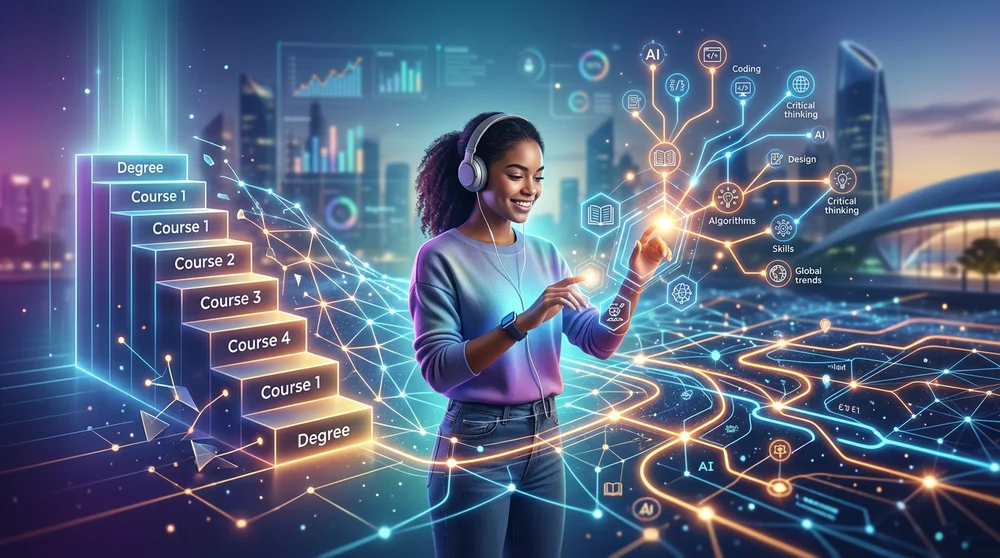
Have you ever been blocked from exploring a topic you were truly passionate about simply because you didn't have the right prerequisite? For centuries, we've accepted a fundamental rule of education: learning is a ladder. You absolutely must master algebra before you're allowed to touch calculus, and you have to sit through Course 101 before anyone lets you near Course 201. It sounds logical at first glance, but this rigid, linear progression was actually designed for institutional scale and administrative convenience, not for the way the human brain naturally acquires knowledge.
The reality is that human curiosity doesn't move in a straight line. We learn by association, by tackling real-world problems, and by seeking out the context that makes information matter. When we force learners into disconnected, highly theoretical foundations without showing them the end goal, they get bored. When we block them from advanced exploration with arbitrary hurdles, they get frustrated. But what if we've had it backward all along?
Today, education is undergoing a massive, structural inversion. By acting as an adaptive, context-aware guide, artificial intelligence is allowing us to take a top-down approach to knowledge acquisition. Students can now start with complex, real-world challenges—like coding a website or analyzing global economic trends—and drill down into the foundational concepts dynamically, exactly when the context demands it. We are officially entering the era of non-linear learning, and it’s about to change how we approach education at every stage of life.
The Collapse of the Learning Pyramid
If you've ever studied instructional design, you're likely familiar with Bloom's Taxonomy. It's often visualized as a "Learning Pyramid" where foundational skills sit at the bottom and creative skills sit at the top. The traditional consensus told us that learners had to slowly progress upward: first rote memorization, then comprehension, application, analysis, synthesis, and finally, creative generation. Institutional credentialing relies heavily on this model, dictating that creative work is a privilege earned only after years of foundational study.
Generative AI is actively collapsing this legacy model. Rather than building slowly from memorization to mastery, modern learners are now able to leap directly to high-level tasks. A high school student can generate a persuasive essay on quantum mechanics without knowing the Schrödinger equation, and a junior analyst can write Python code for sentiment analysis without deeply understanding the underlying natural language processing algorithms. This shift toward "top-down learning" means that, for the first time in history, creative generation can actually precede foundational comprehension.
Top-down learning works by starting with the largest concept or the most exciting application. From that high-level perspective, the learner dissects the topic into smaller, manageable parts as they go. It's an incredibly engaging way to study because you see the immediate, real-world utility of your work, which is highly motivating for those who need a tangible end-goal to stay focused. We are already seeing experts advocate for this approach in complex fields; researchers like Jeremy Howard champion top-down learning in machine learning, arguing that forcing students to master advanced calculus before they can train a practical neural network is fundamentally counterproductive.
This isn't just an academic theory; it's actively reshaping workforce development. While corporate AI learning is often pushed top-down by leadership, industries like manufacturing are seeing adoption happen organically from the bottom-up. Frontline workers are bypassing rigid prerequisites to build applied, contextual capabilities that solve their immediate workflow problems. When we empower learners to jump straight to the application, they successfully embed learning directly into productive, real-world tasks.
The Paradox of "Swiss Cheese" Learning
Whenever you mention non-linear learning to traditionalists, you'll hear the same critique: "Won't this create massive gaps in a student's knowledge?" This is known as "Swiss cheese learning," a scenario where a student moves through a curriculum missing fundamental skills and attitudes. While these holes might not seem disastrous at first, they eventually cause the learner's academic foundation to collapse as they attempt more advanced material. It’s a valid concern, but a deeper analysis reveals a profound irony.
The traditional, time-based education model is actually the primary engine of Swiss cheese learning. In a conventional classroom, a class moves on to Chapter 3 based on the academic calendar, completely regardless of whether a student actually understood Chapter 2. This time-based progression pushes content far too fast for many individuals, resulting in a fragile, incomplete foundation. Educational theorists like Sal Khan have pointed out that forcing students forward before they achieve mastery causes missing prerequisite knowledge to accumulate, leading to widespread frustration and eventual failure.
Instead of causing knowledge gaps, AI-driven, non-linear learning actively repairs them by transitioning us from "seat time" to true mastery-based progression. Mastery learning ensures that a student doesn't advance until they have demonstrated real competence. Historically, doing this at an institutional scale was impossible—a single teacher simply couldn't manually track and remediate the unique knowledge gaps of thirty different students at once. Now, however, AI serves as an invisible safety net that tracks multiple streams of a student's cognitive process.
If a student skipping ahead in a non-linear path hits a concept they don't understand, the AI immediately detects the gap through continuous assessment and dynamically loops them back to the necessary foundational skill. It ensures every hole in the "Swiss cheese" is filled before they move forward, providing a level of foundational rigor that a traditional classroom simply cannot match.
How Adaptive Learning Paths Guide the Way
The core mechanism making all of this possible is the adaptive learning path. Adaptive learning uses computer algorithms to orchestrate a custom interaction with a learner, delivering resources that specifically address their unique cognitive needs in real time. This isn't just a digitized textbook; a truly personalized AI tutor relies on sophisticated machine learning to process vast amounts of data about a learner's performance, preferences, and long-term goals.
As you interact with an intelligent platform, the AI quietly tracks your response times, notes recurring mistakes, and gauges your depth of understanding. Based on this continuous stream of data, the system adjusts the difficulty, pacing, and sequence of your content automatically. When you demonstrate strong ability, the AI increases the challenge to keep you engaged. When confusion appears, it seamlessly slows down to provide targeted, structured support.
The empirical outcomes of these AI-driven adaptive learning paths are staggering. Recent research shows that academic performance increased in 59% of adaptive learning studies. Furthermore, general learning outcomes improved by an impressive 40% when students used personalized paths. By shifting from a course-centric to a learner-centric model, AI is creating a truly customized educational experience at internet scale.
We are already seeing a massive behavioral shift among learners. Recent data indicates that 67% of middle and high school students in the United States currently utilize AI tools for educational support. The best of these systems go far beyond providing instant answers; they replicate the features of high-quality human tutoring by offering clear explanations, immediate feedback, and meaningful interaction. Because the AI continuously re-evaluates progress and re-routes the curriculum, it perfectly balances the freedom of non-linear exploration with the necessity of academic rigor.
Real-World Proof: Classrooms Already Making the Shift
The theoretical benefits of AI-unlocked non-linear learning are currently being tested—and validated—in real-world environments globally. These case studies prove that adaptive algorithms can successfully replace static syllabi.
Take Alpha School, a U.S.-based "microschool" network that provides one of the most fully realized models of individualized, AI-powered learning. Students at Alpha complete their core academics in just two hours a day using an AI-driven, app-based learning system. Because the AI accounts for a child’s specific knowledge and interest graphs, it feeds them a continuous stream of highly relevant questions. This hyper-personalization allows students to learn up to ten times faster than they would in traditional settings. Alumni note that this approach isn't a shortcut; it acts as the "ultimate equalizer" that pressure-tests logic and supercharges deep learning.
To test how generative AI functions in traditional, large-scale classrooms, researchers conducted a randomized controlled trial within Uruguay's Ceibal program, integrating a GenAI chatbot into a computational-thinking curriculum. Interestingly, the study found that without structured guidance, AI use patterns were not neutral and actually risked reinforcing existing inequalities. However, when educators explicitly structured the AI for explanation, feedback, and teacher mediation, the program proved that deliberate, adaptive design heightens inclusion and equity.
Rigorous analyses by the Brookings Institution further validate these findings. Their review of randomized controlled trials suggests that AI systems can effectively perform core pedagogical functions traditionally handled by human experts. The key to their success is employing pedagogies that "teach, not tell"—using Socratic questioning to guide students to identify their own mistakes. This highly scaffolded approach ensures that as students explore non-linearly, the personalized AI tutor carefully manages their cognitive load, breaking complex issues into digestible components.
Actionable Insights: Empowering the Modern Learner
Moving from a linear educational ladder to a dynamic, AI-navigated web requires a fundamental mindset shift. The theoretical framework of Connectivism provides a great lens for this transition. It argues that in the digital age, knowledge isn't built in isolation inside one person's head; it's distributed across dynamic, collaborative networks. By embracing this, learners can finally break free from static syllabi.
If you want to practically leverage AI for non-linear learning—whether for yourself, your employees, or your students—here are a few actionable ways to start:
- Invert the Learning Process: Start with a highly motivating, complex end-goal. Try analyzing a massive dataset or building a software application on day one. When you inevitably hit a cognitive wall, ask your personalized AI tutor to explain specific foundational concepts (e.g., "Explain the statistical variance needed for this dataset as if I am a beginner"). This gives you immediate, contextual motivation.
- Design for Mastery, Not Time: Educators and managers must reverse-engineer expertise into measurable skills. Establish a clear "Mastery Plan" that allows learners to explore topics non-linearly, using AI assessments to verify competency before they progress. This officially eliminates the "Swiss cheese" effect.
- Utilize Socratic Prompting: Effective learning requires productive struggle. Don't let your AI just hand you answers. Instruct your AI to act as a Socratic guide with prompts like, "Pressure test my logic," or "Find the flaws in my argument." This forces iterative refinement rather than passive consumption.
- Embrace Multi-Layered Verification: To ease traditionalist fears about unearned competence, institutions need to layer their assessments. A single AI-detection tool isn't enough. Demand process-based assessments, oral explanations, and documented AI-usage transparency to verify that the non-linear journey actually resulted in deep comprehension.
Non-Linear Learning: The Shift from Ladder to Web
The era of the rigid, linear prerequisite is drawing to a close. For generations, our education systems forced learners along a static path, sacrificing individual curiosity and personal pacing for the sake of institutional efficiency. Generative AI is dismantling this factory model, proving once and for all that human learning doesn't have to be a ladder—it can be an expansive, interconnected web.
By stepping into the role of an adaptive, personalized AI tutor, AI empowers us to take a top-down approach, engaging with complex, exciting, and real-world applications immediately. Simultaneously, these intelligent algorithms resolve the historical vulnerabilities of exploring out of order. By continuously mapping our competency, dynamically adjusting difficulty, and demanding true mastery over mere seat time, AI ensures our foundational knowledge is stronger than ever.
Ultimately, this isn't about replacing human educators or diminishing the value of foundational knowledge. It is about reorganizing how we access that knowledge. When we allow AI to handle the bureaucratic tracking of individual mastery, we free up human energy for deep connection, mentorship, and creative application. The prerequisite isn't dead; it's just been reimagined, arriving exactly when the learner is finally ready to understand why it matters.