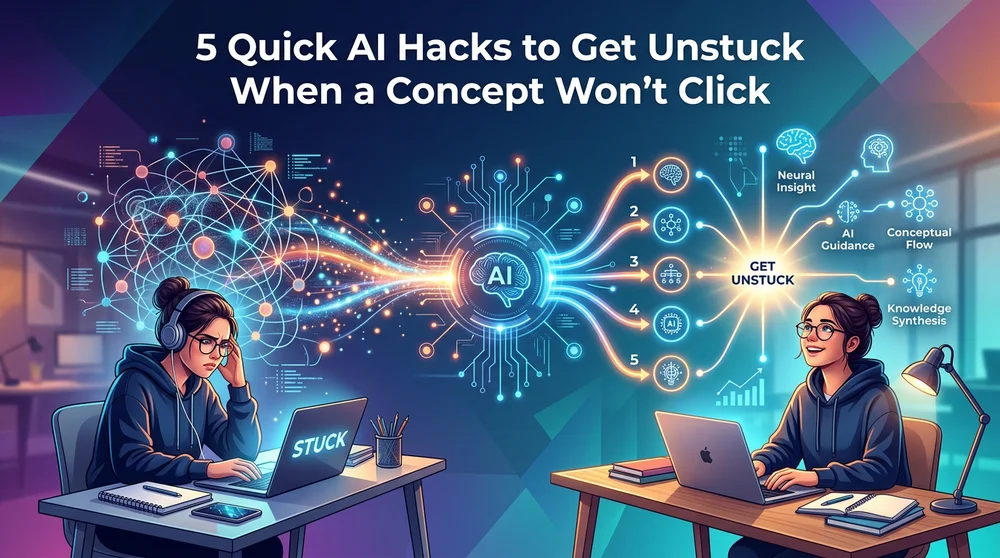
We've all been there—staring at a textbook or screen, waiting for a complex concept to finally make sense. In the past, getting stuck meant waiting days for office hours, but today, savvy students use AI study hacks to bridge the gap. Today, we have generative AI at our fingertips. But here is the catch: just asking an AI for the answer can actually hurt your long-term progress. In fact, research shows that using "unguarded" AI as a cognitive crutch can lead to a 17% drop in final exam performance.
However, when you use specific AI study hacks to turn that chatbot into a Socratic tutor, learning outcomes can soar by up to 30%. The secret lies entirely in how you frame your questions. Let's look at five practical ways to use targeted AI learning prompts to finally overcome learning blocks without losing your intellectual edge.
1. Identify Failures with AI Study Hacks
When a topic refuses to click, it is usually because one specific link in your mental chain is broken. Instead of asking the AI to explain the entire concept from scratch, give it your exact thought process and ask it to find the weak link.
Try a prompt like: "I am trying to understand [Concept], but I am stuck. Here is my step-by-step understanding so far: [Insert explanation]. Act as a Socratic tutor. Do not give me the final answer, but identify exactly where my logic breaks down and ask me one guiding question to help me fix it."
The key takeaway: By forcing the AI to pinpoint your exact misconception, you do the heavy lifting required for true comprehension instead of just reading a generic summary.
2. Try a 'Rubber Duck' Interrogation
Programmers have long used "rubber duck debugging"—explaining broken code line-by-line to an inanimate object to spot logical flaws. Harvard University successfully adapted this for their computer science students, using an AI "duck" to answer hundreds of thousands of questions by guiding students rather than just giving them the code.
You can replicate this by telling the AI: "I am going to explain [Concept] to you exactly as I understand it. Act as a critical listener. Say nothing except 'Go on' unless you spot a factual error or a leap in my logic. If you spot one, stop me and ask me to clarify."
The key takeaway: Explaining a concept out loud (or in text) forces active recall, while the AI acts as a real-time auditor to keep your reasoning on track.
3. Use the 'Different Lens' Approach
Human brains thrive on analogies. If an academic definition feels like an impenetrable wall of jargon, try translating it into a framework you already understand intimately.
Tell your AI: "I am struggling with [Abstract Concept]. Please explain it using an analogy based on [your specific hobby, e.g., baking, rock climbing, or video game mechanics]. Map the academic components directly to the elements of my hobby."
The key takeaway: Connecting new, abstract information to familiar, existing knowledge dramatically lowers the cognitive load required to understand it.
4. Ask for 'Anti-Examples'
Sometimes the best way to understand what something is involves looking closely at what it isn't. Cognitive science shows that defining the strict boundaries of a concept helps clear up deep-seated misconceptions.
Use this prompt: "I am confused about the exact definition of [Concept]. Provide three 'Anti-Examples'—things that seem like they should fit the concept but actually do not. Explain exactly why they fail the criteria."
The key takeaway: Exploring contrasting cases helps you grasp the nuanced differences that standard textbook definitions often miss.
5. Execute a 'Granular Step-Back'
Are you completely lost? Often, a learning block happens because you're missing a foundational piece of the puzzle. You can't build the roof if the walls aren't up yet.
Prompt the AI with: "I don't understand [Advanced Concept], and I suspect I am missing foundational knowledge. Break this concept down into its three most basic prerequisite concepts. Test my knowledge on the first one with a simple question before we move forward."
The key takeaway: Stripping away complexity and testing foundational knowledge ensures your basic mental architecture is secure before tackling advanced ideas.
The ultimate goal of using AI in your studies isn't to find shortcuts, but to build a personalized environment where you can struggle productively. When you shift your mindset from treating AI as an answer machine to treating it as a conversational sounding board, you reclaim your intellectual agency. In a world where immediate answers are cheap, the real educational advantage belongs to the learners who know how to ask the right questions.