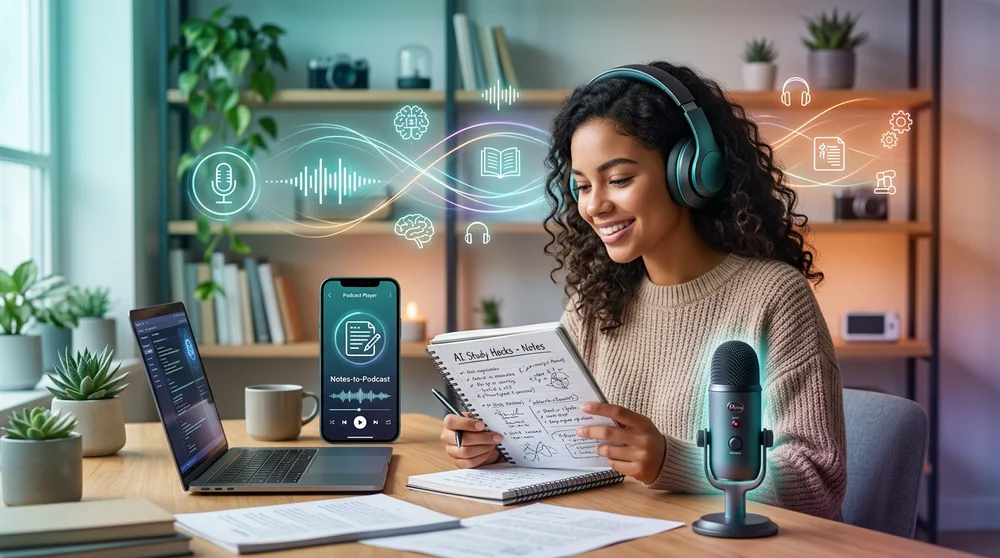
We've all been there—staring at a glowing screen until the words blur together and nothing seems to stick. Screen fatigue is a massive hurdle in modern education, leading to digital exhaustion that actually hinders memory formation. However, using an AI study podcast allows you to step away from the monitor and still get your work done.
That's exactly where text-to-audio AI comes in. Research shows that auditory learning is incredibly effective, allowing many people to absorb and retain complex information completely hands-free. By transforming your written notes into a customized AI study podcast, you can turn passive reading into an active, engaging experience. Here are five practical hacks to help you ditch the screen and study smarter.
1. Create a Conversational AI Study Podcast Script
Nobody wants to listen to a robotic voice drone on for an hour. Instead, prompt your AI tool to rewrite your notes as a dynamic, back-and-forth conversation between two podcast hosts. Listening to an explanatory conversation activates both language comprehension and social cognition circuits in your brain, creating much stronger memories than standard monotone audio.
To make this incredibly effective, instruct the AI to include natural disfluencies like "um," "ah," and casual banter. By adding conversational filler, you help the audio sound convincingly human, which keeps you engaged and prevents tuning out. It tricks your brain into feeling like you're eavesdropping on a fascinating chat rather than studying for a difficult exam.
2. Create Bite-Sized Commute Summaries
You don't need to tackle all your notes at once. Use your AI tool to condense your weekly lectures into short, 5-to-15-minute daily audio summaries. This perfectly sets you up for spaced repetition, a proven cognitive science technique where you revisit material at gradually increasing intervals.
Listening to these short summaries during your daily commute or while doing chores can boost your long-term knowledge retention by up to 200% compared to traditional cramming. You're essentially reclaiming "dead time" in your day for an effortless auditory review session, all without adding a single minute of screen time to your cognitive load.
3. Interview Your AI Tutor
Podcasts don't have to be a one-way street. You can turn a passive listening session into an active learning environment by using voice-to-text features to verbally spar with an AI tutor. Have the AI act as an expert or examiner and engage in a Socratic dialogue, where it asks you probing questions about your study material.
Verbally explaining complex concepts out loud forces you to actively recall information and instantly highlights any gaps in your knowledge. You can even record and transcribe the AI's spoken feedback to add to your study materials later, making this a highly personalized, screen-free study asset.
4. Turn Complex Formulas Into Catchy Jingles
Remember how easily you learned the alphabet song? Your brain has a natural affinity for rhythm and melody. You can prompt your AI to synthesize abstract information, historical dates, or complex scientific formulas into short rhymes or auditory mnemonics.
The brain encodes rhythmic information differently than plain text, linking the data straight to emotional and auditory recall centers. By transforming dry facts into a catchy audio jingle, you can bypass the friction of rote memorization and improve your recall rates by up to 80%. It might feel a bit silly at first, but you'll be thankful when that catchy tune pops into your head during a test.
5. Format Your Text for the Perfect Audio Delivery
Before feeding your notes into an AI generator, do a quick text cleanup. Text-to-speech engines rely on clear formatting to understand how to read the information accurately. Remove messy bullet points, fix weird PDF line breaks, and clearly define your hierarchical headers so the AI understands the structure.
If you want to get advanced, look into Speech Synthesis Markup Language (SSML). Using SSML allows you to insert specific pause commands and emphasize certain words, ensuring your AI delivers crucial exam concepts with the exact vocal weight a human professor would use. A little prep work ensures your final audio is polished, accurate, and easy to digest.
Generative AI is a brilliant tool, but it still requires your strategic input to truly shine. By intentionally shifting toward auditory learning, we aren't just hacking our study schedules; we're fundamentally reshaping how we interact with information. When we align our technology with the way our brains naturally want to process the world, education becomes less of a chore and much more of an everyday conversation.