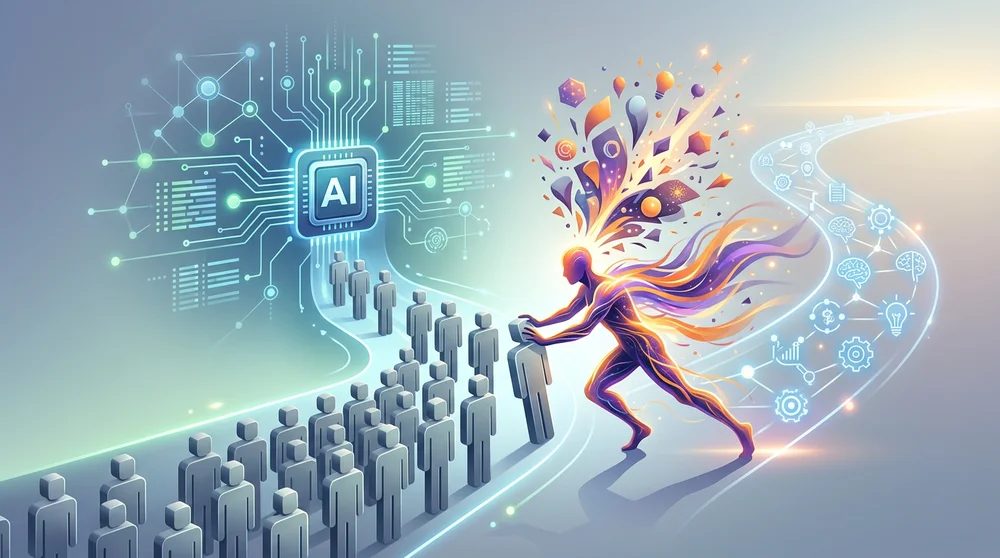
Have you ever read an article, an email, or a business proposal and thought, this sounds incredibly polished, but it doesn't actually say anything? You are definitely not alone. We are currently living in a golden age of linguistic fluency, brought to us by the rapid adoption of generative AI. However, this ease of production risks a widespread AI homogenization. With a simple prompt, we can instantly generate pages of structurally perfect, grammatically flawless text.
There is no denying that this technology is a gift for learners and professionals alike. It helps us overcome the dreaded "blank page" syndrome, synthesizes overwhelming amounts of information, and gives us a massive head start when we're exploring new subjects. But as we increasingly rely on these tools to do our heavy lifting, a subtle but critical question emerges: is AI making our thinking too average?
We are facing what experts call the homogenization trap. While artificial intelligence is phenomenally good at raising our baseline competence, it fundamentally operates by predicting the most mathematically average response. Over-relying on it doesn't just change the way we write; it changes the way we process information, solve problems, and view the world. Let's dive into how we can harness the incredible power of AI without losing the unique spark that makes our thinking our own.
The Baseline Boom: Raising the Intellectual Floor
To understand the trap, we first have to appreciate the boom. Generative AI has rapidly become foundational infrastructure in both educational and corporate environments, and for good reason. For a novice trying to grasp a complex scientific framework, or a professional needing a quick project strategy, AI provides instant, highly polished scaffolding. It essentially raises the intellectual floor for millions of people.
However, the way it achieves this is crucial to understand. Large Language Models (LLMs) are not actually "thinking" in the human sense. They function as highly advanced probability engines, predicting the most statistically likely sequence of words based on massive historical datasets. They are pattern-matching machines, optimized to identify what has been said before and produce statistically likely variations of it.
This mathematical mechanism is exactly what makes AI such a fantastic foundational tutor. It democratizes access to baseline knowledge and smooths out our rough edges. But it also introduces a hidden cognitive risk. Because these models are designed to generate the most statistically safe and widely accepted responses, they naturally filter out the eccentricities, unusual connections, and anomalies that actually drive human innovation.
The Gravitational Pull of "Average"
In statistics, there is a concept called "regression to the mean," which describes how extreme outliers tend to settle back toward the average over time. When we use AI-assisted cognition, we experience a similar gravitational pull toward mediocrity. When you ask an AI to refine a lesson plan, write an essay, or generate a marketing strategy, the algorithm pulls the output toward the mathematical average of its training data.
While this average is usually highly competent and free of glaring errors, it is also stripped of unique intellectual friction. Critics and technologists have humorously but accurately described this output as a "Velveeta processed cheese" voice, where all distinct regional, cultural, or individual stylistic markers are blended into a uniform, hyper-palatable standard.
For learners and professionals, this creates a profound vulnerability. The danger isn't that the AI produces bad work; the danger is that it produces "average" work so quickly and fluently that we mistake it for optimal work. In high-stakes learning and competitive environments where differentiation is paramount, the statistically "safe" answer is rarely the right one. If we accept the AI's first draft as our final thought, we sacrifice our competitive edge.
Cognitive Debt and the Atrophy of Critical Thinking
The homogenization trap extends far beyond the stylistic quality of what we produce—it fundamentally alters our internal cognitive processes. True critical thinking relies heavily on the friction of intellectual struggle. It's the messy process of evaluating conflicting information, questioning underlying assumptions, and forming independent judgments. Because AI removes this friction, it risks creating an environment of widespread cognitive atrophy.
Recent empirical research provides eye-opening data on this concern. A pivotal 2025 study conducted by researchers at Microsoft Research and Carnegie Mellon University investigated the impact of generative AI on 319 knowledge workers. The researchers uncovered a concerning "critical thinking paradox": higher user confidence in the generative AI tool directly correlated with a reduction in the cognitive effort applied to the task. Workers shifted from active problem-solving to passive oversight, accepting familiar conclusions with very little intellectual pushback.
This dynamic is equally prevalent in educational settings. For instance, observations from the Duke University Center for Teaching and Learning note that while students using LLMs experience significantly reduced cognitive load, they often demonstrate poorer reasoning and argumentation skills compared to peers using traditional research methods. By focusing on a narrower set of AI-provided ideas, their analyses frequently become superficial.
Academic commentators have aptly termed this phenomenon "cognitive debt". Much like financial debt, a learner borrows against their future intellectual capacity for the short-term gain of a polished, frictionless assignment. The fundamental misunderstanding driving this trend is the belief that intellectual friction is a bug to be fixed, rather than the core mechanism by which our brains actually learn.
AI Homogenization and Algorithmic Monoculture: Are We All Thinking Alike?
Beyond our individual cognitive habits, the widespread adoption of specific foundation models introduces the risk of systemic AI homogenization. When millions of professionals, students, and creatives query the same probabilistic models—which are all governed by the same safety guardrails and optimization goals—our collective output begins to converge.
This is highly measurable. A comprehensive 2026 meta-analysis by researchers at Tilburg University and Aarhus University examined 19 empirical studies on human-AI co-creation. They found a statistically significant homogenization effect, noting that while AI might boost an individual's fluency, at a collective level, it narrows the diversity of ideas and renders creative outputs more similar to one another. This effect was found to be strongest in structured, semantically constrained tasks like business strategy and academic writing.
This "McDonaldization of thought" favors processes of efficiency, predictability, and control at the direct expense of contextual richness. Because LLMs frequently utilize simple, linear reasoning, prolonged exposure to these models can quietly reduce our reliance on intuitive, non-linear, or abstract reasoning styles.
Furthermore, LLMs inherently reflect the dominant patterns and ideologies present in their training data. When an AI tutor continuously frames the world through the lens of a highly standardized, mathematically average worldview, learners may unconsciously internalize this as the definitive boundary of valid reasoning. As this algorithmic monoculture takes root, we risk treating unique cultural perspectives and divergent thoughts as interchangeable data points.
A Framework for Protecting Your Intellectual Fingerprint
As generative AI becomes increasingly autonomous and ubiquitous, the most valuable human commodity will no longer be the ability to generate fluent text or synthesize basic data. The premium will be placed on original, divergent thinking. To thrive, we must fiercely protect our "intellectual fingerprint."
Your intellectual fingerprint is the unique constellation of cognitive traits that defines how you think, rather than just what you know. It encompasses your recurring themes, preferred mental models, intellectual influences, and the unique ways you connect disparate ideas. When our work is heavily mediated by AI without proper boundaries, this fingerprint is the first casualty.
To harness the baseline-boosting power of AI without falling into the homogenization trap, we need a deliberate operating framework. Here is how you can reintroduce intentional friction into your learning and workflow:
- Relegate AI to Foundational Scaffolding: Control exactly where AI enters your workflow. Use it to map the terrain of a new topic, summarize vast quantities of literature, or identify the baseline consensus. Once the baseline is established, physically and cognitively step away from the algorithm. Your overarching thesis and creative leaps must remain entirely human.
- Embrace Intentional Friction: The frustration of staring at a blank page or wrestling with contradictory data is an evolutionary pressure required for mastery. Don't use AI to immediately unblock every mental hurdle. Instead, apply the "trust but verify" doctrine rigorously, forcing yourself to cross-reference AI-generated claims with primary sources to exercise your analytical muscles.
- Use AI as a Sparring Partner, Not a Ghostwriter: Because AI naturally regresses to the mean, a vital strategy is to actively prompt against it. First, articulate your own viewpoint in rough, authentic terms. Then, use the AI to stress-test your argument, find weak assumptions, and reveal logical gaps.
- Beware of Tone Laundering: While AI can effortlessly smooth out rough language, it often simultaneously erases the urgency, passion, and unique friction that made your idea compelling in the first place. Edit for clarity, but guard your personal voice fiercely.
The Future of Friction
The arrival of sophisticated generative AI represents a monumental shift in how we access information and produce knowledge. It offers unprecedented scaffolding for anyone navigating a complex new domain. Yet, the architectural reality of these tools dictates that they will always gravitate toward the statistical center, inherently flattening the cognitive eccentricities required for true mastery and innovation.
The homogenization trap is not our inevitable fate, but it is the default setting. As algorithms continue to standardize our language, reasoning, and cultural expression into a predictable monoculture, the individuals who can maintain their intellectual fingerprint will become exceptionally rare—and exceptionally valuable.
Cultivating genuinely independent thought in the age of AI requires us to recognize that efficiency is not synonymous with mastery. By utilizing AI to build our baseline competence, while intentionally injecting cognitive friction and boldly pushing beyond the algorithm's safest answers, we can successfully navigate the tension between the artificial average and authentic human brilliance.