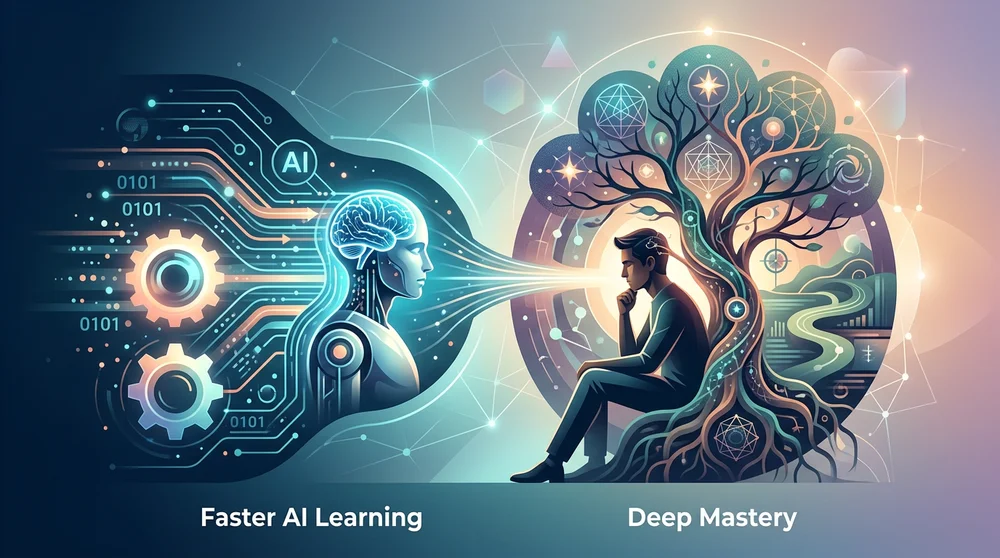
Have you ever tried to speed-read a dense textbook, only to wake up the next morning realizing you can barely remember a single concept? We've all been there. Now, imagine that phenomenon happening on a global scale. In the modern educational landscape, the rise of AI accelerated learning promises to help us "speed-run" complex subjects. With instant summaries, real-time feedback, and customized study guides, it feels like we can compress months of rigorous study into mere days.
It is an incredibly tempting prospect for any curious mind. But there is a hidden catch to this digital hyper-efficiency. While an AI can instantly synthesize a complex framework, the human brain simply cannot wire the physical neural pathways required to use that information just as quickly. Learning isn't a software update that we can just download; it's a physiological process that demands time, effort, and substantial cognitive rest.
We are currently facing what neuroscientists and educators call the Incubation Deficit. This is the critical gap between how fast we can consume AI-generated insights and the actual biological time our brains need for true skill acquisition. Let's explore why faster isn't always better when it comes to deep mastery, and how we can strategically balance the computational power of AI with the natural speed limits of the human mind.
The Seduction of AI Accelerated Learning
The integration of AI into our daily learning habits has happened at a breakneck pace, and for good reason—it works incredibly well for immediate, short-term performance. During the 2024–2025 academic year, surveys revealed an astonishing 86% adoption rate among students, highlighting a near-universal shift in how we approach education. We are drawn to these tools because they remove the friction from the learning process, offering immediate clarity exactly when we feel stuck.
The data supporting AI accelerated learning paints a compelling picture of efficiency. By using advanced intelligent tutors that highlight errors and explain complex concepts in real-time, learners reportedly see up to a 35% faster improvement in their foundational problem-solving skills. Furthermore, students participating in AI-enhanced active learning environments have been shown to achieve up to 54% higher scores on standardized tests compared to peers in traditional settings. When the feedback loop is instantaneous, our momentum feels unstoppable.
However, this metric of "speed" introduces a dangerous divergence between simply consuming information and genuinely integrating knowledge. An AI tutor can map out the intricacies of organizational behavior in milliseconds, but your brain cannot instantly wire the connections required to spontaneously use that leadership theory in a real-world meeting. This raises a vital question for modern learners: are we actually accelerating our mastery, or merely accelerating our access to an externalized answer key?
The Biological Speed Limit: Neuroplasticity and Sleep
To understand why rapid information consumption doesn't neatly equate to faster learning, we have to look under the hood of human cognition. True learning relies on neuroplasticity—the physical, metabolic process where your brain alters its own structure by strengthening synapses and growing new dendritic spines. This biological rewiring is heavily conditional. It strictly requires a sequence of cognitive challenge (effortful friction), followed by periods of rest and spaced repetition.
When you learn something new, your brain goes through memory consolidation to move that fragile, short-term information into durable, long-term storage. The first phase, synaptic consolidation, happens locally within hours of learning. But the heavy lifting occurs during systemic consolidation, a process that takes days, weeks, or even years, as memories are transferred from the hippocampus to the neocortex to be woven into your existing worldview.
Crucially, this systemic consolidation is fundamentally dependent on sleep. The hippocampus doesn't act as a passive storage drive; it acts as an active editor that selectively compresses and rewrites your experiences while you rest. Neuroscience confirms that substituting sleep with additional hours of late-night, AI-assisted study yields diminishing returns, as a full sleep cycle can result in a 40% improvement in memory retention the following day. For learners, this means that sleep is the ultimate biological boundary that no technology can cross.
Missing the Magic of Cognitive Incubation
Beyond sleep, taking strategic breaks while you are awake plays an equally critical role in deep mastery. Cognitive scientists divide our thinking into two distinct modes: the focused mode (used for active concentration) and the diffuse mode (a relaxed state where the subconscious makes broader, creative connections). Both are entirely necessary for complex problem-solving.
When you struggle with a difficult concept without finding an immediate resolution, your brain maintains a productive mental tension known as the Zeigarnik Effect. If you step away to take a walk or wash the dishes, your Default Mode Network activates, allowing your subconscious to quietly process the problem in the background. This cognitive incubation is powerful; research suggests that stepping away from a complex challenge can improve problem-solving success by up to 40%.
The modern AI-assisted study loop inadvertently destroys this process. When you hit a roadblock, your AI tutor provides the perfect answer in seconds. While this keeps your study session moving, it entirely eradicates the "productive struggle" required to trigger neuroplasticity. By outsourcing the struggle to a machine, you skip the incubation phase entirely, preventing your brain from forging the creative, cross-contextual links that define true expertise.
The Fluency Trap and the Illusion of Competence
When the velocity of AI information vastly outpaces your biological ability to process it, you enter the Incubation Deficit. The natural response is cognitive offloading—outsourcing the heavy lifting of information processing to the machine. By bypassing the slow, deliberate, effortful processing required to form durable neural pathways, learners fall victim to what researchers have termed "vaporized learning".
The most dangerous byproduct of this is the Illusion of Competence. This is a metacognitive miscalibration where you mistakenly believe you possess deep knowledge because you are relying heavily on a seamless external aid. Because an AI generates beautifully articulated, coherent explanations, you read the output and genuinely feel the sensation of understanding. But feeling fluent in the moment is not the same as mastering the material.
Real-world environments are already exposing the severity of this illusion. Consider a recent fall semester engineering course where educators introduced a custom AI tool to assist with complex computations. The result was a spectacular failure; student engagement collapsed, and when faced with supervised assessments without their AI crutch, the students' skills crumbled. They had mistaken the temporary fluency provided by the AI for long-term understanding.
A similar crisis occurred in a graduate business analytics practicum. Student teams used AI to build highly polished, strategically excellent frameworks for a client. However, weeks later, when required to orally defend their methodologies and adapt to changing client constraints, the teams froze. The AI had created a perfect output, but the students lacked the underlying, adaptable understanding. For the everyday learner, the takeaway is clear: brittle knowledge looks great on paper, but shatters under the pressure of unprompted, real-world application.
Strategic Slowdowns: Harmonizing AI with Human Biology
If our brains operate under strict biological speed limits, does this mean we should abandon AI in education? Absolutely not. AI remains one of the most powerful learning accelerants ever created. The secret lies in utilizing Strategic Slowdowns—a deliberate approach that introduces calculated friction and cognitive downtime into your AI-assisted workflows.
Instead of letting the machine dictate a breakneck pace, we need to reposition AI as the architect of our learning environment. By using the technology to structure our effort, rest, and spacing, we can harmonize artificial intelligence with human biology.
1. Force Active Retrieval Over Passive Consumption
Instead of asking AI to summarize a podcast or a textbook chapter, prompt it to act as a rigorous Socratic tutor. Testing yourself through active recall is vastly more effective for memory consolidation than passively reading a generated summary. Instruct your AI to generate challenging flashcards, unprompted application scenarios, and oral defense simulations that force you to retrieve information from your own biological memory.
2. Master Spaced Repetition and Interleaving
AI's greatest strength for long-term mastery is its ability to manage complex data schedules. Use AI to build custom spaced repetition schedules that distribute your review sessions across days and weeks, which physically builds stronger neural pathways than massed practice or cramming. You can also ask the AI to generate interleaved practice sets—mixing different topics and problem types together—to mirror the unpredictability of real-world scenarios.
3. Protect the Diffuse Mode
To combat the Incubation Deficit, you must actively schedule cognitive downtime. Techniques like the Pomodoro method (e.g., 25 minutes of intense focus followed by a 5-minute break) are essential. Crucially, during the rest period, you must step away from screens and digital input entirely to let your Default Mode Network activate. Balancing rapid AI prototyping with mental rest allows your brain to synthesize new information organically.
4. Adopt the "Walk, Bike, Motorcycle" Approach
When learning an entirely new skill, treat AI adoption like learning to navigate the road. In the early stages (walking), restrict your AI use to preserve the productive struggle needed for initial neural encoding. As you build foundational judgment (biking), use AI for feedback and direction. Only once you have established deep expertise should you jump on the motorcycle—using AI to scale your output and automate lower-level tasks, secure in the knowledge that your foundational skills are rock solid.
Redefining Educational Efficiency
The fantasy of using artificial intelligence to effortlessly speed-run complex subjects is ultimately betrayed by the biological reality of the human mind. While AI can undoubtedly deliver insights at the speed of light, learning is not simply the consumption of data. It is the physical, metabolic rewiring of your neural architecture—a process that demands the friction of generative processing, the subconscious magic of diffuse mode thinking, and the essential time afforded by rest.
When we rely on AI to remove all the struggle from our educational journeys, we risk trading durable, adaptable wisdom for a superficial fluency. We become highly efficient consumers of information, but remarkably fragile practitioners.
As self-directed learners looking toward the future, we must reframe our definition of educational efficiency. True efficiency is not determined by how fast you can consume the material using a digital assistant. It is determined by how deeply, durably, and permanently you can integrate that knowledge into your own mind.