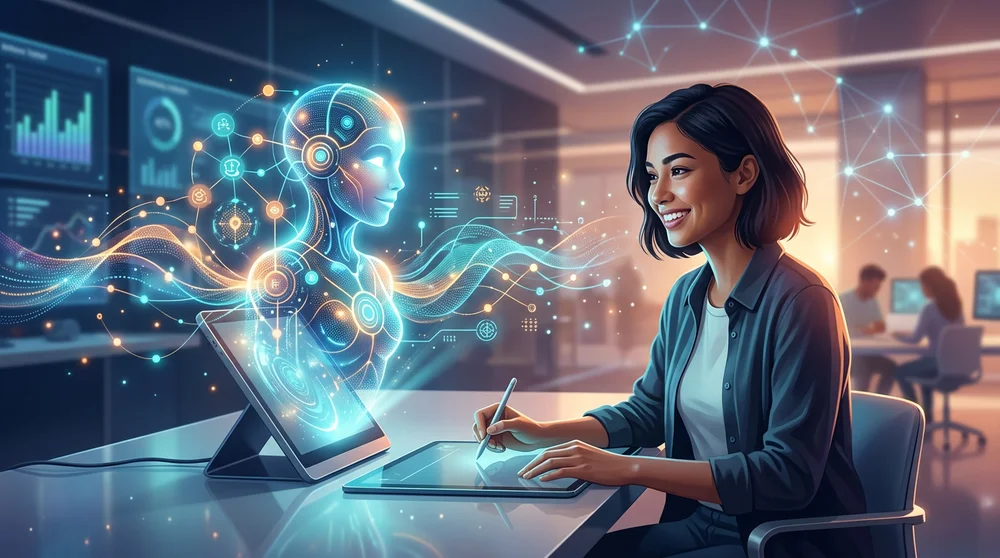
Have you ever sat in a classroom, completely lost, but refused to raise your hand? If you’re nodding your head, you are in good company. For most of us, traditional learning is inherently tied to social risk and a lack of psychological safety. The fear of looking incompetent in front of peers or disappointing a teacher often outweighs the desire to understand the material.
Enter the era of generative AI. Suddenly, learners have access to an omniscient, infinitely patient entity that strips away the emotional stakes of learning. We can ask an AI to explain a basic concept twenty times in a row, and it will never roll its eyes or let out a frustrated sigh. This feels like a massive leap forward for education.
But this frictionless environment introduces a profound paradox. While removing academic shame encourages curiosity, the cognitive friction of struggling through a difficult problem is exactly what builds lasting neural pathways. Are we inadvertently making ourselves worse learners by removing the struggle from education? Let's explore how we can navigate this zero-judgment paradox to get the best of both worlds.
The Sanctuary of AI: Enhancing Psychological Safety and Ending Academic Shame
To understand why artificial intelligence is so disruptive to education, we first have to look at the psychological barriers that hold students back. The dynamic of classroom silence is best understood through the concept of psychological safety, a framework popularized by Harvard Business School Professor Amy Edmondson. It is defined as the shared belief that you can take interpersonal risks—like asking a seemingly silly question or admitting a mistake—without fear of humiliation.
When high academic standards are combined with low psychological safety, the result is anxiety. Students who feel uncertain tend to hide their mistakes, effectively shutting down the very questions that drive learning. AI tutoring systems fundamentally rewire this dynamic by offering a completely judgment-free zone. The machine does not care if you forgot how to add fractions or if you need a concept explained like you're five years old.
For learners, this shift is incredibly liberating. It is particularly transformative for vulnerable students who struggle with imposter syndrome. For example, researchers at Michigan State University found that students in remedial mathematics courses were often too intimidated to attend human office hours, but willingly used AI tools to ask foundational questions and rebuild their confidence in private. The AI acts as a sanctuary, allowing learners to conquer their shame before they ever have to perform in public.
The Cognitive Engine of Productive Failure
If psychological safety represents the emotional ideal of learning, we run into a problem when we look at the cognitive ideal. While AI beautifully solves the emotional friction of education, its default "helpful" design often destroys cognitive friction. To learn deeply, our brains actually need to struggle.
This brings us to productive failure, a learning design theory developed by learning scientist Manu Kapur. His research challenges the common assumption that learning should always feel efficient and smooth. Instead, Kapur's framework suggests that we should let learners persist in exploring complex, novel problems and fail at them before we teach them the correct method.
When you attempt a difficult problem and fail, you are actively priming your brain's cognitive architecture. You generate partial solutions, test your assumptions, and clearly identify the gaps in your own understanding. When a teacher finally steps in to explain the concept, your brain has a ready-made scaffolding to attach that new information to. The empirical evidence for this is staggering: meta-analyses across multiple disciplines show that students who engage in productive struggle before receiving instruction drastically outperform those taught via direct instruction.
What does this mean for you as a learner? It means that the frustration you feel when you can't immediately solve a problem isn't a sign of inability—it's the actual mechanism of learning. The struggle is the feature, not the bug.
The Algorithmic Crutch and the Illusion of Learning
Here is where the zero-judgment paradox bites back. Large language models are trained to be helpful, which usually translates to providing immediate, polished solutions the moment a student expresses confusion. By instantly resolving ambiguity, AI tutors collapse the space where productive struggle lives.
When an AI simply hands you the answer, you can quickly complete the assignment and feel a rush of accomplishment. Cognitive scientists call this the "illusion of learning." Because the machine absorbed all the cognitive load, your neural pathways remain largely unchanged. The damage caused by this algorithmic crutch is highly quantifiable. In one clinical trial, high school math students using an unrestricted AI tutor completed 48% more practice problems than their peers, but when tested later without the AI, they scored 17% lower than students who had never used the technology.
Prolonged reliance on frictionless AI assistance leads to cognitive deskilling. If you grow accustomed to infinite patience and immediate answers, you gradually lose the capacity to wrestle with ambiguity. You stop asking clarifying questions and start relying on the machine to do the heavy lifting. The safety of the AI becomes a trap.
Humans vs. Machines: The Empathy Gap
So, should we ban AI tutors to preserve the struggle, or embrace them for their psychological safety? The answer lies in understanding the specific strengths and limitations of both human and machine educators. For decades, the holy grail of education has been Benjamin Bloom's "2 Sigma Problem"—the finding that one-on-one mastery tutoring improves student performance by two standard deviations over traditional classroom learning.
AI offers the first economically viable solution to this problem. Recent randomized controlled trials at Harvard demonstrated that students using a well-designed AI tutor learned more than twice as much as students in an active learning classroom, and they did it in less time. AI is cheap, available at 2 a.m. the night before an exam, and never loses its temper.
However, AI suffers from a massive emotional blindspot. Research shows a critical disparity in emotional state detection: human tutors recognize a student's emotional shifts with about 92% accuracy, while AI systems miss these cues roughly 32% of the time. A student who is merely confused needs a different approach than a student who is confused and deeply ashamed. Humans can adjust by slowing down, offering empathy, or sharing their own past struggles.
Furthermore, human motivation relies heavily on relatedness—the feeling of being connected to and understood by others. Studies of undergraduate students reveal that while they value AI as a non-judgmental practice space, they experience a much stronger sense of connection and genuine motivation when working with human mentors. We need the AI for practice, but we need the human for purpose.
Case Studies: Finding the Sweet Spot
Several forward-thinking institutions are already navigating the zero-judgment paradox, integrating AI tutoring to foster psychological safety while relying on humans to enforce accountability. Here is how they are doing it:
- Corporate Roleplaying: GE Healthcare integrated AI into its internship program to simulate difficult business conversations. Because the AI acted as a patient sparring partner, interns could practice high-stakes scenarios repeatedly without the fear of looking foolish in front of human managers. They failed productively in private before succeeding in public.
- Socratic AI: At UC San Diego, researchers deployed a bespoke AI tutor for engineering students that was explicitly programmed never to give direct answers. Instead, it used Socratic questioning. While initially frustrating for students, it successfully facilitated genuine learning while still allowing them to ask foundational questions they were too embarrassed to ask professors.
- The Motivation Bottleneck: A large trial in Tennessee middle schools introduced Khan Academy's Khanmigo tutor into remedial math. The study found that while the AI was highly capable, 96% of students rarely engaged it in deep dialogue on their own. The limiting factor wasn't the technology; it was student engagement, highlighting that human teachers are still essential for driving motivation.
A Practical Framework for Synergistic Learning
If we want to maximally exploit AI's judgment-free zone while preserving the rigors of productive failure, we have to treat the use of AI not as a tech upgrade, but as a deliberate pedagogical choice. Here is a practical framework for both learners and educators to strike that balance:
- Implement "Answer-Withholding" Guardrails: Whether you are a developer building a platform or a student typing a prompt into ChatGPT, you must enforce a Socratic methodology. Tell the AI to act as a coach. Command it to assess your current understanding, provide hints one step at a time, and require you to attempt the problem before offering corrections.
- Use Access-Timing Gates: Help that arrives too early short-circuits learning. Educational platforms should implement rules that unlock AI assistance only after a student has made a verifiable independent attempt at the problem. As a self-guided learner, make it a rule to struggle with a problem for at least ten minutes before asking the AI for a hint.
- Rehearsal vs. Performance: Treat AI tutoring as a low-stakes rehearsal space. It is the perfect place to tackle your most embarrassing knowledge gaps because it removes the emotional anxiety that hinders cognitive processing. But remember that the human classroom is the live game. Human friction—the desire to impress a mentor or articulate a concept to a peer—must be preserved to drive discipline.
- Embrace Hybrid Models: The most effective learning ecosystems deploy AI to handle 24/7 baseline cognitive support and repetitive practice, while human educators redirect their time toward high-impact interventions. Humans are needed to spot emotional disengagement, provide mentorship, and guide complex reasoning.
Conclusion: Rewiring How We Fail
The zero-judgment paradox highlights a profound truth about human nature: we crave the emotional safety of effortless learning, but we require the friction of struggle to actually grow. Artificial intelligence has successfully eradicated the social risks of traditional education, offering an unprecedented sanctuary that frees learners from the paralyzing grip of imposter syndrome.
However, if left unchecked, the infinite patience of the machine will smoothly pave over the rugged terrain of learning, leaving us with an illusion of mastery that collapses under pressure. Removing the emotional stakes of human accountability doesn't inherently make us better or worse learners—it simply changes the tools at our disposal.
By deliberately designing our interactions with AI to withhold answers, enforce cognitive struggle, and preserve the deeply human elements of mentorship, we can synthesize the best of both worlds. We can step into a future where learners are entirely safe to fail, yet rigorously challenged to succeed.