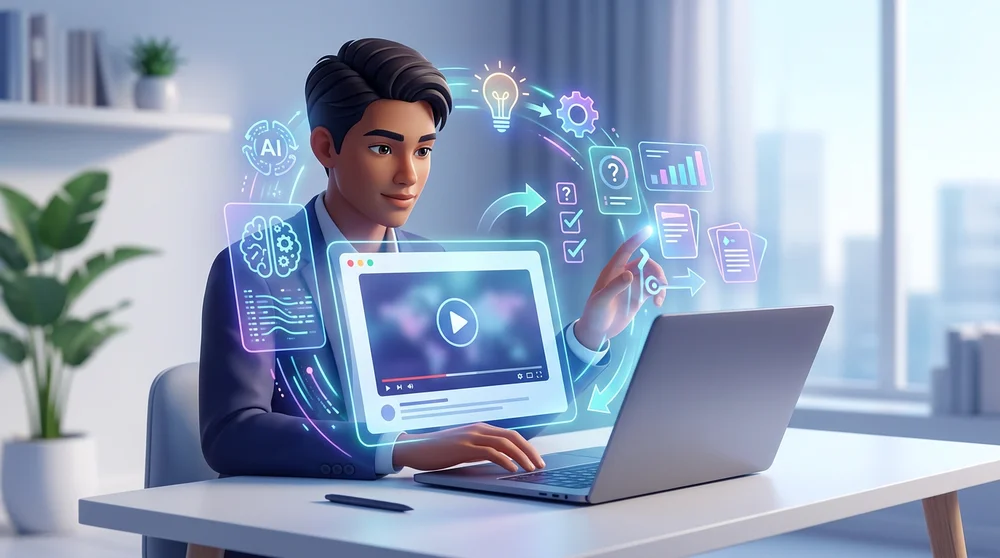
We've all been there. You spend two hours watching brilliantly animated YouTube videos about quantum physics or Python coding, feeling like an absolute genius. But the next day? You can barely remember a single concept. Cognitive scientists call this the "illusion of competence"—our brains confuse the smooth delivery of a highly polished video with actually acquiring a new skill. Watching passively feels incredibly productive, but true comprehension requires active learning.
Fortunately, you don't have to ditch your favorite educational channels to learn effectively. By thoughtfully combining video learning with modern AI study tools, you can systematically transform passive viewing into powerful, interactive study sessions. Here are five practical ways to start.
1. Boost Active Learning with Timestamped AI Quizzes
This is the fastest way to force your brain to do the heavy cognitive lifting. Instead of just rewatching a confusing video segment and hoping it sticks, you can paste the YouTube URL into an AI quiz generator. The AI will grab the transcript and create targeted practice questions tied directly to specific moments in the video.
Testing yourself with transcript-generated questions forces immediate active recall, which is vastly superior to passive rewatching. It anchors your attention and gives you an efficient, highly specific loop for reviewing exactly what you missed.
2. Schedule 'Socratic' Check-Ins for Video Learning
It's incredibly easy to zone out during a 45-minute lecture. To break the trance, try pausing your video every ten minutes to interact with an AI chatbot. But here is the catch: you need to tell the AI to act as a Socratic tutor.
Instead of asking the AI to summarize what you just watched, prompt it to ask you open-ended questions about the material. If you get stuck or give a wrong answer, it should offer targeted hints rather than just giving you the solution.
Pausing to explain concepts to a Socratic AI tutor puts the cognitive heavy lifting entirely on your shoulders, keeping you deeply engaged.
3. Bridge the Logic Gaps with AI Study Tools
How often do you watch a math or coding tutorial where the instructor skips a crucial step for the sake of time? You're left entirely stranded, wondering how they magically got from step A to step C.
Instead of asking an AI to solve the entire problem for you—which completely bypasses your own learning process—use an "Explain the Gap" prompt. Give the AI your starting point and the final result, and ask it to explain only the missing assumption or reasoning.
Prompting AI to explain missing steps helps you overcome frustrating roadblocks without cheating yourself out of the learning process.
4. Play AI Devil's Advocate
Educational video essays are fantastic for exploring new perspectives, but they usually present a highly persuasive, one-sided argument. If you passively accept everything you hear, you're missing out on developing true critical thinking skills.
Next time you watch a compelling video, summarize its main thesis for an AI model and command it to play 'Devil's Advocate'. Ask the AI to ruthlessly challenge the video's assumptions, identify weak logic, and present the strongest counterarguments available.
Using AI to stress-test ideas prevents you from falling into an educational echo chamber and forces you to critically evaluate what you watch.
5. Translate Abstract Concepts into Personal Interests
A major hurdle in self-directed learning is connecting high-level theory to practical reality. An instructor might explain a complex economic principle flawlessly, but if you can't see how it applies to your world, the knowledge simply won't stick.
You can fix this by asking an AI to translate those abstract ideas into concrete metaphors based on your specific hobbies or career goals. For example, ask it to explain a complex data science concept using analogies from basketball, cooking, or whatever you happen to be passionate about.
Contextualizing broad theories into personal, real-world scenarios bridges the gap between passive observation and practical application.
The internet has given us access to the greatest lectures and tutorials in human history, but access alone doesn't guarantee mastery. As recent research shows, embedding active learning strategies into your video consumption creates significant improvements in how much you retain and understand. By leveraging these simple AI workflows, you stop being a mere spectator of your own education. Ultimately, the future of learning belongs to those who know how to turn the world's endless stream of content into a personalized, interactive classroom.