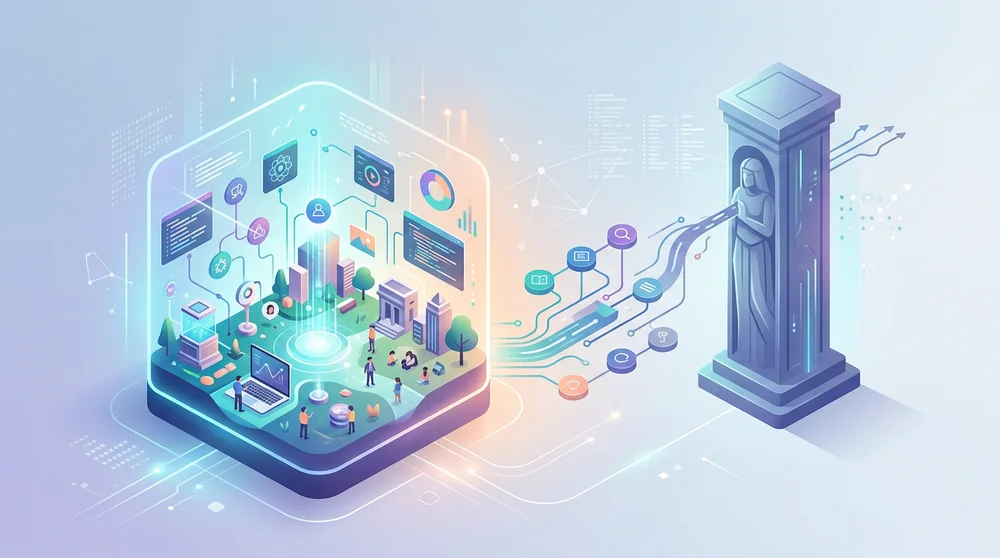
If you have ever used generative AI to summarize a complex topic or engaged with interactive AI simulations, you have likely felt a sudden rush of clarity. In seconds, a beautifully structured, syntactically perfect explanation appears on your screen. You read it, you nod, and you move on, feeling confidently informed. But here is a provocative question we need to ask ourselves: did you actually learn anything, or did you just witness a machine doing the learning for you?
As we integrate generative AI into our classrooms, workplaces, and daily routines, we are standing at a profound pedagogical crossroads. Early on, it made sense to treat these tools like superpowered search engines—a dynamic experts call the "Oracle Model." We ask a question, and the omniscient Oracle dispenses the answer.
While this approach is incredibly efficient for checking a quick fact or formatting an email, relying on it for deep learning is a recipe for disaster. To build real, durable expertise, we need to completely shift our approach. We need to move away from the Oracle and step into the Sandbox.
The Oracle Model and the Illusion of Competence
The Oracle Model maximizes speed and short-term efficiency, but it does so by completely bypassing the cognitive friction required to actually learn. When we use AI as a shortcut to skip the reasoning, synthesis, and critical judgment phases of problem-solving, we engage in what psychologists call "cognitive offloading."
Cognitive offloading isn't inherently bad. We've used calculators to offload math and notebooks to offload memory for centuries. However, researchers draw a hard line between surface offloading (automating tedious procedural tasks) and deep offloading (outsourcing your conceptual reasoning). The Oracle Model encourages deep offloading. Because AI-generated outputs simulate high-level understanding so well, we often confuse the ease of reading the information with our own cognitive retention—a dangerous trap known as the illusion of competence.
What this means for learners: When you constantly rely on an Oracle, you risk developing what researchers are calling "market-ready atrophy". You might be able to produce highly polished reports, essays, or code, but you'll lack the underlying mental stamina to defend, troubleshoot, or adapt those artifacts when you are put under pressure. As AI rapidly commoditizes basic knowledge retrieval, the true value of your education is shifting away from what you can memorize, toward how well you can critically evaluate and synthesize complex ideas.
Enter the Sandbox: Constructionist Learning Reimagined
If the Oracle Model is causing our mental muscles to atrophy, how do we fix it? Curriculum designers and educational technologists are finding the answer by looking back to a framework from the 1970s: Seymour Papert's theory of constructionist learning.
Constructionism asserts that deep learning doesn't happen when we passively consume information; it happens when we engage in "productive struggle" by actively creating tangible artifacts and testing ideas hands-on. Papert famously argued that computers shouldn't just be tools to transmit facts, but rather "objects to think with." Today, modern generative AI has evolved this concept even further, turning these tools into interactive "agents to think with".
This is where the AI Sandbox paradigm comes into play. Instead of asking AI for the final answer, we can use it to build interactive micro-worlds where we manipulate variables, test our hypotheses, and experience the consequences of our decisions in real-time.
One of the most fascinating ways this is being applied is through the "Cognitive Mirror" concept. Rather than treating the AI as an all-knowing expert, developers are actually engineering AI to act as a "teachable novice". In this setup, the human learner is forced into the role of the instructor. If the learner has gaps in their logic, the AI reflects those errors back by feigning confusion or asking clarifying questions. It forces you to repair your own mental models.
The Data Behind Experiential Learning AI
The shift toward the Sandbox Paradigm isn't just an interesting theory for academics; it is heavily backed by modern workforce analytics. Organizations are realizing that traditional training methods are fundamentally broken in the age of intelligent machines.
Historically, we calculated professional expertise as a simple, linear equation: Education + Experience = Expertise. But researchers note that generative AI is completely blowing up this heuristic. When a machine can instantly draft code or formulate business strategies, your competitive edge isn't just what you know. It's how effectively you can interrogate, contextualize, and apply that knowledge within a chaotic, complex environment.
Currently, a staggering 78% of organizations are using generative AI in at least one business function. Yet, formal, lecture-based training on how to use these tools often falls flat. We know that traditional lecture-style learning yields an average knowledge retention rate of just 10%. However, when learners grapple with challenges in simulated environments, that retention rate skyrockets to 65%.
What this means for learners: Experiential learning AI gives you a safe space to fail. Take new managers, for example. Research shows that 60% of new managers fail within their first 24 months due to the psychological complexities of leading former peers. Reading a book about leadership won't fix that. But stepping into an AI sandbox where you can practice handling resistance, delivering tough feedback, and making high-stakes decisions with dynamic AI team members allows you to build real muscle memory without risking your reputation.
AI Simulations in Action
The theoretical benefits of AI simulations are already being validated across both the public sector and higher education. Seeing how different organizations apply the Sandbox Paradigm helps illustrate just how flexible this approach can be.
In the public sector, the Australian Public Service (APS) realized they couldn't just hand their employees generative AI tools and hope for the best. To safely upskill their workforce, they built "GovAI," a secure, interactive learning environment. Rather than giving staff a list of guidelines to memorize, the GovAI sandbox allows public servants to actively build and test AI applications within a ring-fenced infrastructure. By experimenting hands-on, employees move past theoretical AI literacy and actually practice privacy-preserving techniques while creating tools that improve public service delivery.
In higher education, the School of Visual Arts designed an entire graduate course around this concept. Titled "AI & Filmmaking," the class was explicitly framed as an experimental sandbox. Instead of a professor standing at the front of the room dispensing fixed knowledge about rapidly changing tools, the students used AI collaboratively to produce a documentary short film. By grounding their exploration in real creative and historical problems, the students were forced to rely on their own critical human judgment, effectively neutralizing the illusion of competence and confronting algorithmic biases firsthand.
How to Build Your Own AI Micro-Worlds
You don't need a massive enterprise budget or a specialized graduate program to start using the Sandbox Paradigm. Transitioning from a passive consumer of AI outputs to an active world-builder simply requires a deliberate shift in how you construct your prompts and process feedback.
Here is a strategic framework you can use to transform your AI interactions today.
1. Design Simulation Prompts
The foundation of the Sandbox Paradigm is the prompt itself. If you want to learn about economics, do not ask the AI to "Explain the 2008 financial crisis." Instead, you must explicitly command the AI not to give you direct answers. You need to assign it a role, establish constraints, and outline the mechanics of the game.
Example Prompt Structure:
"You are a dynamic macroeconomic simulation environment set in 2007. Do not provide summaries or direct answers. Instead, present me with evolving economic indicators. I will act as the Chairman of the Federal Reserve and make policy decisions. For each decision I make, calculate the systemic consequences, update the data, and introduce random, historically accurate external shocks. Only provide constructive feedback on my mental models after the simulation concludes."
By building this structure, you retain your agency. The AI ceases to be an Oracle and becomes an engine for experiential learning.
2. Establish Learning Feedback Loops
To achieve that impressive 65% retention rate, you need to engage in a cycle of active experimentation and reflective observation. When you are inside your AI simulation, intentionally test different hypotheses. If you are practicing a complex sales negotiation, try different conversational tactics. After the exercise, ask the AI to provide a detailed breakdown of your tone, sentiment, and logical consistency. This structured feedback loop allows you to reassess your strategy, tweak your approach, and dive right back into the simulation to try again.
3. Embrace Productive Friction
The most important step is a psychological one. The modern digital economy has trained us to expect immediate, frictionless results. But cognitive psychologists emphasize that the mental exertion required to retrieve and connect information actually creates "desirable difficulties". You have to learn to love the friction.
What this means for learners: Stop viewing AI upskilling as a race to maximize your output per hour. When you actively choose to engage in the craftsman's workshop rather than bowing at the Oracle's temple, you force yourself to do the essential, structural mortar work of learning that a machine simply cannot replicate.
Navigating the Future of Learning
We are navigating a profound shift in what it means to be an expert. If we default to the Oracle Model, treating artificial intelligence merely as a passive dispenser of facts, we risk cultivating a generation of learners plagued by cognitive offloading and metacognitive laziness. We will have all the answers in our pockets, but lack the mental scaffolding to know what to do with them.
However, if we embrace the Sandbox Paradigm, we can use these exact same technologies to unlock human potential on an unprecedented scale. By designing AI simulations and leaning into constructionist learning, we turn generative models into dynamic partners. We reintroduce the productive friction that makes learning stick.
In an era where facts are instantly retrievable by anyone with a smartphone, information is no longer a differentiator. The true competitive advantage belongs to those who use AI not to fetch answers, but to actively build, navigate, and master complex worlds.