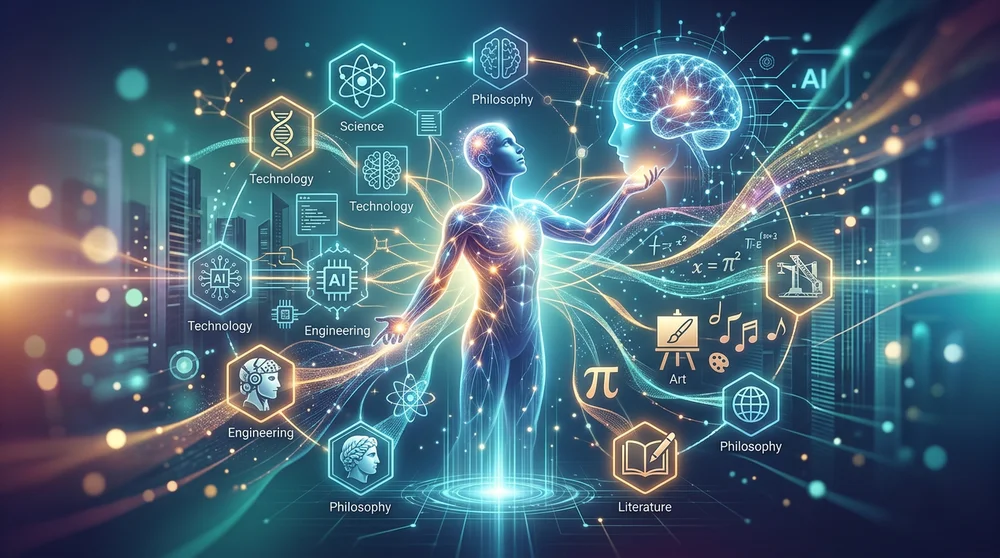
For generations, we have been handed a very specific roadmap for success: pick a lane, study it deeply, and become the undisputed expert in that one narrow thing. Whether you were training to be a software engineer, a financial analyst, or a diagnostic radiologist, the ultimate professional goal was hyper-specialization. But what happens when the very technology we are building is exceptionally good at doing exactly that? The answer lies in cross-disciplinary learning, a fundamental shift from deep silos to horizontal integration.
We are standing at the edge of a massive paradigm shift in education and work. Artificial intelligence is fundamentally changing the value of human knowledge. Because AI excels at narrow, domain-specific tasks, the traditional "deep but narrow" specialist is increasingly finding their core skills commoditized. In response, a new kind of learner is emerging. We are witnessing the dawn of the AI polymath—and with it, a profound shift in how we learn, work, and create value.
The Commoditization of Narrow Expertise
To understand why education is changing, we have to look at the environments we've been training for. The mid-20th-century labor market thrived on what cognitive researchers call "kind" learning environments. These are domains characterized by stable rules, predictable constraints, and immediate feedback loops. If you memorized the patterns, you succeeded.
However, modern AI models function as hyper-specialists that dominate these exact environments. They can process pattern-recognition tasks, write boilerplate code, and retrieve domain-specific facts at a speed and scale no human can match. As a result, the intrinsic market value of possessing isolated, highly vertical knowledge is plummeting.
For learners, this means the traditional approach of memorizing domain-specific facts is becoming a vulnerability rather than an asset. If an AI can perfectly execute the technical minutiae of a task in seconds, spending four years learning to do that same task manually no longer makes strategic sense. Instead, human value is shifting upward.
Enter the AI Polymath and the Synthesis Premium
As the economic value of vertical expertise drops, the value of horizontal integration is skyrocketing. This phenomenon is known as the "Synthesis Premium." It represents the escalating market and intellectual value placed on the ability to connect disparate fields, recognize overarching patterns, and apply insights from one domain to solve a problem in another.
This shift is giving rise to the modern AI polymath. Historically, being a polymath (think Leonardo da Vinci) required a rare genius and decades of study to master multiple disciplines. Today, the AI polymath isn't a "jack-of-all-trades" trying to memorize everything. Instead, they are high-level orchestrators. They understand the foundational mental models of various fields well enough to direct AI agents effectively.
In this dynamic, the AI provides the deep, vertical execution, while the human generalist provides the horizontal connection. Forward-thinking organizations are already recognizing that the future professional must blend creativity, technological literacy, and critical judgment, operating much like the multidisciplinary makers of the Renaissance.
How AI Supercharges Cognitive Synthesis
If we want to thrive in this new era, we need to understand the mechanics of cognitive synthesis. In machine learning, "transfer learning" is the process of taking a model trained on one task and applying it to a statistically related domain. Human cognition, however, relies on something far more powerful: analogical transfer.
Analogical transfer is the ability to take an abstract concept from a familiar domain and apply it to a completely novel challenge. It is the mental leap that allows you to use principles of fluid dynamics to understand traffic patterns, or apply biological evolutionary theories to financial market volatility.
Historically, analogical transfer was difficult because the cognitive barrier to entry was too high. Before you could connect physics to economics, you had to spend years learning the dense, foundational jargon of both. Today, AI acts as a cognitive bridge. By instantly summarizing complex concepts and translating industry-specific jargon, AI removes the friction of raw data accumulation. It allows learners to skip straight to high-level analogical reasoning, making true cross-disciplinary learning accessible to anyone with curiosity.
The Debate: Are We Creating Shallow Learners?
Of course, this rapid shift in how we learn has sparked a fierce debate. If we rely on AI to instantly bridge knowledge gaps, are we risking the creation of a generation of superficial learners?
Critics argue that the grueling process of memorizing facts and manually executing tasks builds the deep intuition required to evaluate AI outputs critically. They warn that if learners offload too much cognitive friction to language models, they may become mere "prompt engineers"—vulnerable to algorithmic hallucinations, systemic biases, and a lack of true foundational understanding.
It is a valid concern, but it misunderstands how the Synthesis Premium actually works. AI does not replace the need for mastery; it shifts the nature of what we must master. Rather than mastering the syntax of a coding language, learners must master systems thinking, abstract reasoning, and problem formulation.
A biologist who uses AI to grasp game theory and narrative psychology isn't a dilettante. They are structurally irreplaceable because they can spot systemic connections that an isolated specialist would miss entirely. By offloading rote execution to machines, humans are forced upward into roles that require acute judgment and deep contextual awareness.
The Economic Reality of Lateral Thinking
The theoretical debate is interesting, but the economic data makes the reality undeniable. Organizations that have tried to use AI purely as a blunt tool for cost-cutting—automating specialists out of existence—are facing a severe reality check.
Without human orchestrators who possess cross-disciplinary knowledge, AI implementations frequently stumble. Consider these recent labor and market findings:
- The Boomerang Tax: Research indicates that organizations attempting to replace talent entirely with AI risk depleting institutional knowledge, with estimates suggesting up to 30% of employees laid off due to AI replacement may need to be rehired to manage the coordination and judgment the AI lacks.
- Project Success Rates: Professionals who combine technical AI skills with cross-disciplinary domain expertise boast a 30% higher project success rate than siloed, hyper-specialized technical teams.
- Predictive Accuracy: In highly complex fields like reservoir engineering, AI tools have improved predictive accuracy by up to 30%, but capitalizing on this required a workforce capable of integrating data science with geological expertise.
The data paints a clear picture. The highest economic returns are captured by individuals and teams who can bridge the gap between technical AI execution and broad, systemic business contexts.
Case Studies in Cross-Disciplinary Learning and Orchestration
To fully grasp what cognitive synthesis looks like in practice, it helps to examine real-world deployments of AI in complex, high-stakes environments.
Polymathic AI and Scientific Discovery
Modern scientific research is heavily fragmented, with brilliant minds siloed in narrow subfields. But dynamic, real-world systems—like climate change or cosmic evolution—do not care about academic boundaries. To address this, researcher Shirley Ho and a coalition of scientists established Polymathic AI, an initiative building a generalist AI foundation model designed specifically for scientific discovery.
Instead of building a model strictly for genomics or solely for astrophysics, Polymathic AI is trained on the structural symmetries shared across multiple disciplines. For example, both fluid dynamics and astrophysics rely on fundamental conservation laws. By training the AI on these overarching global constraints, it empowers scientists to practice lateral thinking, drawing on data one scientific field to solve mysteries in another. It proves that AI's greatest potential lies in illuminating the hidden unities of nature.
The Need for Judgment in Enterprise Strategy
In the corporate sector, McKinsey & Company rolled out a generative AI platform named "Lilli" to synthesize its nearly century-long history of proprietary business knowledge. The platform was wildly successful at commoditizing the routine drafting of research, saving consultants up to 30% of their time on information gathering.
However, a subsequent security event highlighted why the Synthesis Premium is so critical. A security startup utilized an autonomous AI agent to discover unauthenticated endpoints within the platform's architecture, gaining access to the database housing the AI's core system prompts.
This vulnerability revealed a profound risk: an attacker could theoretically rewrite the prompts dictating how the AI evaluates acquisition targets or frames competitive landscapes. The outputs would flow directly into strategy recommendations for Fortune 500 clients. This scenario proves that seamlessly synthesizing data isn't enough. The governance, security, and strategic implementation of AI require leaders who possess deep cross-disciplinary understanding—a blend of cybersecurity, corporate strategy, and prompt engineering.
What This Means for Learners: Building Your "Synthesis Radius"
For anyone navigating this transition, the strategic imperative is clear: you must pivot from vertical accumulation to lateral orchestration. You can no longer bank on being the only person in the room who knows how to execute a specific technical task.
Instead, focus on cultivating your "Synthesis Radius"—the number of genuinely different domains you can operate across and connect simultaneously. Here is how you can actively adapt your learning process:
- Embrace a "T-shaped" Profile: Maintain a solid foundation in your core discipline, but aggressively expand your horizontal knowledge. If you are in marketing, study behavioral economics and data architecture. If you are in engineering, study psychology and design thinking.
- Use AI as a Sparring Partner, Not an Oracle: Don't just ask AI for the final answer. Ask it to translate concepts across domains. Have an LLM explain a complex biological system through the lens of a financial market. Use the AI to train your analogical transfer muscles.
- Focus on Problem Formulation: AI is incredibly good at solving problems, but it still requires a human to define what problem is actually worth solving. Spend your energy learning how to ask better, more systemic questions.
The Future of Learning is Lateral
The rise of artificial intelligence is dismantling the industrial-era construct of hyper-specialization. By automating the routine, predictable tasks that once defined professional value, AI is clearing the stage for a much more dynamic human role.
The fear that AI will create a generation of shallow thinkers fundamentally misreads the technology. AI is a cognitive bridge that removes the friction of raw data accumulation. It frees the human mind to do what it actually does best: engage in analogical transfer, connect disparate ideas, and solve the messy, "wicked" problems that machines cannot navigate alone.
We are entering a modern Renaissance. The most successful professionals and learners of tomorrow will not thrive by knowing every isolated fact. They will thrive by possessing the cross-disciplinary fluency to connect everything. Ultimately, the greatest competitive advantage in the age of AI lies in the unexplored space between domains—where human creativity, judgment, and cognitive synthesis transform disconnected data into profound innovation.