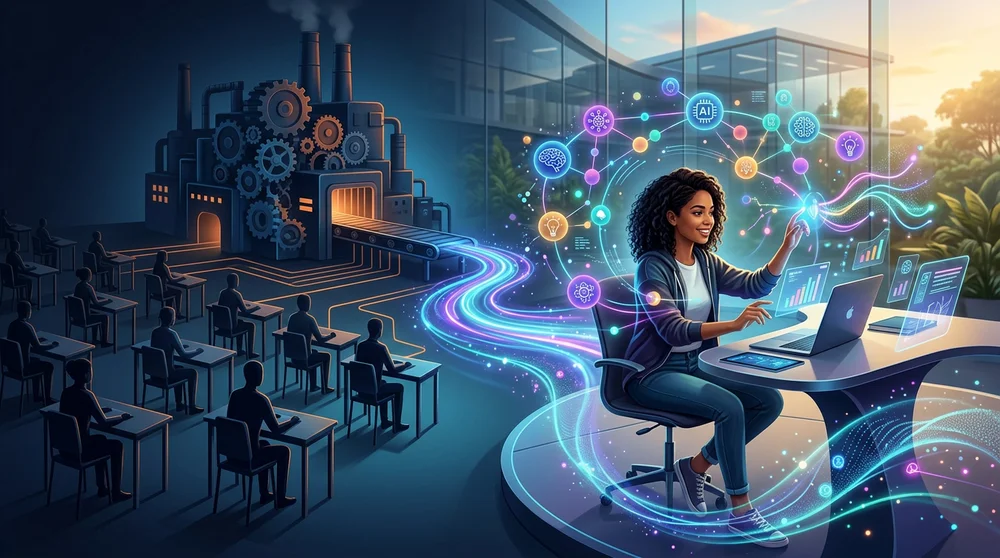
Have you ever bombed a crucial math exam, only to return to class the next day to find the syllabus relentlessly advancing to even harder concepts? It is a universally frustrating experience, and it is entirely by design. For over a century, our prevailing industrial model of education has operated on a standardized, cohort-based timeline, moving students forward based on a fixed calendar rather than demonstrated comprehension—a challenge now being addressed by mastery learning AI.
In this system, time is the constant and learning is the variable. We expect every student to grasp complex topics in the exact same number of days, accepting varying degrees of failure as an inevitable byproduct. But a radical shift is currently underway. The integration of mastery learning AI is completely inverting this outdated equation, making learning the constant and time the variable. We are finally moving away from the factory model, and the implications for independent learners, students, and educators are profound.
The Trap of the "Factory Model"
The traditional classroom operates like an assembly line. When a student scores a 70% on a foundational exam, the system records the grade and the class moves on. But that missing 30% represents a fractured foundation. As the curriculum layers on more advanced, complex knowledge, that initial misunderstanding compounds. Eventually, these minor knowledge gaps grow into insurmountable academic walls.
The psychological toll of this cohort-based pacing is incredibly damaging to both ends of the academic spectrum. Students who just need a little extra time to master foundational concepts are pushed ahead prematurely, inducing acute academic anxiety and a diminished sense of self-efficacy. Conversely, advanced learners who grasp concepts quickly are forced to sit idle, suffering from boredom and disengagement because the system cannot challenge them at their natural pace.
What this means for learners: If you have ever felt like you were "bad" at a certain subject, you might just be a victim of arbitrary pacing. The struggle is rarely a personal cognitive failure; it is a systemic flaw that punishes anyone who doesn't perfectly align with an artificial schedule.
Bloom's 2 Sigma Problem: The 40-Year-Old Educational Paradox
Educators have known about the flaws of the factory model for decades. In 1984, educational psychologist Benjamin Bloom published landmark research demonstrating a staggering reality. He found that average students who were tutored one-to-one using mastery learning techniques performed two standard deviations better than students educated in conventional classroom environments.
To put that in perspective, a two-standard-deviation improvement means the average tutored student outperformed 98% of their traditionally taught peers. Furthermore, about 90% of the tutored students reached an achievement level that only the top 20% of the control class could manage. Mastery learning simply requires that a student achieves a high proficiency threshold before advancing to new material, relying on targeted feedback and corrective procedures until it just clicks.
But Bloom's discovery came with a massive catch. Providing dedicated, expert human tutors for every single learner was economically impossible for society to scale. This 40-year-old educational paradox became famously known as Bloom's 2 sigma problem. It established the holy grail of educational standards while simultaneously acknowledging that we simply did not have the resources to achieve it.
How Mastery Learning AI and Personalized Tutoring Invert the Equation
Today, artificial intelligence is fundamentally resolving Bloom's scaling challenge. Personalized AI tutoring replicates the core benefits of one-to-one instruction without the impossible resource constraints. These systems adapt to your individual cognitive pace, pinpoint your specific learning gaps, and deliver immediate, targeted feedback at a scale that was entirely unimaginable even five years ago.
The empirical data backing this shift is incredibly compelling. A 2025 randomized controlled trial published in Scientific Reports assessed undergraduates in an introductory physics course, pitting a custom-built AI tutor against highly effective, active-learning classroom instruction. The results proved that students relying on the AI tutor achieved vastly superior outcomes, and they did it in less time:
- Median Post-Test Score: 4.5 for AI Tutoring vs. 3.5 for Traditional Classroom (out of a baseline 2.75).
- Median Time on Task: 49 minutes for AI Tutoring vs. 60 minutes for Traditional Classroom.
- Overall Effect Size: An improvement of +0.73 to 1.3 Standard Deviations for the AI group.
This technological shift reveals just how outdated our traditional metrics have become. With machines effortlessly handling rote grading and personalized pacing, the role of the human educator is free to evolve. McKinsey research indicates that AI automation can reduce administrative burdens by up to 40%, freeing up approximately 13 hours per week for educators. Teachers can finally transition from being broad lecturers to targeted mentors, focusing on the emotional support, motivation, and higher-order critical thinking that machines cannot replicate.
What this means for learners: You now have access to an infinitely patient, highly adaptable tutor available 24/7. You no longer have to adapt your learning style to a classroom's median pace. You can dwell on difficult concepts until you achieve true mastery, and accelerate through the topics you grasp intuitively.
Beware the Illusion of Competence (and Metacognitive Laziness)
While the potential of AI in education is thrilling, we must look at this shift with a nuanced perspective. The traditional time-bound model inadvertently trained us all to cram. Cramming forces information into short-term memory just long enough to pass a test, but it fails to build durable, real-world expertise. This creates a psychological trap known as the "illusion of competence," where repeated passive exposure to material makes you feel falsely prepared, even when you cannot actively recall or apply the knowledge under pressure.
If we use generative AI as nothing more than an answer-engine, we risk exacerbating this very problem. Leaning too heavily on an algorithm to do the thinking for you triggers "metacognitive laziness"—a phenomenon where learners offload their critical thinking and self-monitoring to the machine, resulting in a dangerous, unearned perception of mastery.
The solution lies in pedagogical design. The most effective AI systems combat metacognitive laziness through Socratic intervention. Instead of just handing you the answer, platforms designed for education will evaluate your learning history and ask guiding questions. They enforce a state of "productive struggle," requiring you to articulate your reasoning step-by-step to ensure a foundational concept is truly understood before introducing complexity.
What this means for learners: You must actively resist the urge to use AI as a shortcut. If an AI gives you the answer immediately, it is short-circuiting your learning process. Seek out AI tools—or prompt your current AI—to act as a coach that challenges you, not a calculator that solves the problem for you.
Building Your Own Actionable Mastery Workflows
To actively transition away from semester-based thinking, modern independent learners must intentionally design AI workflows that demand active mastery rather than passive consumption. You don't have to wait for an institution to build this for you; you can start applying these frameworks today.
One highly effective method is using AI to generate interleaved practice. Instead of studying a single subject in isolated blocks, you can prompt your AI tutor to generate dynamically mixed practice sets that weave old and new topics together. This technique forces your brain to constantly differentiate between concepts, which is proven to drastically improve long-term retention and conceptual discrimination.
Another powerful workflow is executing the Feynman technique with an AI acting as a strict Socratic skeptic. You can prompt the AI to administer rigorous oral defenses based on your raw study notes. By forcing yourself to teach the concept back to the machine, you expose what you actually know. If your explanation reveals a fractured foundation, the AI can immediately identify the specific misconception and provide targeted remediation.
What this means for learners: You are the architect of your own curriculum. By combining prompting strategies with proven cognitive science techniques, you can unlearn the bad habit of cramming for a test and independently cultivate robust, durable expertise in any subject.
Conclusion: A Future Built on Understanding, Not Deadlines
The dawn of mastery learning AI is not just a story about better educational software; it is a fundamental reimagining of what it means to learn. For generations, we have accepted that time is the unyielding ruler of the classroom, quietly sorting learners into categories of "gifted" or "struggling" based largely on how quickly they could memorize and regurgitate information on a Tuesday morning.
By breaking the factory model, we are entering an era where educational success is defined by comprehensive understanding rather than arbitrary deadlines. As we solve Bloom's 2 sigma problem at scale, we democratize the kind of elite, personalized education that was once reserved for the wealthy few. The goal of learning is no longer just to keep up with the cohort. The goal is true, durable mastery—and for the first time in history, we finally have the tools to ensure every single learner can achieve it.