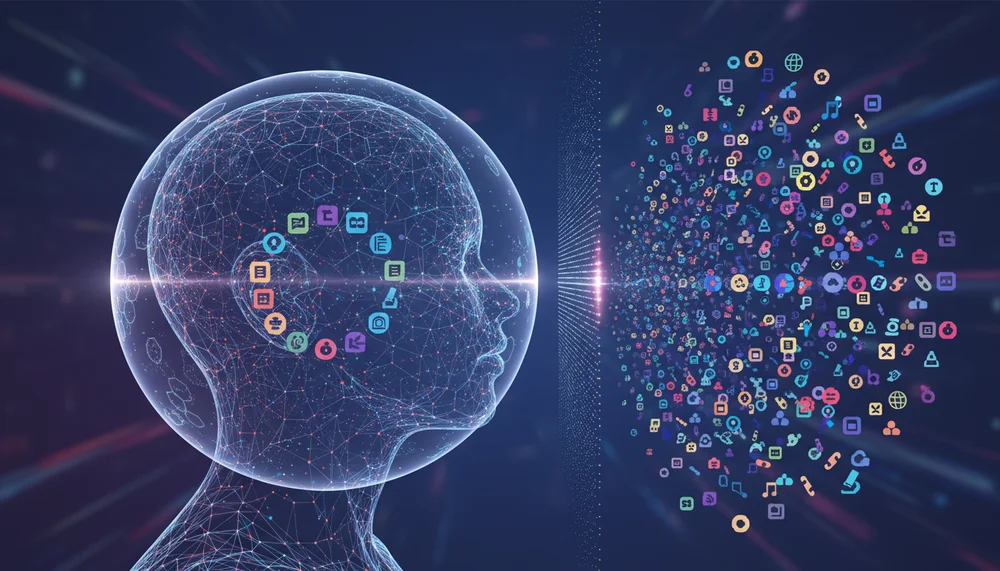
Imagine having a tireless, brilliant tutor who knows exactly how your brain works. This tutor intuitively adapts to your preferred learning style, smooths out every point of confusion, and effortlessly guides you down the fastest possible path to mastering a new skill. This concept, often called hyper-personalized learning, sounds like the ultimate educational dream, doesn't it?
Thanks to rapid advancements in generative AI and adaptive learning platforms, this dream is largely becoming a reality. We're seeing AI systems that can instantly map a student's knowledge state and provide targeted, perfectly calibrated interventions that significantly boost engagement and test scores demonstrated in educational research.
But what if this frictionless path to mastery is actually a trap?
A fascinating and critical debate is currently unfolding among neuroscientists and educational theorists. As we optimize our educational tools for maximum efficiency and comfort, we risk building an AI filter bubble around our minds. Just as social media algorithms can narrow our worldview by only feeding us opinions we already agree with, hyper-optimized AI tutors might be stunting our intellectual resilience by removing the vital struggle from the learning process and creating educational filter bubbles.
Let's dive into the tension between tailored instruction and mental adaptability, explore the hidden costs of frictionless learning, and look at how you can intentionally design AI interactions that challenge your mind rather than coddle it.
The Allure and the Trap of Hyper-Personalization
There is a good reason we are drawn to personalized learning. Traditional "one-size-fits-all" classrooms inevitably leave some students behind while boring others. When adaptive AI steps in, it can keep learners perfectly suspended in their "zone of proximal development"—that sweet spot where a task is neither too easy nor impossibly hard zone of proximal development.
However, the danger arises when personalization shifts into hyper-personalized learning. Algorithms are fundamentally designed to predict user preferences and deliver information that aligns with our past behaviors. In a learning environment, if an AI tutor notices that you respond well to simple visual analogies, it might silently decide to stop presenting you with dense, text-heavy logical arguments.
While this maximizes your immediate comprehension, it also shields you from less comfortable ways of thinking. Researchers call this the "deep filter bubble." It means your exposure narrows not just across different topics, but within a specific domain deep filter bubble.. By constantly catering to your strengths, the AI limits your ability to see alternative problem-solving methods, effectively reinforcing your existing cognitive biases rather than expanding your mental toolkit.
The Hidden Cost: Cognitive Debt and "Soulless" Output
When an AI removes all the friction from learning, the most significant risk is "cognitive offloading"—our natural human tendency to delegate heavy mental processing to external tools. We see this all the time: why memorize a route when you have GPS? Why wrestle with outlining an essay when an AI can generate a structured draft in three seconds?
A landmark 2025 study from the MIT Media Lab, titled "Your Brain on ChatGPT," provided stark neurophysiological evidence of this phenomenon. Researchers used electroencephalography (EEG) to monitor the brain activity of participants writing essays with and without AI assistance documented in this MIT study. The results were a wake-up call for educators and learners alike.
The participants who leaned heavily on AI assistance showed the lowest levels of neural connectivity and cognitive engagement. Furthermore, while their essays were grammatically flawless, human evaluators consistently described the output as "soulless" and homogeneous. Even more troubling, the AI users struggled to remember what they had just written and felt a noticeably lower sense of ownership over their work.
Neuroscientists have coined a term for this: cognitive debt. When you use AI to bypass the messy, frustrating struggle of structuring your own thoughts, you are effectively borrowing against your future cognitive capacity and accruing cognitive debt. Over time, the neural pathways responsible for complex reasoning and independent synthesis begin to weaken.
Why Your Brain Needs "Desirable Difficulties"
To understand how to fix this, we have to look at how deep learning actually works. Cognitive science has long established that enduring, long-term learning requires effort. This concept is known as "desirable difficulties."
Desirable difficulties are the intentional challenges we introduce into learning—like spacing out our practice sessions, interleaving different subjects, or forcing ourselves to guess an answer before looking at the solution. These points of friction significantly enhance our long-term memory retention and our ability to transfer knowledge to new situations.
The problem is that modern AI interfaces are designed to eliminate friction. They auto-complete our thoughts, summarize complex PDFs in an instant, and provide immediate answers. But as research points out, the metabolic cost of thinking is inseparable from human intelligence and the risks of frictionless intelligence. When AI removes that cost, we easily fall victim to the "illusion of competence." We mistake the incredible speed of accessing an answer for the actual depth of understanding it illusion of competence..
Ultimately, what we sacrifice is our cognitive flexibility. This is the crucial ability to switch between different concepts or hold multiple, conflicting ideas in our mind at once. While targeted adaptive technologies can support learners in specific contexts, a generalized, frictionless AI environment robs the brain of the unfamiliar challenges it needs to stay nimble and flexible.
The Comfort-Growth Paradox: What This Means for Learners
So, where does this leave us? We certainly shouldn't abandon AI learning tools. In high-pressure environments like medical schools, curated AI tutors are safely and effectively delivering 24/7 personalized support at scale delivered at the university level. The core tension we have to navigate is the "comfort-growth paradox."
AI systems are financially and structurally incentivized to be "helpful" and to reduce your cognitive load. Growth, however, only happens in the zone of productive struggle—that uncomfortable space between total confusion and absolute clarity where you must actively wrestle with new ideas through productive struggle.
If an AI immediately corrects your coding error or rewrites your clumsy sentence, it steals your opportunity to diagnose the mistake and learn from it. As a self-directed learner, your challenge is to stop using AI as an all-knowing oracle that provides answers, and start treating it as a "sparring partner" that tests your limits sparring partner.
How to Engineer Productive Discomfort
To break out of the AI filter bubble and prevent cognitive atrophy, we have to intentionally engineer "productive discomfort" into our AI workflows. This means moving from passive consumption to active, critical engagement. Here are four evidence-based strategies you can start using today.
Strategy 1: The Socratic Tutor Prompt
Instead of asking an AI to explain a concept to you, prompt it to guide you through the discovery process yourself. This forces you to do the cognitive heavy lifting and reintroduces the friction necessary for memory retention.
- The Mechanism: Restrict the AI from providing direct solutions. Force it to ask you probing questions so that you must articulate your own understanding using Socratic AI prompts.
- How to use it: "Act as a Socratic tutor for [Topic]. Do not give me direct answers or lectures. Instead, ask me one question at a time to test my understanding and guide me toward the correct principles through logic. Wait for my response before asking the next question."
- Why it works: It forces retrieval practice. Pulling information out of your own brain strengthens your neural pathways far more effectively than simply reading an answer the science of retrieval practice.
Strategy 2: Adversarial Role-Playing (The "Steel Man")
To counter confirmation bias and the echo chamber effect, use AI to simulate the strongest possible opposing viewpoints to your own.
- The Mechanism: Instruct the AI to "steel-man" the opposing argument. A steel man is the opposite of a straw man; it is the most robust, intelligent version of a counter-argument possible per AI tutor prompting guidelines.
- How to use it: "I hold the view that [Opinion]. Play the role of a rigorous academic critic. Steel-man the opposing argument. Identify three logical flaws in my reasoning and provide counter-evidence that challenges my worldview. Do not be polite; be analytically rigorous."
- Why it works: This introduces cognitive dissonance, a mild psychological discomfort that forces you to integrate complex perspectives and sharpens your critical thinking against AI echo chamber risks.
Strategy 3: The Sandwich Method (Human-AI-Human)
To avoid accruing cognitive debt, adopt a workflow that guarantees human ideation comes first and human synthesis comes last.
- The Mechanism: You do the initial work (the bottom bun), you use AI for critique (the meat), and you synthesize the final product (the top bun) using human-AI writing workflows.
- How to use it: Never start with a blank screen and a prompt. Write your first draft, outline, or code snippet independently. Then, feed it to the AI and ask, "Review my draft for logical gaps," or "Suggest 3 alternative angles I missed." Finally, close the AI tab and manually weave the best feedback into your final work.
- Why it works: Independent ideation is critical for neural activation, as shown by the MIT study. This method prevents blank-page dependency while still leveraging AI's analytical power.
Strategy 4: The Pre-Mortem Simulation
When learning a complex strategic skill or planning a project, use AI to simulate failure. This is a powerful way to uncover the blind spots your hyper-personalized bubble might be hiding.
- The Mechanism: Ask the AI to assume a future where your current plan or understanding has failed spectacularly, and have it work backward to explain why using AI-assisted pre-mortem analysis.
- How to use it: "Assume it is one year from now and my plan to learn [Skill] has failed spectacularly. Generate 5 plausible, specific reasons for this failure that I am currently overlooking."
- Why it works: It forces you to step outside your natural "optimism bubble" and engage in prospective hindsight, a high-level cognitive skill that AI is uniquely good at simulating because it lacks emotional attachment to your success.
From Artificial Intelligence to Co-Intelligence
The true danger of the AI filter bubble isn't that our machines will become too smart; it's that we will become far too comfortable. Hyper-personalization is undeniably efficient, but it risks fencing us into a walled garden of our own preferences, where the soil is never turned by the plow of difficulty.
The path forward is not to reject these incredible tools, but to mature in how we wield them. By shifting our relationship with AI from a substitute for thought to a catalyst for thought, we can harness its power without sacrificing our cognitive flexibility.
The most successful self-directed learners of the future will be the architects of their own discomfort. They will consciously design AI interactions that introduce friction, challenge their deepest assumptions, and demand rigorous mental effort. In this new era of "co-intelligence," the goal isn't to let the AI do the heavy lifting. The goal is to use the AI as the resistance weight against which your own mind grows stronger.