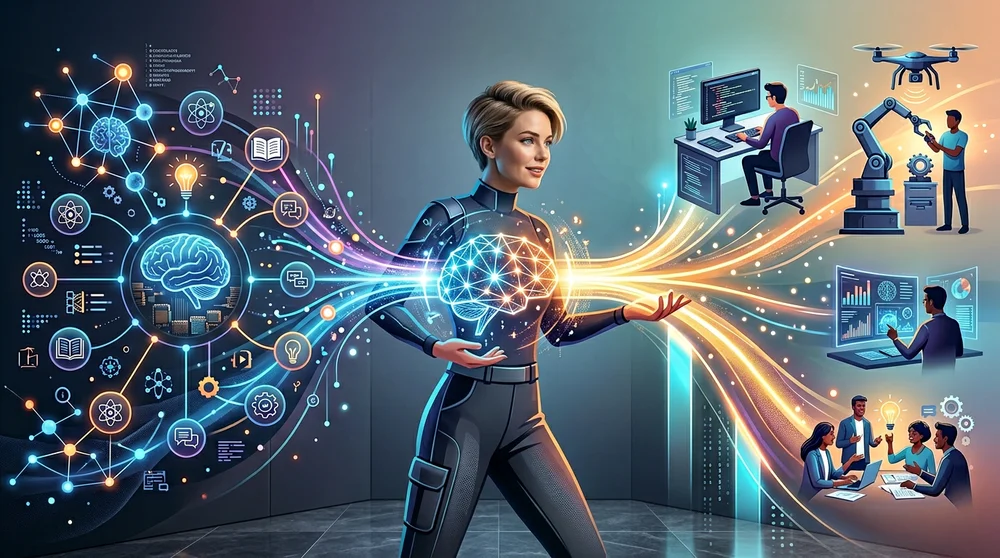
Have you ever mastered a concept in a classroom or a training module, only to draw a complete blank when faced with a related problem in the messy, unpredictable real world? If so, you aren't alone. You've simply collided with one of the most frustrating roadblocks in human cognition: the problem of "far transfer of learning."
For decades, educators and psychologists have recognized that the ultimate metric of robust intelligence isn't memorization—it's the transfer of learning. Transfer happens when you take knowledge acquired in one context and successfully apply it to a new, unfamiliar situation. While it's relatively easy to apply skills to environments that look and feel like your original training ground, taking an abstract concept and applying it to a completely alien scenario is notoriously difficult.
So, how do we bridge the gap between textbook theory and real-world agility? The answer might not lie in studying harder, but in changing the way we interact with information entirely. By merging the latest insights from AI cognitive science with our understanding of human mental models, we are finally discovering a reliable pathway to this educational holy grail.
The Century-Old Problem with Far Transfer of Learning
To understand why far transfer of learning is so difficult, we have to look back at the foundations of traditional education. In 1901, psychologist Edward Thorndike proposed the "identical elements theory," which suggested that learning is highly specific rather than general. According to this theory, knowledge only transfers from one situation to another if the two environments share highly similar elements, procedures, or conditions.
This framework perfectly explains why traditional educational models excel at "near transfer" but stumble when it comes to true adaptability. If you learn a mathematical formula and are tested on a highly similar standardized test question, you will likely succeed. However, if you are asked to use the underlying logic of that same math formula to optimize a business supply chain or structure a computer program, the lack of "identical elements" usually causes the learning process to break down.
Educational theorists have long referred to this pursuit of adaptable knowledge as the "rocky road to transfer". While modern educational philosophies like Constructivism have tried to fix this by emphasizing real-world, authentic learning environments, scaling these highly personalized, cross-disciplinary experiences has been nearly impossible. For the everyday learner, this often means getting trapped in a cycle of context-dependent memorization rather than developing true problem-solving agility.
Mental Models and the Power of First Principles
If we want to achieve far transfer, we have to look beneath the surface of what we learn and examine how we structure that information in our minds. In cognitive science, these internal structures are known as "mental models"—the conceptual frameworks we use to understand the world and adjust to new environments. Cultivating a flexible mind requires us to actively examine and reshape these models.
True adaptability demands what researchers call "double-loop learning." In standard, single-loop learning, your underlying mental model remains static; you simply change your immediate decisions based on the feedback you receive. In contrast, double-loop learning forces you to critically evaluate and alter the mental model itself, shifting your perspective to be broader and more responsive to environmental changes.
For learners, this dynamic adjustment is intimately tied to "first principles thinking." When you break a complex problem down to its fundamental truths or primary causes, you stop relying on assumptions or memorized procedures. By stripping away the context, you can take a foundational principle from biology or physics and apply it to a business strategy or a software architecture. The challenge, historically, has been finding a reliable catalyst to help learners fluidly translate these mental models across seemingly unrelated domains.
Large Language Models as "Context-Shifting Engines"
This brings us to the revolutionary role of Generative AI. We often think of Generative AI and Large Language Models (LLMs) simply as tools that write emails or summarize articles. However, their true power lies in their ability to act as unprecedented engines for cross-disciplinary synthesis. Because LLMs are trained on vast oceans of human knowledge, they inherently map the latent relationships and unseen connections that link disparate academic and professional fields.
Through their underlying architecture, these models can process relationships between vastly different concepts, identifying how they relate within a highly complex, multi-dimensional space. This means that AI doesn't just store information in isolated silos; it understands the foundational grammar of logic, mathematics, law, medicine, and language all at once. For example, without needing any special, task-specific prompting, advanced models like GPT-4 have demonstrated the ability to solve completely novel tasks across various disciplines, performing strikingly close to human-level benchmarks.
What this means for learners: AI serves as a universal translator for your mental models. If you are struggling to grasp a complex economic theory, you can ask an AI to explain it using the principles of fluid dynamics, chess, or musical harmony. By utilizing its "few-shot" capabilities to adapt to completely new tasks on the fly, AI mimics the exact kind of cross-domain reasoning that human learners strive for, effectively creating a synthetic bridge for far transfer.
Escaping the Textbook: AI-Driven Simulation
Perhaps the most profound way AI facilitates the far transfer of learning is by dragging concepts out of static textbooks and thrusting them into dynamic, unpredictable simulations. When you interact with a textbook, you are heavily incentivized to memorize. When you interact with a responsive simulation, you are forced to abstract the underlying principles and adapt to real-time feedback.
Consider the recent development of "generative agents"—computational software powered by language models that simulate believable human behavior. In one fascinating evaluation, researchers provided a single prompt about a Valentine's Day party. In response, these AI agents autonomously spread invitations, formed new acquaintances, coordinated dates, and arrived at the party together. For a student of sociology, psychology, or organizational behavior, this provides an infinitely variable sandbox to test theories in scenarios that are never the same twice.
Beyond social dynamics, AI is also being integrated with physical simulators to ground abstract reasoning in the laws of physics. The "Mind's Eye" paradigm, for example, connects language models to computational physics engines, allowing the AI to actually simulate the physical outcomes of a problem before answering. This grounding in simulated physics improved the zero-shot reasoning ability of language models by a massive 27.9% on average. By generating these emergent realities, AI forces us to synthesize information, adapt our mental models, and practice far transfer in real-time.
Centaurs, Cyborgs, and the Modern Synthesizer
So, what happens when highly skilled individuals integrate this context-shifting technology into their daily workflows? The result is a structural shift from being a siloed specialist to becoming an adaptable synthesizer. AI lowers the cognitive costs of complex reasoning, allowing self-directed learners and professionals to tackle multifaceted problems with unprecedented agility.
A landmark study conducted with management consultants from Harvard Business School and Boston Consulting Group (BCG) vividly illustrates this transformation. Consultants who used AI completed 12.2% more tasks, finished them 25.1% faster, and produced results with over 40% higher quality than their peers who worked without AI. The technology facilitated incredible cross-disciplinary synthesis, helping users seamlessly weave insights from 18 different subtasks—ranging from ideation to market segmentation—into a single, cohesive strategy.
Interestingly, the study revealed that professionals typically adopt one of two collaborative strategies when working with AI:
- Centaurs: These users engage in a clear division of labor, delegating specific, well-defined tasks to the AI based on its strengths, while manually handling tasks that require deep human nuance.
- Cyborgs: These individuals intricately weave AI into their entire workflow. They interact with the model continually, validating outputs, demanding explanations of logic, and refining solutions at a highly granular level.
Remarkably, AI also serves as an incredible tool for skill leveling. The BCG study found that AI assistance boosted the performance of "bottom-half" performers by an astonishing 43%, compared to a 17% increase for "top-half" performers. For learners everywhere, this proves that AI isn't just a tool for the elite; it's a profound equalizer that democratizes access to expert-level cognitive models.
The Trap of "Learned Helplessness"
While the benefits of AI-assisted learning are undeniable, it is crucial to approach this frontier with open eyes. The integration of generative AI into our cognitive workflows carries distinct risks that we must actively manage. If we treat AI as an infallible oracle rather than a collaborative tool, we risk eroding the very critical thinking skills we are trying to build.
Critics operating from a post-humanist perspective warn that the normalization of AI assistance can lead to "learned helplessness." In this scenario, learners lose the capacity to grapple with complex, frustrating problems independently, which can ultimately degrade academic performance and integrity. When the AI does all the heavy lifting of synthesizing information, the human brain is robbed of the productive struggle required to cement new neural pathways.
In the professional world, this over-reliance can create long-term training deficits. If senior workers bypass junior employees to delegate foundational tasks to AI, we risk breaking the traditional mentorship loops that build human expertise. Therefore, we cannot simply outsource our reasoning to algorithms. The goal of using AI in education is to treat the technology as a sparring partner—a tool that challenges our assumptions, presents alternative perspectives, and forces us to refine our own mental models.
Conclusion: The Future of the Adaptable Mind
The challenge of far transfer has haunted the halls of education and cognitive psychology for over a century. For too long, our learning environments have been optimized for standardized testing and near transfer, churning out specialists who struggle to adapt when the rules of the game inevitably change.
Today, we stand at the edge of a remarkable paradigm shift. Large Language Models offer us much more than automated productivity; they provide an interactive, context-shifting engine that maps the hidden connections across human knowledge. By leveraging AI to break concepts down to their first principles and dynamically simulating complex scenarios, we are finally equipped to practice double-loop learning on demand.
As we evolve into modern synthesizers—blending human intuition with the vast associative power of AI—we must remain intentional about how we learn. By using these tools to actively challenge our mental models rather than passively consuming their outputs, we can conquer the rocky roads to far transfer. In doing so, we won't just learn faster; we will unlock a far more adaptable, robust, and brilliant form of human intelligence.