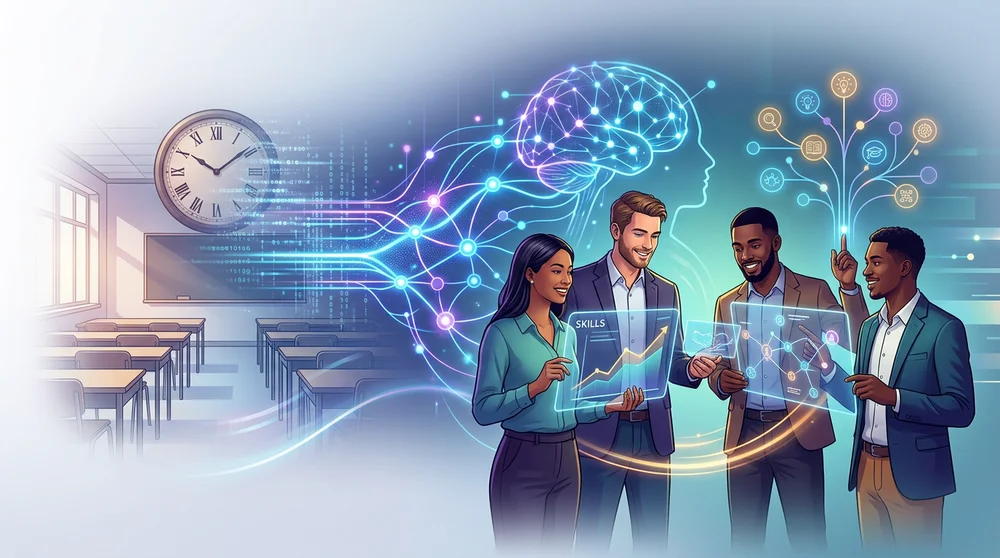
If you spend one hundred hours sitting in a classroom, did you actually learn anything? For generations, educational systems have operated on the assumption that time equals knowledge, but the shift toward mastery-based learning is finally challenging the traditional "seat time" model. We call this metric the driving force behind diplomas, yet staring at a chalkboard doesn't guarantee information transfer into our brains.
Traditional education was built on an industrial-era broadcast model. A single teacher transmits information to dozens of students simultaneously, regardless of who is bored, who is lost, and who is ready to move on. Today, however, the rapid integration of artificial intelligence is breaking the educational clock. We are stepping into an era where measuring learning progress is fundamentally decoupled from the hours you spend at a desk. Instead, the focus is shifting toward deep, undeniable comprehension.
This transition isn't just a technological upgrade; it is a profound reimagining of how we grow. Let's explore how AI is dismantling the vanity metric of seat time, the cognitive science driving this change, and the psychological hurdles you'll need to navigate as a self-directed learner in this new frontier.
Mastery-Based Learning: Replacing the "Seat Time" Vanity Metric
In traditional schooling, a standardized pace forces a diverse group of learners to conform to a uniform timeline. This one-size-fits-all approach inevitably bores advanced students while leaving struggling students behind with compounding knowledge gaps. High school and university systems still largely award credit based on meeting minimum attendance requirements alongside a passing grade. But as any honest learner will admit, surviving a semester does not guarantee you have mastered the material.
The problem is that "hours studied" has become a pervasive vanity metric. For decades, learners have used the sheer volume of time they invest as a badge of honor. But equating hours studied with actual value generated is a flawed equation. It is akin to praising a computer processor simply for running hot and fast, completely ignoring whether its output is actually useful.
This is where mastery-based learning changes the game. In a mastery model, you only progress to the next level once you have demonstrated complete comprehension of the current concept. The friction here is highly psychological. When an AI tutor helps you master a difficult coding language or historical concept in a fraction of your usual study time, it can be jarring. You have to confront the uncomfortable reality that your previous reliance on endurance-based, late-night cramming was largely inefficient.
The Cognitive Science of Stealth Assessment
If we aren't measuring hours, and we aren't relying on massive end-of-year exams, how do we know learning is happening? The answer lies in cognitive science and a concept known as "stealth assessment." Traditional high-stakes exams are stressful events that typically happen at the end of a unit, serving as a judgment rather than a helpful learning tool.
Modern AI technologies blur the boundary between practicing and testing. Through AI continuous assessment, an intelligent platform unobtrusively evaluates your skills in real-time. Rather than stopping you to administer a quiz, the system analyzes your interaction data. It looks at your response times, the specific types of errors you make, and your navigational choices. It maps these observable behaviors directly to your underlying cognitive competencies.
This continuous, low-stakes environment is incredible for learners because it drastically reduces anxiety. Even better, it aligns perfectly with what neuroscientists call the "Eighty-Five Percent Rule." Studies show that human learning happens most rapidly when the difficulty of a task yields a success rate of about 85%. If it's too easy, you disengage. If it's too hard, you get frustrated and quit. AI adaptive platforms dynamically adjust content difficulty second by second, keeping you perfectly suspended in that 85% sweet spot.
When Learning Breaks the Speed Limit
The theoretical benefits of ditching seat time are already proving themselves in the real world, often with jaw-dropping results. Take K-12 education as an example. Certain progressive networks, like Alpha Schools, are using personalized AI tutoring to compress core academic subjects into just two hours a day. By utilizing algorithms that pinpoint exactly what a student knows and dynamically filling in the gaps, they eliminate the non-instructional downtime that plagues traditional classrooms.
The data from these environments is staggering. Students using these highly focused, two-hour AI models are completing full grade levels of material in roughly 20 to 30 hours of total study time. That is nearly ten times faster than traditional pacing, and these students consistently score in the top percentiles nationally. Because the AI handles the direct instruction, the human teacher's role beautifully evolves. They become "Guides" who focus on mentoring, emotional support, and collaborative projects.
We are seeing this exact same shift in adult education and corporate environments. Major tech organizations are building infrastructure that supports flexible learning based on competency skills graphs rather than mandatory seminar hours. Corporate Learning and Development (L&D) leaders are actively pivoting away from episodic, week-long training courses. Instead, they are embedding continuous, AI-driven development directly into employees' daily workflows.
What this means for you: You no longer need to wait for a curriculum to catch up to your curiosity. By leveraging adaptive AI platforms, you can accelerate through foundational concepts at your own pace, reclaiming hours of your day for deeper, practical application.
The Algorithmic Trap: Trading One Flawed Metric for Another
As incredible as these efficiencies are, we have to talk about the risks. As we replace traditional grades and classroom hours with fluid competency models, there is a very real danger of trading one flawed metric for another. It is incredibly easy to become hyper-fixated on digital dashboards and algorithmic progress bars.
The first trap is "gamification addiction." Many educational apps use software mechanics like experience points (XP), daily streaks, and digital badges to keep you engaged. While this helps maintain your momentum, an over-reliance on these dopamine hits can backfire. If you become obsessed with maximizing your daily XP, you might start viewing learning as a transactional video game to be optimized, stripping away the joy of unstructured, creative inquiry.
In higher education and corporate spaces, this can quickly devolve into a "Big Brother" effect. Because AI systems require vast amounts of behavioral data to personalize your path, it's easy to feel like your every keystroke and pause is being judged by a machine. This surveillance can lead to performative work. Instead of genuinely trying to understand a concept, you might find yourself tailoring your behavior simply to satisfy the algorithm.
Finally, we have to protect the "productive struggle." If an AI tutor acts as a constant digital crutch—instantly smoothing over every single cognitive roadblock before you even have a chance to get frustrated—you miss out. The messy, chaotic process of wrestling with a problem is often where true human innovation is born.
A New Psychological Framework for Learners
Navigating this tech-enabled landscape requires more than just logging into a new app. It demands a fundamental rewiring of how you view yourself and your educational journey. As the familiar crutches of "hours studied" and letter grades are dismantled, you need a new psychological framework.
- Decouple your self-worth from the algorithm: Psychological experts often remind us that performance is a variable, while self-worth is a baseline. If you confuse the two, every academic struggle feels like an existential threat. When an AI system flags a knowledge gap, don't view it as a personal failure. Your worth is not determined by a progress bar.
- Treat AI feedback as neutral navigational data: In traditional school, a failing grade was a final verdict. In a mastery-based system, failing is just a stepping stone. AI continuous assessment tracks your errors to adjust your scaffolding, not to punish you. Frame this data neutrally. Transform the thought "I am bad at this" into "I have not mastered this concept yet."
- Protect your unstructured exploration: While an intelligent tutor is exceptionally efficient at teaching you a defined framework, true mastery requires synthesizing disparate ideas on your own. You must purposefully carve out time away from the algorithms. Dedicate the time you've saved to collaborative projects, messy brainstorming, and unbounded creativity.
Looking Beyond the Clock
The era of relying on seat time to gauge human potential is drawing to a close. AI-powered tutoring and stealth assessment have unequivocally exposed the inefficiencies of treating education like an assembly line. When instruction is dynamically tailored to your exact cognitive needs, true mastery can be achieved at a fraction of the historical time cost.
But the most significant change isn't happening in the software; it has to happen within you. To truly thrive in this new educational paradigm, you must be willing to let go of the clock. Stop measuring your dedication by how long you sit at a desk. Resist the urge to performatively chase gamified points, and instead, embrace a mindset of continuous, genuine growth. By using AI as a fluid navigational tool rather than a final judge, you can finally transcend the limitations of the classroom and discover what true, lifelong learning really looks like.