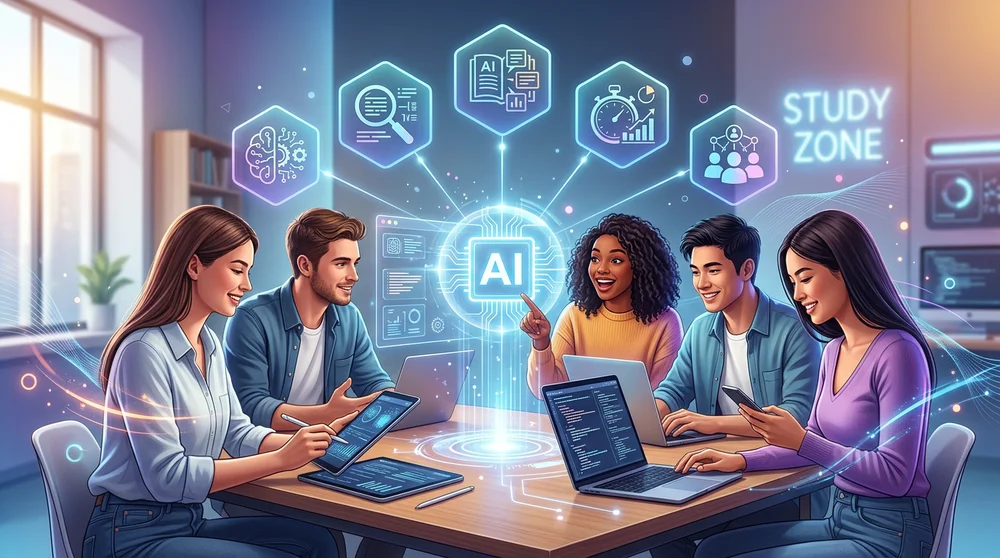
Let's be honest: study groups are incredibly valuable, but they can easily derail into chaotic note-swapping or off-topic chatting. While artificial intelligence is often viewed as a solitary, single-user technology, it is actually one of the most powerful collaborative learning tools available today. When used correctly, group study AI shifts your focus from administrative friction to actual, deep learning. In fact, research shows that integrating AI into team projects can boost successful completion rates by up to 40%. Ready to transform your next study group from a social hour into a powerhouse of productivity? Here are five peer learning hacks you can try at your next meetup.
1. Synthesize a Master Study Guide with Group Study AI
When five people attend the same lecture, you usually end up with five conflicting sets of notes. Merging all this disparate information manually is a massive time sink that eats directly into your actual study time.
Instead, feed everyone's notes or a shared audio recording into an AI platform to create one unified, authoritative guide. The AI will consolidate overlapping points and highlight crucial blind spots where the group's collective notes are lacking detail.
By offloading note compilation to AI, your group can immediately jump into debating and mastering the core concepts instead of arguing over who wrote what.
2. Use AI as a Neutral Arbitrator
We've all been there: the study group grinds to a halt because two people have completely different interpretations of a complex theory. Before this turns into a frustrating argument, bring in your AI tool.
Generative AI serves as an excellent, objective mediator. When you reach a cognitive impasse, prompt the AI with the debated concept. It provides instant, neutral clarification without stepping on anyone's toes or stifling productive discourse.
Using AI to settle conceptual disputes keeps the conversation flowing and prevents shared misconceptions from taking root in your study group.
3. Deploy an Interactive Quizmaster
Passive reading simply isn't enough to make information stick. Active recall is where the magic happens, and AI is exceptionally good at facilitating this for groups.
You can prompt an AI to act as a trivia host based on your shared master guide. Try asking it to generate 10 challenging questions and wait for the group's consensus before revealing the answer. Advanced tools can even rapidly generate custom flashcards for everyone to use later.
Transforming your review session into an AI-hosted trivia game objectively reveals which concepts your group has mastered and which areas need more collective focus.
4. Upgrade the Jigsaw Method
The Jigsaw method—where each student masters a specific sub-topic and teaches it to the rest of the group—is a fantastic way to learn. However, it can be intimidating to become an "expert" entirely on your own.
This is where a "partially engaged AI" strategy comes in. Before presenting to the group, use AI to help outline your assigned topic, answer your specific clarifying questions, and brainstorm the best way to teach the material to your peers.
Practicing with an AI tutor first ensures every group member returns to the study session as a confident, well-prepared expert ready to teach.
5. Offload Low-Level Problem Solving
In STEM subjects or computationally heavy courses, study groups often get bogged down by minor syntax errors, formatting issues, or simple calculation mistakes. This completely derails higher-order conceptual discussions.
Integrate AI to handle these low-level debugging queries. Studies show that using an AI chatbot for this kind of scaffolding during group work can result in productivity gains of up to 37% and a massive increase in thematic diversity during problem-solving.
By letting AI catch the minor technical errors, your group saves its mental energy for tackling the big-picture analytical challenges together.
The goal of integrating artificial intelligence into your study routine isn't to replace human interaction—it's to enhance it. By removing the administrative hurdles that typically slow down peer learning, you free up more time for the high-value debates and discussions that actually build cognitive retention. When applied thoughtfully, AI becomes less of a screen you hide behind and more of a catalyst for genuine, productive human connection.