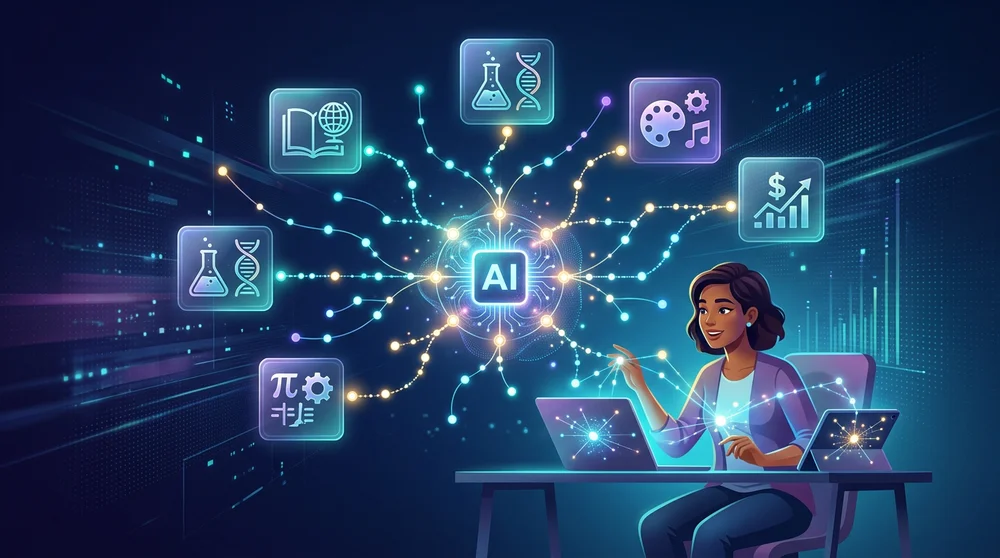
Have you ever noticed how traditional education likes to put everything into neat little boxes? Math goes in one bucket, history in another, and science somewhere else entirely. But the real world is messy, and the biggest breakthroughs usually happen when we mix those boxes together. This is where cross-disciplinary learning comes in, helping you see the big picture instead of just isolated puzzle pieces.
The good news is you don't have to be a natural-born polymath to master this. Today, you can use an associative learning AI as your personal, on-demand tutor to build bridges between totally different subjects. When used thoughtfully, AI doesn't just do the heavy lifting for you; it helps you develop serious cognitive flexibility. Let's look at five practical ways to turn your favorite AI tool into a master connector of ideas.
1. Build an "Analogy Bridge" for Cross-Disciplinary Learning
The fastest way to understand a complex new topic is to relate it to something you already know. Research in cognitive science shows that concept mapping before diving into detailed reading can boost your comprehension by roughly 40%. By asking an AI to translate a new idea into the vocabulary of a familiar subject, you bypass the initial confusion.
The key takeaway here is to use your strongest subject as a translation tool for your weakest. Try using this exact framework to make it happen:
- "I am studying [Concept] in [Subject A]. Explain this concept to me using a concrete, real-world analogy based on the foundational principles of [Subject B]."
2. Generate Cross-Disciplinary Hybrid Practice Problems
Passive reading will only get you so far. True mastery comes from actively applying what you've learned. Generative AI is fantastic at creating customized, scenario-based learning materials that force you to think outside the box. In fact, a recent randomized controlled trial at Harvard University found that students using a customized AI tutor achieved roughly double the learning gains in significantly less time compared to traditional active learning.
To get these same benefits, challenge the AI to create scenarios that force two separate fields to collide. Use this prompt to test your adaptability:
- "Act as a university professor teaching a hybrid course on [Subject A] and [Subject B]. Generate 3 advanced practice problems that require the mathematical formulas of [Subject A] to solve a theoretical dilemma in [Subject B]. Provide step-by-step solutions."
3. Activate a Polymath AI Persona for Debates
Giving your AI a specific "persona" or role to play dramatically improves the quality and focus of its answers. Educators at Dartmouth College have successfully used AI personas as safe sparring partners, allowing students to practice evidence-based argumentation and challenge their own misconceptions.
By casting your AI as an expert in two conflicting fields, you can uncover fascinating friction points and novel solutions. Try facilitating a clash of ideas with this framework:
- "Adopt the persona of a historical polymath who is an expert in both [Discipline A] and [Discipline B]. Facilitate a debate between the conflicting principles of these two fields regarding [Specific Topic]. Present the strongest argument for both sides, then synthesize a novel conclusion that combines both perspectives."
4. Use the "Lens" Technique for Fresh Perspectives
Sometimes a problem seems unsolvable simply because you're looking at it with the wrong set of tools. Generative AI can act as a seamless communication coach, helping you borrow theoretical frameworks from one academic field to analyze another.
Applying a completely foreign "lens" to a familiar topic forces your brain to recognize hidden patterns. Step out of your comfort zone with this prompt:
- "Take the historical event of [Event from History]. Analyze the root causes of this event strictly through the lens of [Economic/Psychological Theory]. Use the specific vocabulary of the theory to explain the historical outcome."
5. Uncover Hidden Overlaps with Syllabus Synthesis
Academic evaluations of generative AI highlight its profound utility in holistic, interdisciplinary studies. If you're taking multiple classes that seem totally unrelated—like accounting and psychology—you can use AI to map out their hidden thematic intersections.
Finding the common ground between your courses allows you to study smarter, as mastering core principles in one area gives you a distinct advantage in another. Map your semester with this prompt:
- "[Upload Syllabus 1] and [Upload Syllabus 2]. Analyze these two course documents and identify 3 hidden thematic intersections. Explain how mastering the core principles of the first course will give me a distinct advantage in understanding the second."
As we move into an era where generative AI has the potential to automate up to 70 percent of employees' time-consuming tasks, human workers will need to pivot toward higher-order AI knowledge synthesis. The most valuable skill of the future isn't just memorizing facts; it's the ability to fluidly connect the dots across boundaries. By treating AI as a collaborative partner in combinatorial thinking, you aren't just learning for a test—you are actively rewiring your mind to solve the complex, multifaceted challenges of tomorrow.