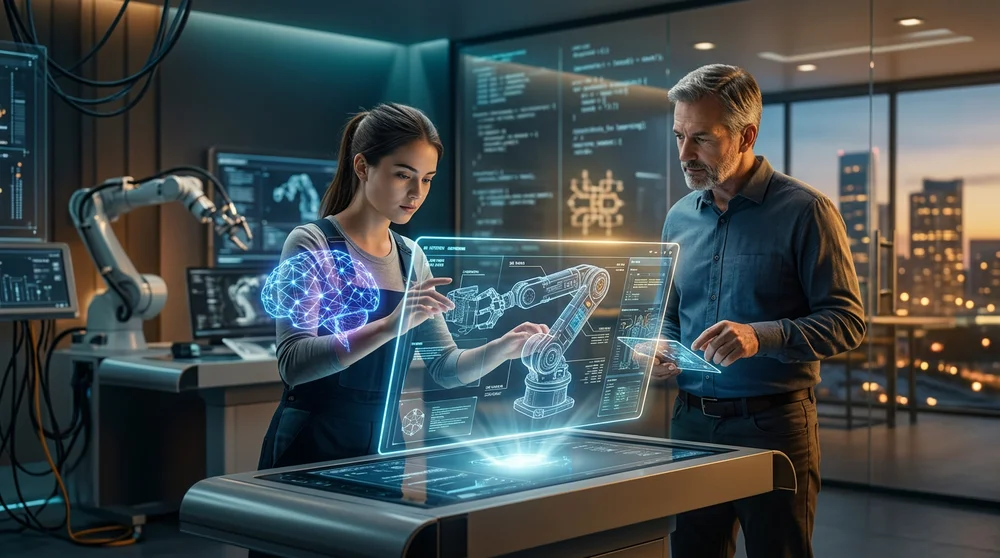
Have you ever stopped to consider why our modern educational system looks the way it does? As we move toward a new era of AI cognitive apprenticeship, most of us still recall learning as sitting in a room with dozens of other people, listening to a single instructor, and passively taking notes. We have been conditioned to view education as a broadcast—a one-to-many transmission of facts to be memorized and tested.
But for the vast majority of human history, that is not how we learned at all. Before lecture halls and standardized tests, human mastery was cultivated through the deeply intimate, highly personalized master-apprentice dynamic. You stood shoulder-to-shoulder with an expert, watching their techniques, mimicking their actions, and receiving immediate feedback tailored specifically to your progress. It was a brilliant system for building true competence, but it had one fatal flaw: it couldn't scale.
Today, we are standing at the edge of a massive paradigm shift. As artificial intelligence evolves from a basic computational tool into a dynamic, conversational partner, it is effectively acting as a time machine for educational theory. AI is reviving the lost art of personalized mentorship, fundamentally transforming how we acquire complex skills. For modern learners, this isn't just a technological upgrade; it is an invitation to reclaim your role as an active, engaged apprentice.
The Assembly Line vs. The Master-Apprentice Model
To understand where we are going, we have to recognize what we left behind. Whether teaching blacksmithing, tailoring, or the scholarly arts, ancient knowledge transmission relied on a physical model of apprenticeship. The novice directly observed the master's actions, and the master could dynamically adjust the difficulty of tasks based on the novice's real-time performance.
When the Industrial Revolution arrived, society suddenly needed to educate a massive workforce rapidly. The intimate, bespoke guidance of expert mentorship was sacrificed for the assembly-line efficiency of the modern classroom. Mass education was a necessary, functional compromise. We traded personalized pacing for scale, prioritizing the efficient transfer of codified knowledge over deep, contextual skill-building.
For modern learners, this historical compromise has shaped our entire psychology of learning. We are used to consuming information in a vacuum, often divorced from the practical context of how experts actually think and solve problems. We've been taught to hunt for the "right answer" rather than master the process of discovery.
Solving a 40-Year-Old Puzzle: Bloom's 2 Sigma Problem
Educators have known about the structural limitations of the industrialized classroom for decades. This pedagogical dilemma is most famously encapsulated in a concept known as Bloom's 2 Sigma problem. In 1984, educational psychologist Benjamin Bloom discovered something incredible: students who received personalized, one-on-one tutoring performed two standard deviations better than their peers in traditional group instruction.
To put that in perspective, the average tutored student outperformed 98% of the students in a standard classroom setting. Yet, despite this overwhelming empirical evidence, giving every single student a dedicated human tutor has always been economically and logistically impossible. Until now.
The rise of personalized learning AI is finally providing a scalable solution to this four-decade-old conundrum. Generative AI possesses the capacity to serve as a live, adaptive tutor for millions of students simultaneously. The real-world impact of these systems is already becoming highly visible across global educational metrics:
- Boosting Outcomes: Research has shown up to a 30% increase in student performance and academic outcomes when using AI-powered personalized learning tools.
- Deepening Engagement: AI systems that adapt to a learner's pace have driven up to a 72% boost in student engagement, significantly reducing dropout rates.
- Empowering Educators: By reducing administrative tasks, AI tools are creating a 20% to 40% improvement in classroom efficiency, freeing up teachers to focus on complex, human-centered mentorship.
What this means for you as a learner is unprecedented access to mastery. The logistical bottleneck of human tutoring is gone. You now have a digital mentor available around the clock, capable of processing your unique learning profile and adjusting its instruction to fit your exact needs.
Inside the AI Cognitive Apprenticeship
While traditional apprenticeships relied on watching a master's physical actions, modern knowledge work happens entirely inside the brain. You can't visibly watch an expert write a line of code or strategize a marketing campaign in the same way you can watch a blacksmith strike an anvil. To bridge this gap, educators utilize a framework designed to make invisible thinking visible, a model perfectly suited for today's technology.
This approach, known as the AI cognitive apprenticeship, operates through four core pedagogical pillars that bring the master craftsman's mindset directly into your digital environment:
- Modeling: In a traditional classroom, you might just be handed a final rubric. AI changes this by "thinking aloud," revealing the step-by-step cognitive framework and heuristics used to approach a complex problem. It shows you how to think, not just what to know.
- Coaching: Because AI operates instantaneously, it delivers personalized feedback while your thinking is still "warm." It acts like a mentor looking over your shoulder, pointing out logical leaps or errors in real-time.
- Scaffolding: Rooted in the psychological concept of the Zone of Proximal Development, AI scaffolding breaks complex tasks into smaller, manageable parts. It offers temporary structural support to ensure a task is challenging enough to promote growth, but supported enough to prevent you from giving up.
- Fading: Crucially, a true apprenticeship relies on the gradual, intentional withdrawal of scaffolding as you demonstrate mastery. Advanced AI tutors are designed to step back, ensuring you don't become dependent on digital crutches.
We are already seeing this model deployed successfully in the real world. Take Khanmigo, Khan Academy's AI tutor built on the GPT-4 architecture, as a prime example. Rather than functioning as a standard chatbot that hands out direct answers, Khanmigo was explicitly engineered to emulate the Socratic method. If you ask it for the answer to a math problem, it responds with guided coaching, asking you to explain your reasoning. It acts as a true digital mentor, scaling the apprenticeship model without short-circuiting your learning process.
The Trap of "Easy": Protecting Productive Struggle
Transitioning to an AI cognitive apprenticeship requires a profound psychological shift. Let's be honest: when a machine is capable of instantly generating a polished essay or debugging complex code, the temptation to simply offload your cognitive responsibilities is incredibly high. But taking the easy way out carries a massive hidden cost.
If you hand over the thinking to the machine, you risk severe cognitive atrophy. To prevent this, both developers and learners must zealously protect productive struggle. Cognitive scientists define productive struggle as the mental wrestling, discomfort, and iterative failure that occurs when you engage with tasks just beyond your current abilities. It is exactly this friction that builds neural pathways, mental resilience, and deep comprehension.
If an AI system is used poorly—providing immediate solutions rather than targeted hints—it actively destroys productive struggle. The data on this "effortless trap" is alarming. A recent study involving high-school mathematics students demonstrated that those who used an unguarded AI helper (which handed over answers) performed 17% worse on an unaided exam compared to peers who used no tool at all. The AI provided a dangerous illusion of mastery.
This means you must treat AI as a "guarded helper." The integration of AI into your education isn't about eliminating friction; it's about calibrating that friction. The goal is to keep you in the driver's seat, doing the deep cognitive work necessary for true, lasting skill acquisition.
Your New Learning Playbook: Thriving as a Digital Apprentice
Unlocking the true power of artificial intelligence requires abandoning your old, industrialized study habits. You can no longer afford to be a passive consumer of information. You must adopt the dynamic, iterative philosophy of a digital apprentice. Here is how you can recalibrate your daily learning habits to thrive.
Shift to Active Co-Creation
Stop treating AI like a ghostwriter or a vending machine for answers. Asking an AI to "just do this for me" completely circumvents the learning process. Instead, you need to prompt for pedagogy. Explicitly command the AI to adopt the persona of an expert mentor. Try prompts like: "Act as an expert in this subject. Do not give me the answer. Instead, show me the step-by-step cognitive framework you use to approach problems like this." This active prompting forces the AI to model expert thinking for you to absorb.
Prioritize Critique and Validation
In a world where AI can automate entry-level execution, the most valuable human skill becomes validation. You must learn to critique, verify, and iterate upon the outputs generated by AI. Try completing a task independently first. Then, feed your work into the AI and ask it to generate an expert-level alternative. By comparing your novice approach against the AI's generated model, you engage in reflective comparison, easily spotting the gaps in your own logic.
Prepare for Dual Readiness
Finally, modern learners must prepare for "dual readiness." You must be fully capable of collaborating seamlessly with AI as a co-worker, integrating machine suggestions into human-led decisions. Simultaneously, you must possess the robust, independent competence required to perform at a high level if AI suddenly becomes unavailable. You are the pilot; the AI is your co-pilot. You retain ultimate agency and responsibility over your intellectual growth.
Embracing the Future of Mastery
The industrialized model of mass education helped us build the modern world, but it demanded a steep trade-off between scale and personalization. By successfully addressing Bloom's 2 Sigma problem, artificial intelligence is finally allowing us to reclaim the gold standard of human development. We no longer have to choose between reaching everyone and teaching deeply.
Through the rigorous application of modeling, coaching, scaffolding, and fading, digital platforms are transforming the educational landscape. But remember, this technology will only fulfill its incredible promise if we intentionally preserve the friction of productive struggle. Learning is supposed to be challenging. It is supposed to stretch you.
When you wield AI not as an oracle of easy answers, but as a demanding, infinitely patient mentor, you unlock a completely new level of potential. Today's learners have a historic opportunity to resurrect the ancient art of apprenticeship for the digital age, forging a future where expert-level mastery is truly accessible to all.