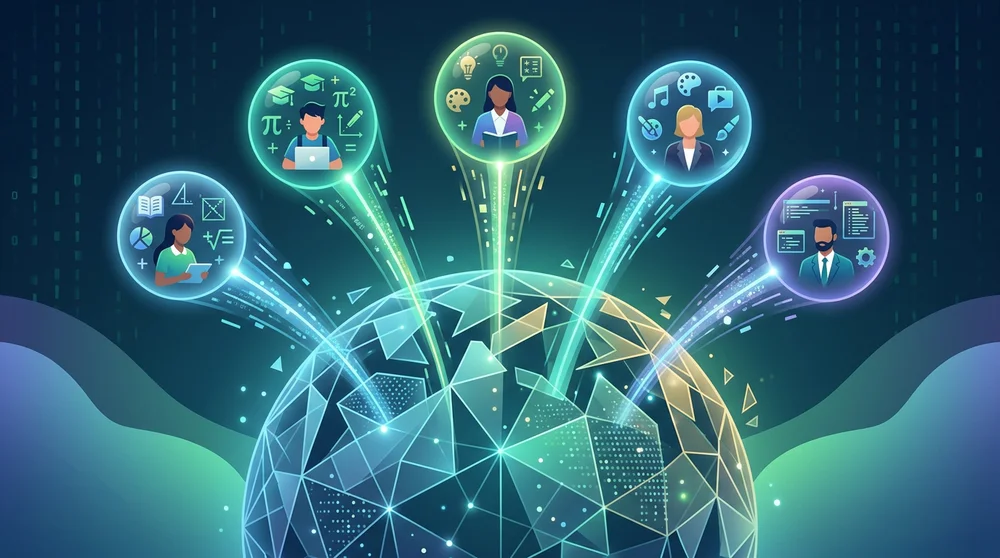
Imagine two brilliant students. One masters complex physics through the metaphorical lens of jazz music, understanding particle interactions as improvisational chords. The other grasps the exact same concepts through the mechanics of competitive gaming, seeing physics as rule sets and cooldowns. Thanks to their AI tutors, both achieve individual brilliance in record time. However, this shift introduces significant personalized learning challenges. What happens when they join a research team and try to solve a problem together?
They might find they have absolutely nothing to say to one another.
For centuries, formal education has been defined by standardization. We all know its flaws—chief among them the inability to accommodate diverse learning speeds and neurodivergent styles. Yet, the "one-size-fits-all" classroom served a vital societal function. It functioned as a synchronizing mechanism, ensuring students graduated with a shared vocabulary, a common baseline of facts, and universally recognized conceptual frameworks.
Today, artificial intelligence is systematically dismantling this model. By offering bespoke educational journeys tailored to our precise cognitive profiles, we are entering a golden age of individual engagement. But as we celebrate this milestone, a severe unintended consequence is quietly emerging. We are risking a modern Babel Effect, where hyper-personalized learning inadvertently fragments our shared human knowledge.
The Allure and Personalized Learning Challenges of AI
The transition from standardized instruction to algorithmically driven, bespoke education isn't just a trend; it's a paradigm shift accelerating at a breakneck pace. Modern Learning Experience Platforms (LXPs) and Intelligent Tutoring Systems leverage large language models and real-time behavioral data to dynamically adapt learning pathways. They adjust the difficulty, pacing, and thematic framing of educational materials to perfectly match the learner.
It's easy to see why we are racing toward this future. Traditional education often suffers from high attrition and low engagement because static content fails to resonate with a student's unique background. AI remedies this friction seamlessly. Recent research from global consulting firms indicates that hyper-personalized AI learning can increase learner engagement by up to 50% while simultaneously reducing training time by nearly 40%. Unsurprisingly, market analytics project that North America alone will capture 40% of the booming global market for these adaptive solutions by 2025.
However, beneath these dazzling operational efficiencies lie profound personalized learning challenges. In both corporate and academic settings, poorly executed implementations of adaptive learning frequently lead to the fracturing of core narratives. When a curriculum is hyper-fragmented to cater strictly to individual preferences without a rigid structural logic, learners often lose the fundamental thread that connects their knowledge to the broader discipline. We are building brilliant individual minds, but we are placing them in isolated algorithmic bubbles.
The Cognitive Science of Collaborative Learning
To fully grasp the latent risks of this Babel Effect, we have to look at the cognitive science of how humans collaborate. The foundation of effective teamwork and collaborative learning is built upon what cognitive psychologists call shared mental models (SMMs). Originally studied in the context of expert team decision-making, SMMs are overlapping cognitive representations that enable individuals to anticipate challenges and coordinate actions seamlessly.
Think of a high-performing surgical team or a veteran software development squad. They don't need to stop and explain every basic term to one another during a crisis. They possess highly convergent mental models, which literature consistently shows is the primary reason they outperform teams lacking a shared conceptual framework. This shared framework drastically reduces the need for explicit, exhaustive communication under pressure.
In a traditional educational environment, students undergo an "apprenticeship of observation". By sitting in the same physical space, listening to the same lectures, and wrestling with the exact same texts, students implicitly develop highly similar mental models. They adopt standardized metaphors and universally accepted baseline assumptions.
But when humans collaborate following heavily AI-mediated, individualized training, these mental models can diverge wildly. If individual team members draw from entirely different, personalized data sets and metaphors to understand their field, the foundational structures of SMMs dissolve. The critical challenge in modern instructional science is ensuring that as we individualize the intake of knowledge, we don't accidentally destroy our capacity for collaborative learning.
Epistemic Fragmentation: The Rise of Learning Silos
The central tension of AI tutoring lies in a phenomenon increasingly recognized by information philosophers as epistemic fragmentation. Originally conceptualized to describe the structural isolation caused by online targeted advertising, epistemic fragmentation refers to environments where individuals are algorithmically walled off from the information diets and contexts of their peers.
When applied to education, this fragmentation poses a unique and insidious threat. If an AI tutor perfectly molds its instructional style to fit your pre-existing worldview, it inherently strips away the friction of communal learning. You are no longer challenged by the diverse, sometimes contradictory frameworks your peers are bringing to the table. This isolation results in the creation of distinct learning silos.
While tailored experiences make learning feel easier and more engaging in the short term, they can lead to a long-term inability to function within diverse teams. Society risks fracturing into "digital tribes" that operate on proprietary epistemic systems rather than common facts or shared industry standards. We emerge from our bespoke learning journeys possessing deep, localized knowledge, but we lack the universal vocabulary required to translate that knowledge to anyone outside our specific algorithmic bubble.
What This Means for Learners: Bridging the Gap
Abandoning the efficiencies of AI tutoring is neither practical nor desirable. The genie is out of the bottle, and the benefits for accessibility and engagement are simply too vast to ignore. Instead, to navigate these personalized learning challenges, our educational paradigm must evolve to prioritize translation. The ultimate test of mastery in the 21st century will not merely be the retention of information, but the ability to act as a conceptual bridge.
Institutional leaders are already beginning to recognize this gap. Experts are advocating for frameworks of "algorithmic psychological safety," emphasizing transparency and human-AI collaboration to prevent organizational knowledge from fracturing into toxic silos.
A crucial step toward mitigation is the intentional co-creation of a shared vocabulary. Educational researchers suggest that both students and educators must proactively teach AI systems about the broader classroom or corporate context, prompting the AI to align its personalized support with universal, standardized instructional goals. Furthermore, digital learning platforms must balance dynamic personalization with social interaction. Integrating social learning features—like peer review and communal problem-solving—explicitly pulls learners out of their isolated bubbles and forces them to reconcile divergent viewpoints.
Actionable Strategies for the Algorithmic Age
As formal institutions grapple with the systemic implications of the Babel Effect, self-directed learners must take proactive steps to protect their collaborative learning skills. Here is how you can ensure your highly individualized education doesn't cost you your ability to communicate in the real world:
- Intentionally Step Out of the Bubble: Deliberate exposure to friction is your best defense against epistemic fragmentation. Routinely engage with foundational texts, unedited primary sources, and standardized curriculums that do not adapt to your preferences.
- Reverse the Prompt (The Translation Engine): Once an AI explains a complex concept using your preferred metaphor, reverse the prompt. Ask the AI to translate that understanding into formal industry-standard terminology.
- Actively Audit for Bias: Counteract algorithmic bias by actively querying your AI for alternative methodological frameworks and theoretical schools.
- Co-Construct Mental Models Early: In any collaboration, prioritize the early establishment of shared mental models by explicitly defining terms and assumptions.
Rebuilding the Intellectual Commons
The integration of artificial intelligence into our educational infrastructure represents one of the most profound pedagogical shifts in human history. The ability to offer tailored, hyper-personalized learning paths resolves age-old problems of pacing, frustration, and accessibility. We have finally built a tutor for every student.
Yet, as emerging research makes clear, this individual triumph threatens the collective intellectual commons. The Babel Effect poses a severe risk to our collaborative potential, threatening to trap our brightest minds in bespoke realities where they cannot communicate their brilliance to the person sitting right next to them.
To fully harness the power of AI without succumbing to the isolation of the algorithmic bubble, the future of education must be anchored in the art of translation. Mastery must be defined by your capacity to export that knowledge into the shared human forum. By actively using AI as a bridge rather than a silo, we can embrace the future of learning while keeping our shared understanding deeply and powerfully intact.