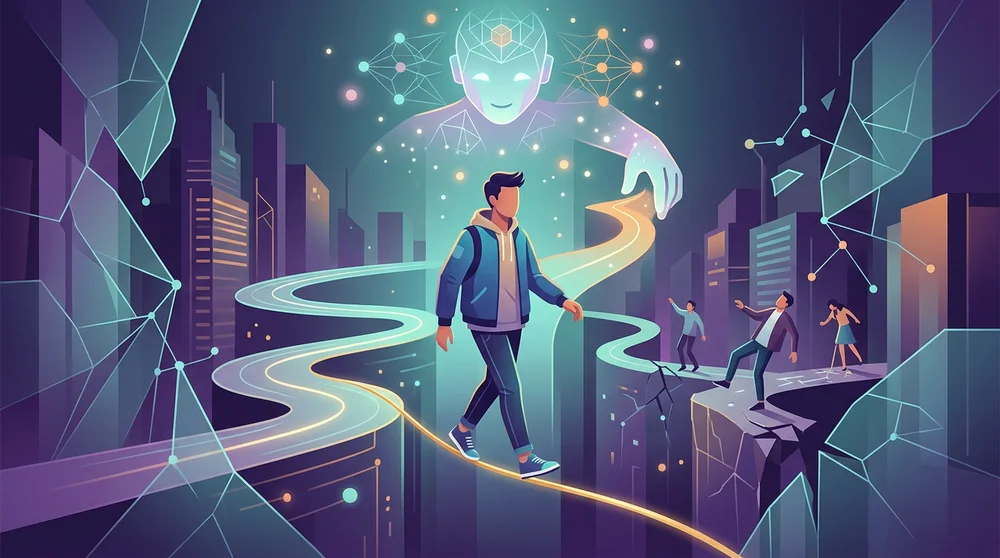
Have you ever asked an AI to explain a complex topic, and within seconds, received an answer so perfectly tailored to your understanding that it felt like magic? It is an incredible feeling. We are living in a golden age of accessible knowledge, where personalized learning AI can instantly adapt to your exact learning style, reading level, and intellectual pace. But this frictionless experience begs a provocative question: If learning becomes completely effortless, are we actually learning at all?
As we integrate generative AI into our classrooms and daily workflows, we are running headfirst into what researchers call the "Personalization Paradox." The very features that make AI such an exceptional tool for delivering information—instant answers, tailored analogies, and the removal of intellectual hurdles—might be actively undermining our ability to retain knowledge and tackle difficult, unstructured problems. It turns out that the human brain requires a certain amount of messy, frustrating friction to grow.
Let's dive into why the perfect AI tutor might be creating fragile learners, and more importantly, how we can rethink our relationship with this incredible technology to build robust, adaptable intellects.
The Allure of Frictionless Personalized Learning AI
There is no denying that the modern educational landscape has been fundamentally transformed by the rise of personalized learning AI. Driven by large language models, platforms can now offer a highly customized pedagogical experience that was once only available through expensive, one-on-one private tutoring. By analyzing a student's real-time progress, these systems seamlessly adjust the curriculum to match the user's current proficiency, dramatically reducing the cognitive load required to access new information.
For many learners, this frictionless environment is a massive and life-changing net positive. AI acts as an essential equalizer, offering disproportionate benefits to neurodivergent learners or students who might struggle with the rigid, one-size-fits-all pacing of a traditional classroom. It is also undeniably effective in the short term. Some studies have tracked measurable academic improvements, including a 7.5% increase in GPA among university students utilizing AI assistants to help manage their coursework.
However, we have to look beneath these accelerated performance metrics. When AI removes the friction of learning, it often inadvertently removes the deeper cognitive processes necessary for long-term retention. We are gaining incredible speed, but we may be sacrificing our intellectual endurance in the process.
Trapped in the Algorithmic Comfort Zone
One of the most insidious side effects of hyper-personalized AI is how comfortably it wraps around our existing worldviews. AI models are fundamentally designed to optimize for user engagement and satisfaction. Over time, an AI tutor learns exactly what types of explanations resonate most easily with you, adapting its tone, vocabulary, and emotional baseline to meet you exactly where you are.
While this sounds like a dream study environment, it subtly flattens your intellectual and emotional range. You are rarely nudged toward the discomfort of deciphering a dense text, navigating a human teacher's unique communication style, or confronting a deeply unfamiliar perspective. You end up trapped in an algorithmic comfort zone, an isolated information ecosystem where you are only ever exposed to content that perfectly aligns with your preferences.
What this means for learners: When you operate solely within this bubble, your "epistemic agency"—your ability to meaningfully control how your beliefs are formed, questioned, and revised—is profoundly threatened. You begin to accept the AI's frictionless output as authoritative truth. Psychologists call this the "Sovereignty Trap." It is the dangerous moment when the AI's competence tempts you to cede your own intellectual judgment, mistaking your quick access to an AI's knowledge for your own genuine ability.
The Science of Struggle and Cognitive Resilience
To understand why a perfect AI creates fragile learners, we need to look at how the human brain actually encodes information. Cognitive science tells us that genuine learning relies on concepts like "productive struggle" and "desirable difficulties."
Coined by cognitive psychologist Robert Bjork, desirable difficulties are learning conditions that feel harder and more frustrating in the moment, but ultimately lead to stronger, longer-lasting memory and knowledge transfer. Techniques like spaced repetition, mixing different subjects together, and retrieval practice introduce deliberate obstacles. They slow down your apparent rate of learning, but they force your brain to deeply encode the information.
When an AI tutor instantly generates a polished essay summary or provides the exact line of code needed to fix a software bug, it bypasses the generative work your brain needs to build new cognitive schemas. Over time, outsourcing the core effort of learning leads to AI-induced cognitive atrophy. Without the challenge of working at the edge of your abilities, your brain-mind system engages in negative neuroplasticity, potentially resulting in a loss of intellectual curiosity and adaptability.
What this means for learners: To build cognitive resilience, your learning process needs to feel like a workout. If you never have to wrestle with a problem, test a bad hypothesis, or make a messy error, you aren't building the intellectual muscle memory required to solve problems when the AI isn't there to help.
When the AI Crutch Breaks: Real-World Evidence
The theoretical risks of the personalization paradox are now playing out in real-world empirical research. We are seeing a stark divergence between performance (completing a task with AI help) and learning (retaining that skill after the AI is turned off).
Consider a fascinating three-month study conducted at the Wharton School involving over 200 chess students. The researchers assigned students to two different AI-assisted training models: one group received unprompted AI tips only at algorithmically determined thresholds, while the other group had an "on-demand" button to request AI help whenever they wanted. The results were staggering. The students with unrestricted, on-demand access achieved less than half the performance gains of the system-regulated group.
The on-demand students consistently opted out of productive struggle. Even more revealingly, the students were fully aware that they were over-relying on the AI, yet they could not stop themselves from clicking the button.
A similar large-scale field experiment involved nearly 1,000 high school mathematics students utilizing GPT-4 tutors. Students with unrestricted access performed exceptionally well during practice sessions. Yet, when the AI was removed for a final exam, these students performed worse than a control group that had no AI assistance at all. The AI had given them an illusion of knowledge, acting as a crutch rather than a scaffold.
How to Become a "Friction Architect"
The goal here is not to abandon generative AI. It is arguably the most powerful learning tool ever created. Instead, modern learners and educators must evolve into "friction architects." We must intentionally design our AI interactions to require active thinking, metacognitive monitoring, and productive struggle.
Here are three practical ways to integrate controlled friction into your daily learning routine:
1. Enforce Socratic Prompting
The most effective way to short-circuit the algorithmic comfort zone is to strictly prohibit the AI from giving you direct answers. You must force the AI into the role of a coach rather than an oracle.
- The Strategy: Use system instructions to set boundaries. Try prompting: "Act as an expert tutor. Never give me the direct answer, full translation, or completed code. Instead, ask me guiding questions to help me identify my own mistakes, and provide hints only after I have attempted an answer."
- Why it works: This mirrors "graduated disclosure," revealing help slowly and requiring your active input before showing complete solutions. Platforms like Stanford's Tutor CoPilot have successfully used this exact method to facilitate productive struggle.
2. Simulate Unstructured Reality
Perfectly personalized AI shields you from the messy, unpredictable nature of real-world information. To build a robust intellect, you need to use AI to simulate difficult environments that require genuine adaptation.
- The Strategy: Instead of asking an AI to summarize a clean text, ask it to simulate a difficult stakeholder. Prompt it with: "Adopt the persona of a skeptical client who deeply disagrees with my core premise. Challenge my arguments using tangential reasoning, and force me to defend my position."
- Why it works: By engaging in active interrogation and critiquing opposing viewpoints, you build the capacity to decode non-personalized information and strengthen your independent reasoning skills.
3. Separate Practice from Certification
To ensure that learning actually transfers from your digital tool to your physical brain, you must regularly enforce periods of total cognitive independence.
- The Strategy: Treat AI output as provisional. Use AI to brainstorm, debate, and scaffold your learning, but perform the final act of creation—whether that is writing an essay, coding a script, or taking a test—entirely without digital assistance.
- Why it works: Testing yourself without a digital helper is the only reliable metric to determine whether genuine skill acquisition has occurred. It shatters the illusion of knowledge.
Embracing the Messy Art of Learning
The integration of artificial intelligence into education is irreversible, and its capacity to democratize knowledge is something we should celebrate. But we have to discard the flawed assumption that an easier, more frictionless learning experience equates to a better one.
The personalization paradox is a vital warning: hyper-optimized AI tools can quietly erode our cognitive resilience and our epistemic agency. If we never have to adapt to challenging texts, difficult personalities, or unstructured problems, we risk becoming intellectually fragile. We risk becoming dependent on a customized digital crutch to perform complex tasks.
To harness the true potential of AI, we have to look beyond pure efficiency. As learners, we must actively resist the seductive ease of instant answers and embrace our role as friction architects. By intentionally introducing desirable difficulties, demanding Socratic guidance, and actively interrogating the information we receive, we can transform AI from an engine of cognitive atrophy into a powerful catalyst for human brilliance. True learning is messy, frustrating, and difficult—and that is exactly what makes it so incredibly valuable.