Have you ever stared at a loosely structured essay assignment and felt completely paralyzed? For those seeking effective ADHD study strategies, the transition to self-paced study often feels insurmountable. Traditional educational environments demand high levels of self-regulation, working memory, and sustained attention. When these demands meet a neurodivergent brain, the result is frequently burnout rather than enlightenment.
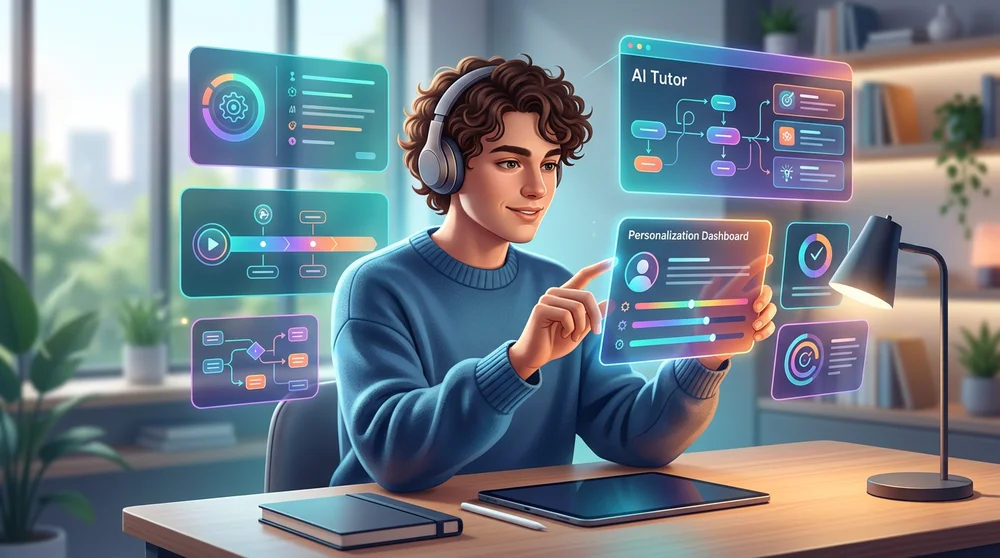
But what if you could reshape this dynamic? The rise of adaptive artificial intelligence offers a profound opportunity to change how we learn. We aren't talking about using technology to do your work for you. Instead, we're looking at how to customize AI to act as a personalized executive function coach, breaking down complex assignments and adapting to your unique pace.
Let's explore how to configure your AI tutor to support your specific cognitive needs and build resilient, independent study habits.
Why Traditional Studying Fails the Neurodivergent Brain
To effectively deploy ADHD study strategies, we first need to understand the specific neurological barriers that get in the way. Attention Deficit Hyperactivity Disorder (ADHD) is a lifelong neurodevelopmental condition affecting roughly 2.5% to 6% of adults globally. While society often frames it as a simple deficit of attention, modern experts recognize it fundamentally as a disorder of executive dysfunction and behavioral self-regulation.
The ADHD brain typically runs on an "interest-based nervous system." This means that tasks lacking novelty, urgency, or high stimulation fail to trigger the dopamine responses required for sustained focus. In an academic setting, this often shows up as a severe lack of "activation energy"—the sheer cognitive effort required to simply begin a task.
When you are faced with a dense textbook or a massive project, your brain struggles to sequence the necessary steps. This leads to analysis paralysis, where you become overwhelmed by the unstructured chaos of the assignment and default to procrastination. Without external scaffolding to help organize this chaos, neurodivergent learning can feel like an endless uphill battle.
Shifting from Chatbot to AI Executive Function Coach
The true power of AI lies in its ability to externalize the executive function required to manage your workload. By utilizing AI organizational tools, you can offload the administrative burden of studying—such as breaking down projects, tracking deadlines, and prioritizing tasks. This frees up your cognitive energy for actual knowledge acquisition.
In fact, a 2024 study found that students with executive function challenges perceived AI as particularly beneficial for schoolwork requiring heavy planning and organization. However, to transform a standard chatbot into an AI executive function coach, you must set clear boundaries.
Try this Master Setup Prompt: Start your next study session by pasting this exact instruction into your AI tool:
"You are my executive function coach. Never do my work for me. Instead, ask me questions that help me plan, prioritize, and start tasks on my own. When I ask for help, break problems into steps and let me choose which step to take first."
3 Steps to Customize Your AI Tutor
To get the most out of your digital study partner, you need to configure it to address your unique cognitive bottlenecks. Here is a step-by-step guide to customizing your AI.
Step 1: Overcome Task Paralysis with Micro-Tasking
When starting an assignment feels impossible, you need to reduce the activation energy to near zero. Because ADHD brains struggle with generating the neurological "go signal" rather than performing the actual work, completing just one micro-step builds the momentum necessary to keep going.
Try this: If you are completely stuck, prompt your AI with: "I need to start this assignment but I am stuck. Give me the single smallest step I could take in the next 60 seconds." This eliminates the need to sequence the whole project and gives you a single, highly achievable starting point.
Step 2: Defeat Boredom with High-Stimulation Formatting
Standard, passive reading under-stimulates the ADHD brain, leading to rapid distraction. To combat this, prompt your AI to deliver information in short, active bursts that match your natural attention span.
You can also request hyper-focused, multimodal formatting to maintain dopamine-driven engagement. Engaging multiple senses—such as combining interactive text, visual diagrams, and text-to-speech audio—can increase knowledge retention in neurodivergent students by up to 75%. Ask your AI to act as an interactive quizmaster, providing immediate positive reinforcement and instant feedback to gamify your study session.
Step 3: Simulate 'Body Doubling' for Time Management
"Body doubling" is a widely recognized productivity strategy where you work in the passive presence of another person, acting as an external anchor for your attention. A recent study on neurodivergent participants revealed that 85% reported significant improvements in task completion when using body doubling strategies.
Try this: You can simulate this effect using conversational voice AI. Configure your AI to act as a digital body double during a 25-minute focus sprint. Instruct it to verbally check in every ten minutes, ask for a quick progress update, and provide gentle accountability. This creates a calm, persistent presence without the anxiety of human judgment.
Using AI as Training Wheels, Not a Crutch
While AI offers incredible accommodations, there is a fine line between a supportive scaffold and a cognitive crutch. If you rely on technology to decompose every task and synthesize all your information, you risk stunting the development of your own internal strategies.
Experts warn that over-relying on AI to do our thinking for us may weaken the mental skills we develop through our own effort and struggle. To build resilient, long-term independent study habits, we must view AI as cognitive "training wheels."
The goal is to observe how the AI breaks down complex tasks and gradually internalize those frameworks. Start by having the AI generate micro-tasks. Over time, progress to structuring the assignment yourself, using the AI merely as a tool to validate your plan. By intentionally monitoring your reliance on the technology, you ensure you are enhancing your capabilities rather than outsourcing your intellect.
Summary: What We Learned
Navigating self-paced learning with a neurodivergent brain requires strategy, self-compassion, and the right tools. By treating AI as a collaborative partner rather than an answer key, you can overcome common cognitive hurdles.
Here are the key takeaways to remember for your next study session:
- Set boundaries early: Use a Master Setup Prompt to instruct your AI to act as a coach, not a cheat sheet.
- Lower activation energy: Use micro-tasking prompts to find the smallest possible next step when you feel paralyzed.
- Increase stimulation: Ask the AI for interactive formatting, quizzes, and multimedia to keep your dopamine levels engaged.
- Leverage voice features: Simulate body doubling with conversational AI to maintain focus during timed study sprints.
- Fade the assistance: Gradually take over the planning and structuring processes yourself to build your own executive function skills.
Technology should ultimately serve as a bridge to your own potential. By mindfully customizing your AI tutor, you are doing much more than surviving your coursework—you are actively redesigning the learning environment to finally work for your brain, rather than against it.