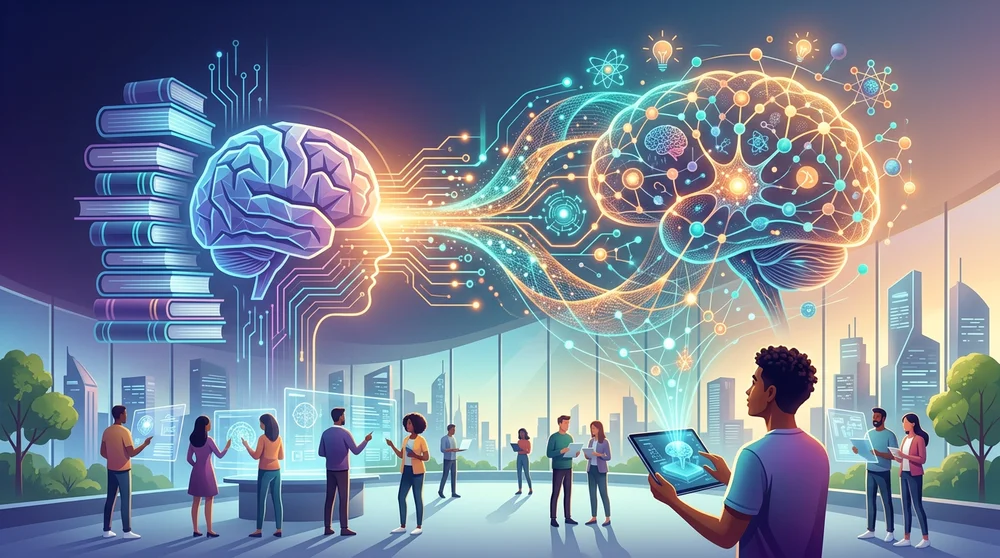
What if we have spent the last two centuries measuring human intelligence backward? Imagine a system that, instead of constantly pointing out what you don't know, dynamically adapted to amplify the very things you are naturally best at. We are watching the definitive transition toward asset-based learning at scale. For most of modern history, education has operated as a giant sorting mechanism designed to find our flaws. We establish a baseline of "acceptable" knowledge, test students relentlessly, and when they inevitably fall short in certain areas, we prescribe remediation to fix the gaps.
In the learning sciences, this is known as deficit model education. It is the architectural foundation of traditional schooling, special education, and standardized testing. But a seismic shift is happening right now. The rapid evolution of generative artificial intelligence is directly challenging the logic of this "find and fix" approach.
Instead of punishing weaknesses to push everyone toward a mediocre average, emerging AI systems can dynamically map and leverage a learner's unique cognitive strengths. Let's explore how AI is rewriting the rules of intelligence, what the end of the deficit model means for learners, and why we must tread carefully to protect our cognitive growth in the process.
The Hidden Cost of Deficit Model Education
To understand why this shift is so revolutionary, we have to look honestly at the toll of the old system. The deficit model conceptualizes academic struggles as inherent flaws inside the student. Educators, despite their best intentions, are often trained by this system to view intelligence through a lens of scarcity, categorizing non-traditional thinkers as "at risk" or lacking.
The psychological impact of this approach is heavy. When you are continually defined by the gaps in your knowledge, the classroom becomes a breeding ground for academic anxiety and stigma. Many educational scholars point out that this standardizing system ultimately produces mediocrity, as it assumes every student must be forced through the same rigid funnel to solve known problems with known solutions.
For a long time, technology actually made this worse. Early generations of digital education tools largely operated on the exact same premise. These adaptive learning technologies were highly efficient deficit-trackers, sniffing out a student's weak points and serving up endless, repetitive tasks to fix them. They sped up the grading, but they didn't change the underlying philosophy. If you were a highly visual learner struggling with sequential math logic, the software just gave you more of the same sequential math logic until you either memorized it or gave up.
Flipping the Script: The Rise of Asset-Based Learning
In response to the harm caused by deficit-focused remediation, modern educators have championed a radically different approach: asset-based learning. Rooted in the idea that every student brings valuable "funds of knowledge" to the table, this pedagogy focuses on discovering what a learner naturally excels at. Instead of obsessing over gaps, asset-based teachers structure academic challenges around a student's inherent cultural, linguistic, and cognitive strengths.
We're starting to see how powerful this can be when combined with modern technology. For instance, in a recent National Science Foundation study exploring critical AI literacy, researchers asked educators to use an asset-based approach with marginalized students. By leveraging the students' unique cultural backgrounds as a strength, the learners transformed from passive tech consumers into active agents who could successfully identify biases in generative AI models.
What this means for learners: You are no longer defined by your lowest test score. Your alternative ways of thinking are not errors that need to be overwritten. Under an asset-based framework, your unique cognitive profile is treated as a functional bridge to master difficult subjects.
How AI Cognitive Mapping Changes the Game
The true disruption of generative AI is that it makes asset-based learning possible at a massive scale through AI cognitive mapping. Today's AI doesn't just sequence a pre-written curriculum; it can semantically transform the material in real-time to match how your brain works.
Consider the new STREAM framework (Semantic Transformation and Real-Time Educational Adaptation Multimodal). Rather than forcing a student to adapt to a textbook, STREAM uses natural language processing and computer vision to break down educational content and instantly regenerate it. If the AI maps a student as a highly visual, spatial thinker, it bypasses their weakness in sequential text processing and dynamically generates annotated path diagrams to teach the exact same core concept.
We are also seeing a shift in how we measure success. Advanced cognitive mapping tools are moving away from retrospective grading (looking backward at what you failed to memorize) toward generating predictive "Cognitive Scores." These multidimensional assessments evaluate traits like adaptability, pattern recognition, and creative problem-solving, charting intelligence based on natural brain excellence rather than standardized baselines.
Real Classrooms, Real Change
This isn't just theoretical learning science; it is already happening in public school districts. The Anaheim Union High School District (AUHSD) in California recently deployed new AI tools specifically designed to help educators map student strengths rather than just auto-grade papers. Supported by the Chan Zuckerberg Initiative, AUHSD uses AI to build personalized pathways shaped by direct student input.
The psychological shift for educators and students is palpable. As Tyler Sherman, an AUHSD teacher, noted, educators finally have tools to differentiate instruction in ways that help students find their actual purpose and identity for life after high school. The district is moving away from rigid "time-on-task" metrics and fostering neuro-inclusive environments where mastery matters more than seat-time.
We see an even more profound application in what researchers call the "Dyslexia 5.0" paradigm. Historically, dyslexia has been treated as a severe reading deficit requiring exhausting remediation. But when AI text-to-speech and large language models lift the mechanical burden of decoding words, the natural cognitive assets of the dyslexic brain—like exceptional lateral thinking and risk tolerance—are unleashed. AI acts as a prosthetic for the mechanical weakness, allowing the student's true intellectual brilliance to shine.
The Results: Why This Approach Works
When we align technology with how humans actually learn best, the outcomes speak for themselves. The shift toward AI-enabled asset-based learning is already producing compelling empirical data:
- Better Academic Performance: Students learning in personalized, AI-enhanced environments have achieved up to 54% higher test scores and a 70% increase in course completion rates compared to traditional, one-size-fits-all methods.
- Surging Motivation: Because the content is mapped to their strengths and feels immediately relevant, learners report higher engagement and intrinsic motivation to tackle hard subjects.
- More Human Mentorship: By automating routine tasks, AI is saving teachers nearly 6 hours a week. That is precious time educators are reallocating toward direct, human-centered mentorship and responsive instructional design.
The Trap: Beware of Cognitive Offloading
As exciting as AI cognitive mapping is, we have to look at the full picture. Cognitive scientists evaluate learning tools through the lens of Cognitive Load Theory. Good learning requires a delicate balance: we want to reduce "extraneous load" (the frustrating busywork of finding information) but we must fiercely protect "germane load"—the productive, effortful struggle required to actually build new neural pathways.
If we use AI just to make things easy, we risk falling into the trap of cognitive offloading. Nita Farahany, a professor studying the ethical impacts of emerging tech, warns that the seductive efficiency of AI is deeply troubling because it tempts us to offload our executive functioning. If a student uses an AI co-pilot to passively bypass a difficult task entirely, they aren't learning; they are just outsourcing their thinking.
Furthermore, while AI is incredible at generating personalized content, it still struggles with the deep, redirective instructional dialogue that an expert human tutor naturally provides when a student hits a wall. To preserve intellectual growth, AI must be used to generate autonomy and competence, not passive dependency.
What this means for learners: AI is a powerful climbing gear, but you still have to climb the mountain. You should use AI cognitive mapping to find the best route up the rock face—the route that fits your unique grip—but you cannot let the AI helicopter you to the summit. The struggle of learning is where your intelligence actually grows.
A New Era of Human Potential
The dismantling of deficit model education represents much more than a software update for our schools; it is a fundamental evolution in what society values. For generations, economic opportunity has been gatekept by a narrow set of metrics heavily biased toward rote memorization. But in an AI-integrated economy, rote data recall is basically worthless. The human competencies that now matter most are empathy, creativity, metacognition, and lateral problem-solving.
As we move into an era of brain-computer interfaces and advanced neurotechnology, the concepts of "mental privacy" and "cognitive liberty" are becoming central to our human rights framework. We are finally recognizing that human cognition is wonderfully diverse, deeply sacred, and entirely too valuable to be flattened into a single standardized bell curve.
Moving beyond the deficit model offers us profound psychological freedom. When we let technology handle the standardized valleys of human cognition, we liberate learners from the demoralizing weight of their weaknesses. By embracing AI to map and celebrate our cognitive peaks, we are building an educational ecosystem where every type of mind is finally recognized as an essential piece of our shared future.