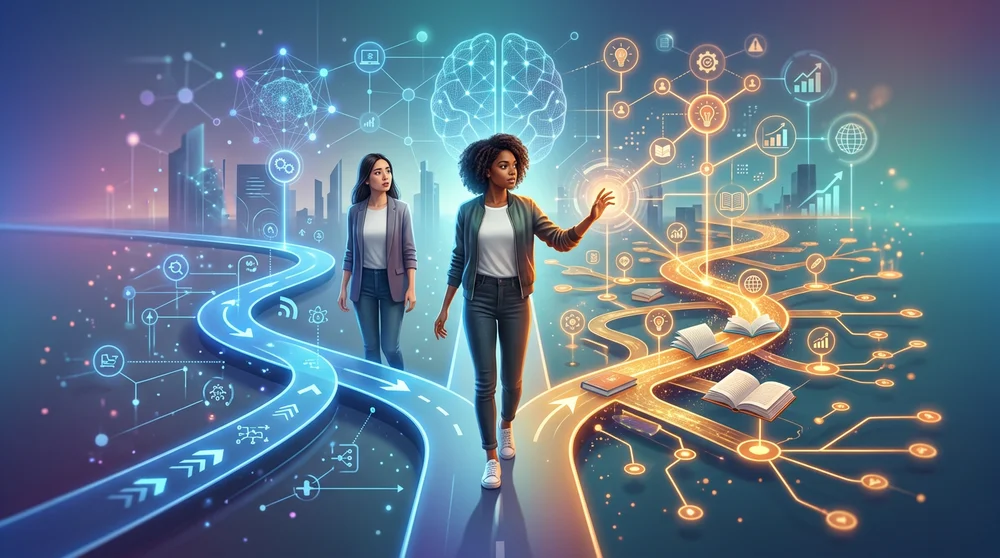
Have you ever driven to a new destination using a digital navigation app, arrived safely, and suddenly realized you couldn't retrace your steps if your life depended on it? You reached your goal efficiently, but you didn't actually learn the route. In the world of cognitive psychology, this is known as the "GPS Effect"—and it is currently staging a quiet takeover of our educational systems, posing a significant risk to learner agency.
Artificial intelligence has finally cracked the code on frictionless education. Today's modern AI platforms can map perfectly optimized, highly individualized pathways from novice to expert. They can diagnose our conceptual weaknesses in real-time and serve up instant, tailored answers to our most complex questions. But this algorithmic hyper-efficiency introduces a profound paradox: if true learning is defined by the neurological adaptations that happen when we struggle, what happens to our brains when technology eliminates that struggle entirely?
We are standing at a fascinating crossroads in the future of education. As we increasingly delegate the messy, frustrating parts of learning to automated systems, we face a critical question. Is our shiny new AI autopilot actually sabotaging learner agency?
The Promise and Peril of the AI Autopilot: Protecting Learner Agency
We can't ignore the incredible benefits that AI brings to both traditional classrooms and corporate e-learning environments. In the professional training sector, "AI Autopilots" are revolutionizing instructional design by ingesting raw company documentation and generating fully branded courses, practical exercises, and assessments in a matter of minutes. By removing the administrative friction of course creation, these tools free up educators and professionals to focus on higher-level strategy rather than tedious formatting.
But when this frictionless approach is applied directly to the student experience, the cracks begin to show. The OECD Digital Education Outlook has recently highlighted the dual-edged nature of this technological leap, noting that while generative AI scales tutoring like never before, it introduces severe risks to our cognitive stamina.
When AI removes the productive struggle that is essential for deep learning, we see a fascinating illusion of competence. As learners, we complete tasks faster and achieve better immediate results. However, because we haven't had to grapple with the material, our foundational understanding is fragile and less deeply consolidated in our long-term memory. The danger isn't that the AI fails to deliver the right information; the danger is that it delivers it entirely too easily.
The 'GPS Effect' and Cognitive Offloading
To understand what happens to our brains on "AI autopilot," we can look directly at how modern navigation technology has impacted human spatial memory. A fascinating 2017 study mapped the brain activity of participants navigating virtual environments and found that when people used turn-by-turn GPS, there was significantly less activity in the hippocampus and prefrontal cortex. These are the exact brain regions responsible for spatial navigation and building episodic memories.
Even more concerning is that habitual reliance on digital navigation actively creates a poor sense of direction. Research shows a dose-dependent relationship: the more heavily you rely on a GPS, the more measurable the decline in your spatial memory and cognitive mapping skills when you try to navigate on your own. The technology removes the cognitive demand of wayfinding, so your brain stops building the mental maps.
In our modern learning environments, AI assistants frequently function as this kind of cognitive GPS. By dynamically rerouting us around conceptual roadblocks and instantaneously providing correct answers, these systems encourage "metacognitive laziness," essentially training us to offload our thinking onto the machine. When we hand off the foundational intellectual work to generative AI, we inevitably struggle to complete complex, unassisted tasks later on. For learners, this means that avoiding the early, frustrating stages of intellectual wayfinding fundamentally compromises our higher-order thinking.
The Atrophy of Epistemic Agency
This digital GPS effect directly threatens one of the most important pillars of human intellect: epistemic agency. This is the capacity of an individual to control, initiate, and regulate their own processes of knowledge construction and critical evaluation. It is the metacognitive muscle that allows you to identify what you don't know, formulate your own organic questions, and decide for yourself what counts as a justified fact.
Historically, knowledge is co-constructed through debate, inquiry, and a healthy tolerance for ambiguity. But the rise of generative AI introduces a "surrogate knower" into the learning dynamic—an entity that spits out fluent, highly confident, and instantaneous responses. Because these AI systems inherently favor assertiveness and speed over nuance, they have a hidden curriculum. They subtly discourage us from asking deep, clarifying questions, training us instead to reward quick answers over critical reflection.
When an AI performs all the cognitive operations without requiring us to sustain our own skilled inquiry, it leads to "epistemic substitution". We start treating machine-generated outputs as absolute authorities, bypassing the incredibly human practices of assessing evidence and triangulating sources. If we want to prevent the atrophy of our epistemic agency, the goal of modern education isn't just teaching people how to write good prompts. We have to cultivate learners who know how to reason with, through, and against these generative systems.
The Extinction of Productive Wandering and Productive Failure
The hyper-efficiency of AI-driven learning pathways also poses an existential threat to two highly validated cognitive processes. The first is "productive wandering." Cognitive science reveals that the human mind actually wanders about 49% of the time, using the brain's default mode network to engage in forward planning and creative incubation. In a learning context, these unstructured moments of creative disorientation are exactly when we independently connect disparate concepts and experience 'aha' moments. When an AI instantly provides a polished answer, it robs us of the necessary boredom and unstructured time that facilitates deep cognitive incubation.
The second endangered process is "productive failure." Educational researchers have long championed the idea that effective learning should not always feel efficient. Allowing students to grapple with a complex problem and fail before they receive direct instruction leads to significantly deeper conceptual understanding and stronger skill transfer.
The danger of unrestricted generative AI is its inherent design to prevent us from failing. A landmark field experiment published in the Proceedings of the National Academy of Sciences (PNAS) starkly quantified this risk by providing nearly a thousand high school math students with access to GPT-4. The results were startling. Students using a standard, unrestricted ChatGPT interface saw a 48% improvement in grades during practice, but suffered a massive 17% reduction in grades when subsequently tested without AI access.
The unrestricted AI acted as a crutch. The students completely bypassed the productive failure phase, relied on the AI to do the cognitive heavy lifting, and ultimately failed to acquire the target skills. Conversely, a second group of students used a safeguarded "GPT Tutor" model that only provided contextual hints. By forcing students to engage in the productive struggle, this model successfully preserved the learning process and led to positive skill retention. Recognizing this dynamic, new initiatives are actively developing applications designed specifically to reintroduce intentional failure and productive struggle back into AI-assisted environments.
Self-Determination Theory in the Age of AI
To fully grasp how algorithmic guidance interacts with self-directed learning, we can look through the lens of Self-Determination Theory (SDT). This foundational theory of human motivation posits that we all possess three basic psychological needs: autonomy (feeling in control of our actions), competence (mastering skills), and relatedness (a sense of connection). When a learning environment satisfies these three needs, we experience deep, intrinsic motivation.
Artificial intelligence sits at a precarious crossroads here. When integrated thoughtfully, AI can be a brilliant adaptive scaffold that boosts our competence and supports self-directed learning. However, if an AI platform autonomously manages our learning goals, corrects our path without prompting, and dictates the pace of our education, it severely undermines our psychological need for autonomy.
This dilemma is perfectly captured by the Agency Allocation Framework, which asks a simple but profound question: in a hyper-automated learning environment, who actually holds the decision authority?. If AI systems take over the structural planning and forethought that students traditionally manage themselves, the technology shifts from being a tool of empowerment to an instrument of behavioral regulation. Preserving our autonomy means ensuring that AI acts as a mediator of information, not the ultimate manager of our educational journey.
The Paradigm Shift: From GPS to Compass
So, how do we solve the Wayfinding Paradox? It requires a fundamental paradigm shift for learners, educators, and technology designers alike. We must transition our AI tools from functioning as a "GPS" to operating as a "compass."
This distinction is a powerful metaphor for ethical AI integration. If you blindly follow a GPS and encounter a blocked road, you freeze, entirely dependent on the algorithm to reroute you. In contrast, a compass doesn't tell you exactly where to step; it simply provides your bearings and orientation. As educational frameworks rightly point out, a learner raised with a compass can handle a blocked road, whereas one handed only a rulebook freezes at every edge case. The tool provides convenience, but the skill provides resilience.
Applying the compass paradigm to educational AI means designing systems that enhance human judgment rather than replace it. For ambitious learners and forward-thinking educators, this looks like:
- Withholding the final answer: AI should be prompted to act as a Socratic tutor, providing contextual hints and feedback that force the learner to cross the final cognitive finish line themselves.
- Promoting metacognitive reflection: AI tools should ask open-ended questions that require us to evaluate our own progress and articulate our thought processes out loud.
- Encouraging epistemic friction: Instead of offering seamless, perfectly tailored pathways, AI should occasionally challenge our assumptions, serving as an intellectual sparring partner rather than an omniscient oracle.
When we treat AI as a compass, we acknowledge that we must still know our desired destination and actively engage our critical thinking to navigate the terrain. This ensures we remain the active architects of our education, wielding AI to accelerate our mastery without surrendering the cognitive friction required to actually learn.
Conclusion: Reclaiming the Wilderness of Knowledge
The advent of the educational AI autopilot is one of the most significant technological leaps in the history of learning. It promises highly individualized pathways and unprecedented, scalable academic support. Yet, the cognitive science sends a clear warning: completely eliminating friction and struggle from the learning process yields a shallow, hollow mastery.
Just as the over-reliance on digital navigation slowly atrophies our brain's spatial memory networks, the unmitigated use of generative AI threatens to erode our capacity for independent, critical thought. We simply cannot afford to let artificial intelligence become the cognitive GPS of the next generation, dictating every intellectual step while the human mind rests passively in the passenger seat.
By intentionally framing and designing AI systems as compasses—tools that provide orientation, timely feedback, and Socratic scaffolding—we can protect the vital, beautifully human processes of productive wandering and productive failure. Ultimately, it is the messy, frustrating struggle of navigating the uncurated wilderness of knowledge that transforms a novice into an expert. It's up to us to ensure that human curiosity remains firmly in the driver's seat.